
First Successful Creation of an Artificial Human Body Part
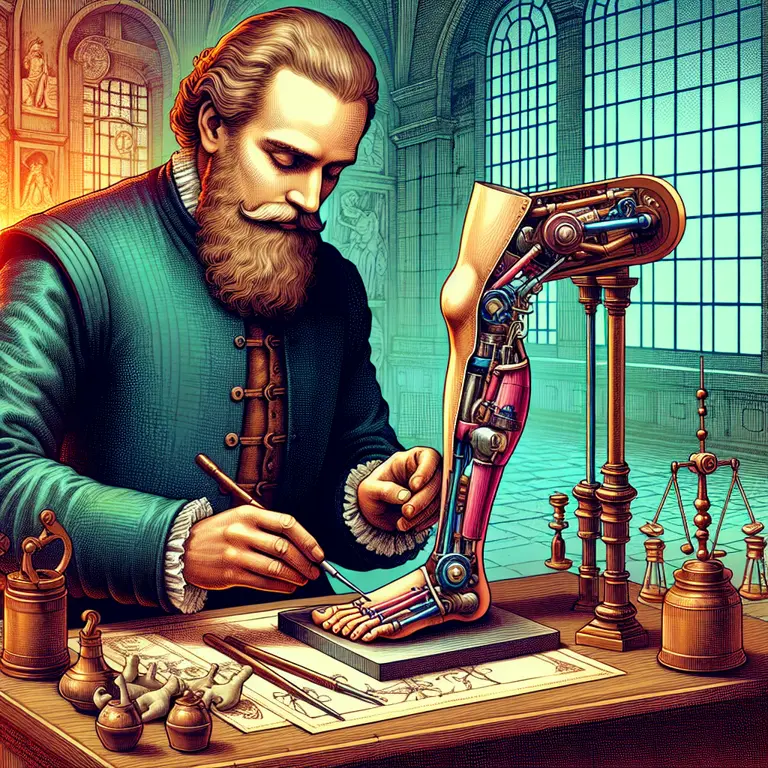
The first artificial body part was a false leg, designed by Ambroise Pare in 16th Century.
From Barber’s Chair to Bionic Limb: The Long History of Prosthetic Innovation
While modern medical technology continues to push the boundaries of what is possible in healthcare, the history of medical innovation stretches back much further than many might realize. One of the earliest advancements on the path to creating artificial body parts began in the 16th century with the work of Ambroise Paré, a pioneering French barber-surgeon. Paré is celebrated for his contributions to human anatomy and surgical techniques, but one of his most significant achievements was the creation of what many historians consider the first truly functional artificial limb. This invention began what would evolve into the sophisticated prosthetic devices that are now an essential part of modern medicine, and the story of how we arrived at today’s bionic prosthetics is one of the most compelling threads running through the entire history of science and human ingenuity.
Ambroise Paré: Barber-Surgeon and Innovator
In the 16th century, medicine was still in its early stages of development, and many surgical practices were performed by barber-surgeons. These individuals occupied a peculiar space in society, combining the everyday trade of barbering with basic medical procedures such as bloodletting, tooth extraction, and wound treatment. The role existed largely because trained physicians of the era considered manual labor beneath their station, leaving the messy, hands-on work of surgery to craftsmen who were already comfortable wielding sharp instruments. Ambroise Paré began his career in exactly this tradition, apprenticing in Paris before eventually serving in the French royal court, but his curiosity and dedication to understanding human anatomy quickly set him apart from his peers.
Paré gained widespread recognition for his innovative surgical techniques and his work as a battlefield surgeon during the Italian Wars, a series of conflicts that consumed much of the first half of the 16th century. War has always been a grim yet undeniable driver of medical progress, and Paré was no exception. Confronted daily with catastrophic injuries, shattered bones, and the urgent need for amputation, he was forced to improvise, experiment, and ultimately innovate at a pace that peacetime medicine rarely demands. In an era where battlefield injuries were common and often fatal, Paré focused on improving patient care by developing more effective surgical procedures and medical devices. His detailed studies of the human body and his hands-on experience with traumatic injuries inspired him to seek solutions not just for keeping patients alive, but for restoring something of the lives they had before injury.
The First Prosthetic Leg
Among Paré’s many contributions to medicine, one of the most remarkable was his creation of a prosthetic leg, widely regarded as the first artificial body part designed to restore some meaningful degree of functionality to the user. The history of artificial limbs actually predates Paré by centuries. Ancient Egyptians fashioned prosthetic toes from wood and leather, and Roman soldiers were reportedly fitted with iron hands and legs. However, these earlier devices were primarily cosmetic, designed to complete the appearance of the body rather than restore its capacity for movement. Paré’s contribution was fundamentally different in its ambition and execution.
Paré’s prosthetic leg featured an adjustable harness and a hinged knee joint, allowing considerably more movement than any previous model. This was not simply a carved block of wood strapped to a stump. It was a mechanical device, engineered with an understanding of how the human body moves and of what a person who has lost a leg actually needs to walk, work, and live with some degree of independence. He also designed a prosthetic hand with individually articulated fingers that could be positioned using the remaining hand, a device of remarkable sophistication for its time. These inventions represented a significant leap forward in prosthetics, providing amputees with more practical solutions that genuinely enhanced their quality of life rather than simply concealing their injuries.
What made Paré’s approach especially significant was his insistence on customization. He understood that no two patients were alike, that each individual's height, weight, occupation, and specific injury demanded a tailored response. His work demonstrated the potential for artificial body parts to help individuals recover from traumatic injuries and regain independence, and it planted the idea that prosthetics should be designed around the needs of the person wearing them rather than around ease of manufacture or social convention.
The Legacy of Prosthetic Devices
Ambroise Paré’s creation of functional prosthetic limbs laid the foundation for an industry that has become a crucial aspect of modern healthcare. The centuries following his work saw gradual but steady progress. During the American Civil War, the enormous number of amputees created an urgent demand for better prosthetic solutions, and the United States government funded prosthetic research on a scale previously unimaginable. By the 20th century, two world wars produced similar waves of innovation, each conflict leaving behind thousands of veterans whose needs pushed engineers and physicians to develop lighter, more durable, and more functional devices.
Today, prosthetic devices are built from advanced materials such as carbon fiber and titanium, and many incorporate microprocessors and robotic elements that enable a wide range of movement and precise control. Prosthetic limbs can now mimic the natural motion of human limbs with extraordinary fidelity, providing users with increased mobility and agility across a remarkable range of activities. Athletes compete in international sporting events with carbon-fiber running blades. Climbers scale mountains on prosthetic legs. Musicians play instruments with bionic hands. In some of the most advanced cases, prosthetics are controlled by muscle signals or direct neural inputs, allowing the device to respond to the user’s intentions in a way that begins to approximate the experience of a natural limb.
This field of neural prosthetics, sometimes called neuroprosthetics, represents perhaps the most profound frontier in the history of artificial limbs. Researchers have demonstrated that electrodes implanted in the motor cortex of the brain can be used to control robotic arms with considerable precision, and ongoing work is creating sensory feedback systems that allow users to feel pressure and texture through their prosthetic hands. The distance between Paré’s hinged knee joint and a thought-controlled bionic arm is vast, but the underlying ambition connecting them across five centuries is exactly the same.
Ambroise Paré’s Broader Impact on Medical Practice
Beyond his work on prosthetics, Ambroise Paré made numerous contributions to surgical practices and medical understanding that helped shape the future of medicine, extending far beyond artificial limbs. He is often credited with revolutionizing wound care by abandoning the then-standard practice of pouring boiling oil into gunshot wounds, a treatment that caused enormous additional suffering and was based on the mistaken belief that gunpowder itself was poisonous. According to his own account, Paré ran out of oil during one battle and was forced to use a soothing digestive of egg yolk, rose oil, and turpentine instead. When he checked on these patients the following morning and found them resting comfortably while those treated with boiling oil were feverish and in agony, he drew the obvious conclusion and never used the old method again.
He is also credited with reintroducing the use of ligatures to control bleeding during amputations, tying off blood vessels rather than relying on cauterization with a red-hot iron. This change alone saved countless patients from dying of shock during surgery. Paré’s holistic approach to patient care and his willingness to let observation override tradition had a lasting impact on medicine, rippling through generations of surgeons and scientists. His famous phrase, often translated as “I dressed him, and God healed him,” reflects a humility and pragmatism that was genuinely radical in an age when medicine was still heavily entangled with superstition and dogma. His innovative spirit and willingness to challenge conventional practices set the stage for future generations of medical professionals to explore new solutions and push the boundaries of what was possible in healthcare.
Conclusion
The development of prosthetic devices, which began in earnest in the 16th century with Ambroise Paré’s creation of functional artificial limbs, represents one of the earliest and most important milestones in the entire history of medical technology. Paré’s pioneering work not only improved the lives of individuals who had lost limbs in his own time but also established a set of principles that prosthetics should be functional rather than merely cosmetic, customized to the individual, and continuously improved through observation and experimentation, which continue to guide the field today.
From Paré’s mechanical knee joint to modern-day neural prosthetics capable of responding to thought, the journey of creating artificial body parts has transformed medicine and expanded our understanding of what it means to restore a human life after injury. That journey is far from over. Researchers are currently working on prosthetics that restore the sense of touch, osseointegration techniques that anchor artificial limbs directly to the skeleton, and fully implantable devices that interact seamlessly with the nervous system. Each of these advances carries forward a tradition of care and ingenuity that began in a 16th-century battlefield tent. Paré’s legacy continues to inspire medical professionals and technologists as they seek to improve and expand prosthetic capabilities, ensuring that those in need have access to the most effective and life-enhancing solutions that human knowledge can provide.