
The One and Only Robotic Surgeon Still in Training
The Da Vinci Surgical System, a complex medical robot, does not operate on its own. It is fully controlled by a surgeon from a console.
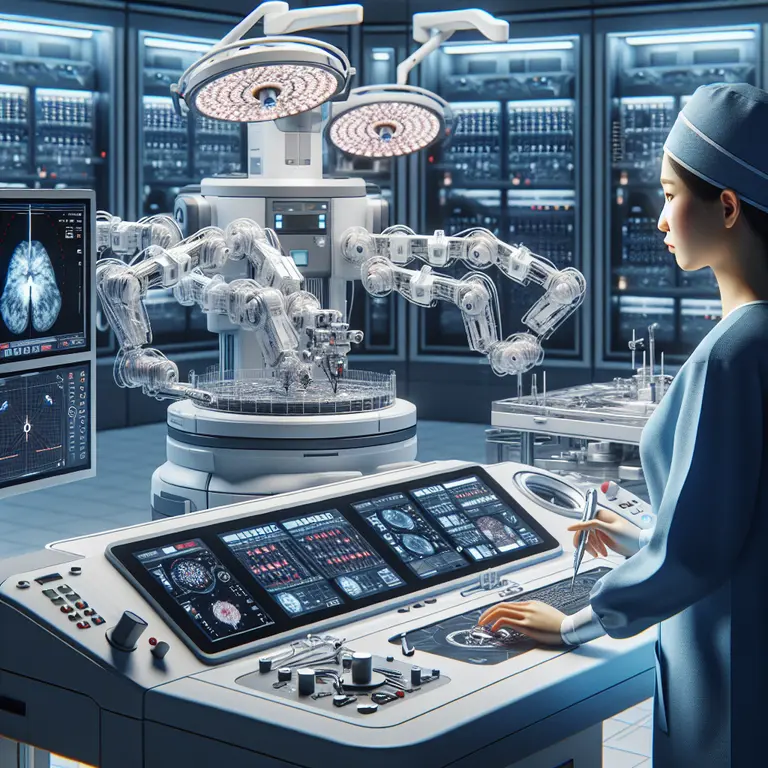
The da Vinci Surgical System is one of the most recognizable and frequently misunderstood technologies in modern medicine. Its sleek robotic arms, high-definition cameras, and extraordinary mechanical dexterity give it the appearance of something operating with a mind of its own. Many patients and even some medical professionals assume that when a surgeon steps away from the operating table and sits at a console across the room, the machine has taken over. This assumption, while understandable, is entirely incorrect. The da Vinci system is not autonomous. It does not think, plan, or act independently. Every movement it makes is a direct translation of the surgeon’s own hands, filtered through sophisticated engineering designed to enhance human capability rather than replace it. Named after Leonardo da Vinci, the Renaissance polymath whose curiosity bridged art, anatomy, and mechanical invention, the system carries a name that speaks to its essential character: precision guided by human intelligence.
A Telesurgical System: Surgeon at the Helm
To understand the da Vinci Surgical System properly, it helps to understand the concept of telesurgery. In a telesurgical setup, the surgeon does not stand directly over the patient with instruments in hand. Instead, they operate from a console that may be several feet away, or, in theory, even further. From this console, the surgeon controls robotic arms that are positioned at the operating table. These arms hold miniaturized surgical instruments that mirror the surgeon’s hand and wrist movements in real time, with a level of accuracy that surpasses what unaided human hands can achieve in a confined surgical space.
The console itself is an ergonomic workstation. The surgeon looks into a stereoscopic viewer that provides a magnified, three-dimensional image of the surgical site. Their fingers and wrists manipulate controls that translate every subtle motion into corresponding movements by the robotic instruments inside the patient’s body. If the surgeon’s hand trembles slightly, the system filters it out. If the surgeon needs to make a motion smaller than the human hand can naturally produce, the system scales it down accordingly. These features do not represent autonomous decision-making. They represent precision engineering placed entirely in the service of the surgeon’s intentions.
At no point during a procedure does the da Vinci system initiate an action on its own. It has no artificial intelligence component, no machine learning algorithm assessing the surgical field, and no capacity to respond to unexpected developments without the surgeon’s direct input. The system is, in the most literal sense, an extension of the surgeon’s body, one that happens to be made of titanium and fiber optics rather than flesh and bone.
Minimally Invasive Surgery and Enhanced Precision
One of the most significant clinical advantages of the da Vinci system is its ability to make minimally invasive surgery feasible for procedures once considered too complex for small-incision approaches. Traditional open surgery often requires large incisions to provide the surgeon with adequate visibility and room to work. While effective, this approach comes with considerable costs to the patient, including longer hospital stays, extended recovery periods, greater postoperative pain, and a higher likelihood of complications such as infection or excessive blood loss.
Minimally invasive surgery addresses these drawbacks by working through small incisions, sometimes only a centimeter or two in length. The trade-off has historically been reduced dexterity and limited visibility for the surgeon. The da Vinci system resolves both of these limitations. Its robotic instruments can bend and rotate in ways the human wrist cannot within a narrow surgical corridor. They move with what engineers call “wristed” articulation, meaning the instrument tip can pivot and flex independently of the shaft, giving the surgeon access to angles that would be physically impossible to achieve with conventional laparoscopic tools.
The visualization component is equally important. The system’s endoscopic camera delivers a high-definition, three-dimensional image magnified many times. Surgeons describe the experience as seeing the surgical site with a clarity and depth that far exceeds what the naked eye can offer, even in open surgery. This enhanced view enables more precise identification of blood vessels, nerves, and other critical structures, reducing the risk of inadvertent damage during the procedure. For patients, this translates into shorter recovery times, reduced scarring, less postoperative pain, and a faster return to normal life.
The Inspiration Behind the Name
The choice to name this system after Leonardo da Vinci was not arbitrary. Leonardo was among the first individuals in history to approach the study of the human body with both scientific rigor and artistic devotion. He conducted numerous dissections of human cadavers at a time when such work was controversial and often conducted in secrecy. From these dissections, he produced hundreds of anatomical drawings of extraordinary accuracy and beauty, illustrating the musculature, skeletal structure, nervous system, and internal organs with a level of detail that would not be surpassed for generations.
Leonardo also devoted enormous intellectual energy to the design of machines. His notebooks contain designs for flying machines, hydraulic devices, war engines, and mechanical automata, many of which were conceptually sound despite being centuries ahead of the technology needed to build them. He was, in essence, a man who believed that understanding the human body and engineering precise mechanical systems were complementary pursuits rather than separate ones.
By naming the surgical system after him, its creators drew a deliberate line of continuity between Leonardo’s vision and their own. Just as Leonardo sought to understand the body in order to represent it with perfect fidelity, the da Vinci system seeks to understand and replicate the movements of a skilled surgeon’s hands, carrying them out with perfect fidelity within a patient’s body. The name is not merely a marketing decision. It reflects a genuine philosophical kinship between Renaissance anatomy and twenty-first century surgical engineering.
No AI or Autonomous Functioning
In an era when artificial intelligence is transforming nearly every field of medicine, it is worth being precise about what the da Vinci system does and does not do. It does not use AI to analyze the surgical field. It does not suggest incision points, flag potential complications, or adjust its movements based on what it observes. It does not learn from previous procedures or adapt its behavior over time. Every one of these capabilities, under development in next-generation experimental surgical systems, remains absent from the current da Vinci platform.
This distinction matters for several reasons. First, it has direct implications for accountability. When a human surgeon controls every movement, responsibility for surgical decisions remains clearly with that surgeon. Second, it affects how the system is regulated and approved by bodies such as the United States Food and Drug Administration. Third, it shapes how patients should understand and consent to procedures performed with the system. A patient who agrees to da Vinci-assisted surgery agrees to a procedure performed by their surgeon using a sophisticated tool, not a procedure performed by a machine.
The system serves as a force multiplier for surgical skill. It makes a skilled surgeon more precise and expands the range of minimally invasive procedures they can perform. It does not, however, make an unskilled surgeon competent, nor can it compensate for poor judgment or inadequate training. The human element is not merely present in da Vinci surgery; it is the entire foundation upon which the system’s value rests.
Conclusion
The da Vinci Surgical System represents one of the most consequential developments in surgical history, not because it removes the surgeon from the equation, but because it makes the surgeon’s capabilities more powerful than ever before. It is a telesurgical platform, not an autonomous robot. It has no artificial intelligence, no independent judgment, and no capacity to act without direct human control. What it does have is the ability to translate a skilled surgeon’s intentions into movements of extraordinary precision, delivered through instruments that can reach places and perform maneuvers that unaided human hands cannot.
Named for a man who believed that art, science, and mechanical ingenuity were inseparable, the da Vinci Surgical System embodies that same belief in a clinical context. It is a tool of remarkable sophistication, but it remains a tool. The intelligence, judgment, experience, and responsibility belong entirely to the surgeon at the console. As surgical technology continues to evolve and true autonomous capabilities begin to emerge in experimental systems, the da Vinci platform stands as a testament to what becomes possible when human expertise is given the right instrument to work with.