
Star Wars Inspired the Inception of Modern Laser Surgeries
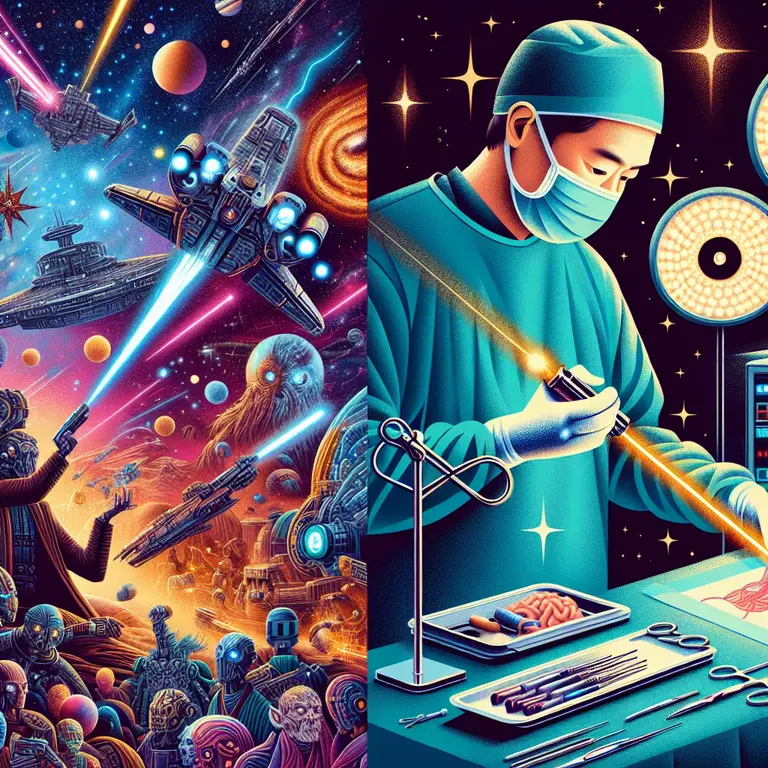
The concept of laser surgeries was initially inspired by the science fiction franchise, Star Wars.
 Watch on YouTube
 Watch on Rumble
From Lightsabers to Operating Rooms: How Star Wars Helped Inspire Laser Surgery
The concept of laser surgery, a revolutionary innovation in modern medicine, has an unlikely origin story with roots partially embedded in popular culture. Among the many cultural forces that helped stir scientific imagination, the Star Wars franchise holds a notable place. Released in 1977, George Lucas’s epic space opera introduced audiences to a futuristic universe where laser-based technologies, most famously the lightsaber, showcased the dramatic potential of focused light as a tool of both destruction and precision. What began as a fictional idea soon captured the imagination of scientists and engineers, contributing to a broader cultural momentum that accelerated practical developments in laser surgery. The result was a transformation in healthcare, one built on precision, minimally invasive techniques, and outcomes that would have seemed like science fiction just decades before.
Science Fiction Meets Medical Science
The Star Wars franchise was among the first major cultural phenomena to popularize advanced laser technology for a mass audience. In the films, lightsabers and other energy-based tools were depicted as powerful yet precise instruments capable of cutting through materials with remarkable surgical accuracy. Although these devices were primarily portrayed as weapons in a galactic conflict, the underlying concept resonated far beyond entertainment. The idea that a beam of focused light could be wielded with extraordinary control planted seeds of possibility in the minds of those watching.
It is worth noting that lasers themselves were not invented because of Star Wars. Theodore Maiman demonstrated the first working laser in 1960, nearly two decades before the film’s release. However, the cultural visibility that science fiction provided helped sustain public and institutional interest in what lasers might one day accomplish. Scientists who were already working with lasers in industrial and research contexts began to think more expansively about medical applications. The question of whether a focused light beam could perform delicate procedures without damaging surrounding tissues became increasingly compelling. Early experiments in the medical use of lasers focused on their ability to precisely target cells and tissues at specific wavelengths, offering a fundamentally different approach from traditional surgical tools like scalpels and cauterizing instruments.
The relationship between science fiction and scientific progress is rarely a simple cause-and-effect story, but it is rarely coincidental either. The cultural environment that franchises like Star Wars helped create encouraged a generation of researchers to think ambitiously, to treat the seemingly impossible as a legitimate starting point for inquiry.
The Development of Laser Surgery
The journey from science fiction inspiration to practical medical application was marked by decades of careful research, failed experiments, and incremental breakthroughs. Researchers discovered early on that different wavelengths of laser light interact with biological tissue in distinct ways. Some wavelengths are absorbed by water within cells, others by pigment, and still others by specific proteins. This selectivity became the cornerstone of medical laser technology, enabling surgeons to target specific tissues with a level of precision no mechanical tool could match.
LASIK surgery, which stands for Laser-Assisted In Situ Keratomileusis, became one of the earliest and most widely recognized successes of medical laser technology. The procedure uses an excimer laser to reshape the cornea, correcting refractive errors such as nearsightedness, farsightedness, and astigmatism. The laser removes microscopic layers of corneal tissue with such accuracy that the entire reshaping process can be completed in under a minute per eye. For millions of patients worldwide, LASIK has eliminated or significantly reduced the need for corrective lenses, and its safety record over decades of use has made it one of the most commonly performed elective procedures worldwide.
Laser technology also profoundly transformed dermatology. Procedures such as skin resurfacing, treatment of vascular lesions, tattoo removal, and scar reduction are now performed routinely with lasers calibrated to interact with specific chromophores in the skin. The ability to remove damaged or unwanted tissue while leaving surrounding healthy cells intact has produced outcomes that traditional dermabrasion or chemical treatments could rarely match. Recovery times shortened, infection risks dropped, and patient satisfaction climbed.
In urology, laser lithotripsy changed the treatment landscape for kidney stones. Using a holmium laser delivered through a thin fiber-optic cable, urologists can fragment stones directly within the urinary tract, allowing the resulting debris to pass naturally. This approach replaced many open surgical procedures, dramatically reducing recovery time and the risk of complications. In oncology, laser ablation techniques have been developed to destroy tumor tissue in the liver, lungs, and other organs, often guided by real-time imaging to ensure precision.
The Benefits of Laser Surgery
Laser surgeries offer a range of advantages that have fundamentally changed what patients and surgeons can expect from a procedure. The most frequently cited benefit is precision. Lasers can be calibrated to interact with tissue at the cellular or even subcellular level, allowing surgeons to remove or modify tissue while minimizing collateral damage. This level of control is especially valuable in procedures involving the eyes, the brain, or delicate vascular structures, where even a fraction of a millimeter can make a significant difference in outcome.
The minimally invasive nature of laser procedures represents another major advance. Many laser surgeries require no incisions at all, or only very small ones through which fiber-optic instruments are passed. This dramatically reduces trauma to the body, shortens hospital stays, and accelerates recovery. Patients who undergo laser procedures often return to normal activity within days rather than weeks. The reduced need for general anesthesia in many laser procedures also lowers the risk profile considerably, making surgery accessible to patients who might not tolerate more invasive approaches well.
Beyond improving existing procedures, laser technology has enabled entirely new categories of treatment. The ability to seal blood vessels during surgery, for instance, reduces blood loss and the need for transfusions. Photodynamic therapy, which uses laser light to activate photosensitive drugs that destroy cancer cells, represents a targeted approach to oncological treatment that spares healthy tissue in ways that conventional chemotherapy cannot. These capabilities have not merely improved patient outcomes in existing treatment pathways but have opened entirely new ones.
The Influence of Star Wars and Science Fiction on Innovation
The influence of Star Wars on the development of laser surgery is best understood not as a direct causal link but as part of a broader pattern in which science fiction shapes scientific culture. The franchise’s portrayal of advanced technologies inspired a generation of scientists, engineers, and medical professionals to think expansively about what tools might one day exist. When researchers encountered problems in medicine that seemed to demand precision beyond what mechanical instruments could offer, the cultural vocabulary of laser technology was already present, already normalized as something worth pursuing.
This pattern extends well beyond laser surgery. The communicator devices in the original Star Trek series are widely credited with inspiring early mobile phone designers. The tablet computers depicted in science fiction throughout the 1960s and 1970s anticipated the devices now in the hands of billions. Submarine technology, helicopter design, and even the internet have all been traced in part to ideas first explored in fiction. The mechanism is not that scientists watch a movie and immediately rush to replicate what they see, but rather that fiction expands the collective sense of what is worth trying, what problems are worth solving, and what solutions might be imaginable.
In this sense, Star Wars contributed to a cultural moment in which lasers were understood by the general public as instruments of precision and possibility. That understanding helped sustain funding, interest, and talent in laser research during the decades when the technology was still finding its footing in medicine. The imaginative leap from lightsaber to surgical laser is not a direct line, but it is a real one.
Expanding the Horizons of Laser Technology
As laser technology has matured, its medical applications have continued to expand in directions that even optimistic researchers might not have predicted. In neurology, focused laser systems are being used in minimally invasive brain surgeries, allowing neurosurgeons to ablate abnormal tissue responsible for epileptic seizures or to target tumors in regions previously considered too dangerous to operate on conventionally. Laser interstitial thermal therapy, or LITT, delivers laser energy through a thin probe inserted through a small hole in the skull, destroying targeted tissue with heat while real-time MRI imaging monitors the procedure.
In dentistry, lasers have replaced drills in certain cavity treatments and are used for gum contouring and the treatment of periodontal disease, often with less pain and faster healing than conventional methods. In cardiology, laser atherectomy uses focused light energy to remove arterial plaque, offering an alternative to mechanical approaches in certain patients with peripheral artery disease.
Lasers also play an increasingly critical role in diagnostic imaging. Optical coherence tomography uses near-infrared laser light to produce cross-sectional images of biological tissue at resolutions approaching those of conventional histology, making it an effective optical biopsy in some contexts. This technology has become standard in ophthalmology for detecting retinal diseases such as glaucoma and macular degeneration at early stages, allowing effective intervention. Researchers are now exploring its application in cardiology and oncology as well.
Challenges and Future Prospects
Despite the remarkable progress of the past several decades, significant challenges remain in the broader adoption and development of laser surgery. The cost of laser equipment is substantial, and the specialized training required to use it safely and effectively creates barriers that limit access, particularly in lower-income healthcare settings. Not every medical condition is amenable to laser treatment, and determining which patients are appropriate candidates requires careful clinical assessment.
Looking forward, the integration of laser technology with robotic surgical systems represents one of the most promising frontiers. Robotic platforms can already perform movements with greater precision and consistency than human hands, and combining that mechanical precision with laser energy delivery could produce surgical capabilities of an entirely new order. Artificial intelligence systems capable of analyzing tissue in real time during a procedure could automatically adjust laser parameters, optimizing outcomes on a moment-to-moment basis.
Researchers are also investigating the use of ultrashort pulse lasers, which deliver energy in bursts lasting femtoseconds, or quadrillionths of a second. These pulses can ablate tissue with so little heat transfer that surrounding cells experience virtually no thermal damage, potentially opening applications in areas of the body where conventional lasers remain too risky.
Conclusion
The evolution of laser surgery from a concept energized in part by science fiction into a cornerstone of modern medicine illustrates something important about how human progress actually works. It is rarely linear, rarely purely technical, and rarely disconnected from the broader cultural imagination of an era. Inspired in part by the futuristic vision of franchises like Star Wars, and built on decades of rigorous scientific work, laser-based surgical techniques have transformed patient care in ways that continue to expand.
Today, laser surgeries stand as a testament to how imaginative ideas, even those originating in entertainment, can contribute to real-world innovations with life-changing consequences. As technology continues to advance, the interplay between creative thinking and scientific inquiry will remain one of the most powerful engines of discovery. The story of laser surgery is a reminder that the seeds of innovation can germinate in unexpected soil, and that the distance between a lightsaber flickering on a cinema screen and a surgeon reshaping a cornea with a beam of light is shorter than it might appear.