
Did You Know? the First Pacemaker Was Fully Portable!
The first pacemakers were not implantable but rather were large, external devices that were carried around.
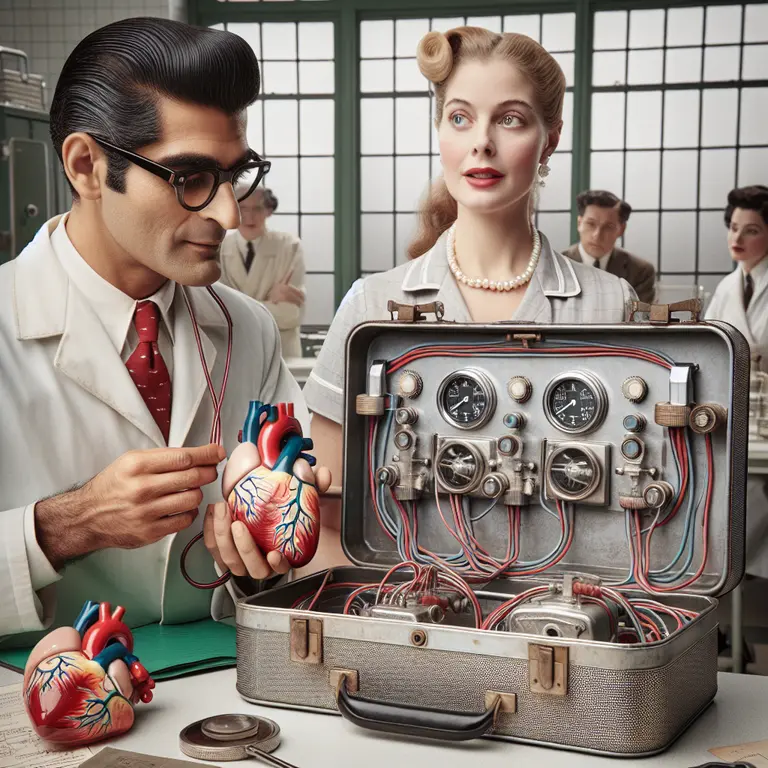
The Pacemaker: From Bulky Machine to Life-Saving Marvel
The pacemaker stands as one of the most transformative inventions in the history of modern medicine. Today, it is a tiny, implantable device that continuously monitors and regulates the heart’s rhythm, offering patients with cardiac conditions a reliable, largely invisible form of support. Millions of people around the world carry one inside their chest, often barely aware of its presence as they go about their daily lives. Yet the road to this remarkable miniaturized technology was long, winding, and filled with engineering challenges that took decades to overcome. When the concept of the pacemaker first emerged in the 1950s, the technology bore almost no resemblance to what we know today. The first functional pacemaker, developed by Earl Bakken and C. Walton Lillehei in 1957, was a large, cumbersome device that had to be physically connected to an electrical outlet to operate. Understanding how medicine arrived from that unwieldy starting point to the sophisticated devices of the present day reveals a story of ingenuity, persistence, and the relentless drive to improve human life.
The Early Days of Pacemaker Technology
In the early 1950s, physicians and researchers began seriously exploring the possibility of using electrical stimulation to treat arrhythmias, a broad category of conditions in which the heart beats too slowly, too quickly, or irregularly. The underlying science was not entirely new. Physicians had known since the nineteenth century that the heart responds to electrical impulses, and early experiments had demonstrated that external electrical stimulation could restart a stopped heart. What was missing was a practical, reliable, and patient-friendly method of delivering those impulses on a sustained basis.
The first external pacemaker, developed by Earl Bakken and C. Walton Lillehei at the University of Minnesota in 1957, represented a genuine breakthrough, even if the device itself was far from elegant. About the size of a small hardcover book, it delivered electrical pulses to the heart through wires that connected directly to the patient. To function, it had to be plugged into a standard wall socket, which created an immediate and serious practical problem. Patients were effectively tethered to the electrical grid. They could not move freely, could not be transported easily, and were entirely dependent on a stable and uninterrupted power supply. In a hospital setting, this was manageable, but it severely limited what could be done for patients outside of closely monitored clinical environments.
There was also a deeper and more troubling vulnerability in this arrangement. In 1957, a power outage at a hospital in Minneapolis cut off electricity to the wards where several young cardiac patients were being treated with wall-powered pacemakers. Some of those patients died as a direct result. This tragedy brought the limitations of existing technology into sharp, devastating focus, and it gave Bakken and Lillehei an urgent new motivation to find a better solution.
Introducing a Portable Backup Battery
The response to that power outage was swift and inventive. Bakken, drawing on his background in electrical engineering, set to work designing a pacemaker that could operate independently of the electrical grid. Working from a circuit diagram he found in a hobbyist electronics magazine, he developed a battery-powered, wearable pacemaker within a matter of weeks. The new device incorporated a small backup battery that allowed patients to move around for a limited period without being connected to a wall socket. This was a modest but genuinely significant improvement.
The battery life was short, lasting only a few hours before the device needed recharging or reconnection to an external power source. The pacemaker was still external, still connected to the heart by wires running through the skin, and still required careful management by medical staff. By the standards of later decades, it remained a primitive instrument. But in the context of what had existed before, it was a meaningful leap forward. For the first time, patients with life-threatening arrhythmias had access to a device that could regulate their heart rhythm with some degree of freedom from a fixed location.
This early version of the pacemaker also served an important conceptual function. It demonstrated that portability was achievable, that the core technology need not be anchored to a wall, and that battery power could sustain cardiac stimulation. Those insights, modest as they seemed at the time, pointed the way toward everything that followed. The idea of a fully implantable, self-contained device was still years away, but the battery-powered wearable pacemaker of the late 1950s made it possible to imagine one.
The Role of Medtronic
Earl Bakken’s work on the pacemaker was closely intertwined with the founding and growth of Medtronic, which would become one of the world's most influential medical device manufacturers. Bakken had co-founded Medtronic in 1949 with his brother-in-law, Palmer Hermundslie, initially operating out of a garage in Minneapolis. The company began as a small repair shop for medical equipment, but it quickly evolved into a developer and manufacturer of its own technologies. The pacemaker became the central product around which Medtronic built its early reputation and commercial foundation.
The relationship between Bakken and Lillehei was not simply that of inventor and collaborator. Lillehei, a pioneering cardiac surgeon, provided the clinical insight and the direct patient experience that shaped what the pacemaker needed to do. Bakken provided the engineering knowledge to make it work. Together, they represented a model of collaboration between medicine and technology that would become increasingly important as the field of medical devices grew more sophisticated.
Over the following decades, Medtronic invested heavily in research and development, driving many of the key advances that transformed the pacemaker from an external device into an implantable one. The first fully implantable pacemaker was developed in 1958 by Rune Elmqvist in Sweden and implanted by surgeon Ake Senning, but it was Medtronic that helped bring implantable pacemaker technology into widespread clinical use in the United States and around the world. The company continued to refine the devices, improving battery life, reducing size, and developing increasingly sophisticated programming capabilities. Medtronic also expanded its work beyond pacemakers into other areas of cardiac care, including defibrillators, heart valves, and monitoring systems, becoming a comprehensive force in cardiovascular medicine.
The Evolution of Pacemakers
The transformation of the pacemaker from the large, wall-powered device of 1957 to the miniaturized implantable instruments of today reflects not just advances in a single technology but the convergence of progress across multiple fields, including materials science, battery chemistry, microelectronics, and wireless communication. Each decade brought new capabilities that made devices smaller, more reliable, and more responsive to patients' individual needs.
By the 1960s and 1970s, implantable pacemakers had become a clinical reality for many patients, though the devices still required periodic battery replacements. Advances in lithium battery technology during the 1970s dramatically extended battery life, reducing replacement frequency and improving the overall patient experience. By the 1980s and 1990s, pacemakers had become programmable, allowing physicians to adjust the device’s settings after implantation without surgery by using external equipment to communicate with the pacemaker through the skin.
The most recent generation of pacemakers represents perhaps the most dramatic departure from the original design. Leadless pacemakers, which are small enough to be delivered directly into the heart via a catheter inserted through a vein, eliminate the need for the wires that once connected external devices to the heart and later ran beneath the skin to connect implanted devices to their leads. These devices are roughly the size of a large vitamin capsule and can be implanted in a minimally invasive procedure that requires no chest incision. Modern pacemakers can also communicate wirelessly with external monitoring systems, allowing physicians to check device performance and detect potential problems remotely, without requiring a patient to come into a clinic.
Conclusion
The story of the pacemaker is ultimately a story about what becomes possible when a clear human need meets sustained scientific and engineering effort. Earl Bakken and C. Walton Lillehei did not invent a finished product in 1957. They established a starting point, a proof of concept demonstrating that electrical stimulation could reliably support cardiac function in living patients. That starting point was crude, inconvenient, and in some ways dangerous, but it was real, and it worked well enough to save lives and inspire further work.
The founding of Medtronic gave that initial innovation an institutional home, a company dedicated to refining and expanding the technology over time. The decades of development that followed transformed the pacemaker into one of the most successful and widely used medical devices in history, extending and improving the lives of tens of millions of people worldwide. The arc of the pacemaker’s development, from a book-sized machine plugged into a hospital wall to a capsule-sized device implanted directly in the heart, offers a compelling illustration of what medical technology can achieve when curiosity, urgency, and collaboration are brought together in the service of human health.