
The Qwerty Keyboard Design Was Intentionally Unoptimized
The design of the QWERTY keyboard we use today was made to slow down typists and prevent typewriter jamming.
Introduction
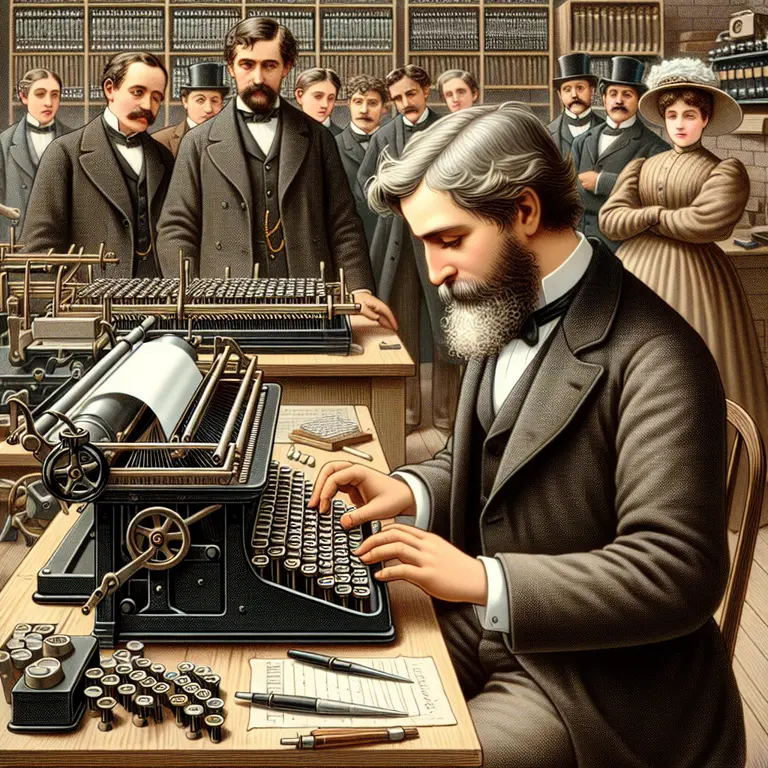
The QWERTY keyboard, named after the first six letters in the top left row of keys, is the world’s most widely used keyboard layout. Despite the rise of modern technology and sweeping advances in computing, the QWERTY layout remains the global standard today, largely due to its deep-rooted history and the extraordinary momentum of its widespread adoption. What makes this story particularly fascinating is not simply that the layout persisted, but why it was designed the way it was in the first place. The invention of the QWERTY keyboard can be traced back to the 19th century, when Christopher Latham Sholes, a newspaper editor and printer working in Milwaukee, Wisconsin, designed it to address a frustrating mechanical problem that plagued early typewriters. Understanding how and why QWERTY came to dominate the world of written communication requires a closer look at the technological constraints of its era, the commercial forces that drove its adoption, and the powerful human tendency to resist change once a system becomes deeply familiar.
The Origins of the QWERTY Layout
In the early days of typewriters, the mechanical components were remarkably prone to jamming. When typists pressed keys too quickly or in rapid succession, the metal typebars representing each letter would collide mid-air and become tangled together in a frustrating tangle of interlocked arms. This disrupted typing flow, slowed productivity, and caused significant wear on the machine. For anyone attempting to use a typewriter professionally, the jamming problem was not a minor inconvenience but a fundamental barrier to practical use.
Christopher Latham Sholes, who had been working on typewriter designs since the late 1860s alongside his colleagues Carlos Glidden and Samuel Soule, recognized this issue and set out to find a practical solution. His approach was counterintuitive by modern standards: rather than engineering faster mechanical components, he chose to rearrange the keyboard layout to slow down the typist. By separating commonly paired letters and placing frequently used keys in less accessible positions, he reduced the likelihood that two adjacent typebars would be struck in quick enough succession to cause a jam. The result was the QWERTY layout, which strategically distributed commonly used letters across the keyboard to prioritize mechanical reliability over human convenience. By making it subtly more difficult to type at maximum speed, Sholes effectively brought the typist’s pace into alignment with what the machine’s moving parts could handle without colliding.
It is worth noting that some historians have debated the precise rationale for specific key placements in the QWERTY layout. One persistent theory holds that the letters spelling “typewriter” were deliberately placed in the top row so that salespeople could type the word quickly and impressively during demonstrations. Whether or not this is entirely accurate, it speaks to the commercial pressures that influenced the keyboard’s design from its earliest days. The layout was never purely a product of ergonomic or linguistic analysis. It was shaped by machinery, marketing, and the practical demands of a nascent industry.
The Adoption and Standardization of QWERTY
The QWERTY layout achieved its position as the standard keyboard configuration largely through its association with the Remington Company, the firearms manufacturer that pivoted to typewriter production in the 1870s. Remington acquired the rights to Sholes’s design and manufactured the first commercially successful typewriters under the name Remington No. 1, released in 1874. As Remington typewriters gained popularity among businesses, government offices, and professional typists, so too did the QWERTY layout that came built into every machine. It soon became the dominant keyboard arrangement not because it had been proven to be the most efficient system for human typing, but because it solved the technical limitations of the hardware available at the time and happened to be attached to the most commercially successful product on the market.
Over time, typists and businesses became deeply accustomed to the QWERTY layout. Typing schools emerged to train professional typists, and those schools naturally taught the layout used on the machines their students would use in the workplace. This created a self-reinforcing cycle: the more people learned QWERTY, the more employers expected their workers to know it, and the more essential it became for manufacturers to continue producing QWERTY keyboards. The layout had achieved what economists sometimes call a network effect, where the value of a standard increases simply because more people use it, regardless of whether it is objectively the best option available.
Although alternatives such as the Dvorak Simplified Keyboard were later introduced with credible claims of greater efficiency, QWERTY’s dominance was already firmly established by the time these alternatives appeared. The costs and logistical challenges of retraining typists, replacing machines, and updating educational curricula made switching to a new layout deeply impractical for most organizations. QWERTY remained the default standard not through any ongoing proof of superiority, but through the sheer weight of accumulated habit and institutional investment.
Modern Computing and the Persistence of QWERTY
With the advent of modern computers in the latter half of the 20th century, the original problem that QWERTY was designed to solve became completely obsolete. Digital keyboards do not rely on metal typebars, mechanical linkages, or any moving parts that could collide. A person can press keys at any speed and in any combination without the slightest risk of jamming. The entire engineering rationale behind the QWERTY layout had evaporated, and yet the layout itself remained untouched.
By the time personal computers began replacing typewriters as the primary tool for written communication in offices, schools, and homes throughout the 1970s and 1980s, millions of people worldwide had already spent years or decades learning to type on QWERTY keyboards. The layout had become deeply encoded in muscle memory across the global workforce. Retraining an entire generation of typists to use a different keyboard arrangement would have required an enormous coordinated effort with no clear financial incentive for manufacturers, employers, or governments to bear the cost. The inertia of widespread adoption made it nearly impossible to introduce a competing standard, no matter how well-designed.
This phenomenon is not unique to keyboards. Historians and economists have documented similar patterns in other technologies, from the standard gauge of railroad tracks to the format of electrical outlets. Once a technical standard achieves sufficient market penetration, it tends to persist far beyond the lifespan of the original conditions that made it sensible. The QWERTY keyboard is simply one of the most visible and universally experienced examples of this principle in action. Even today, as new devices such as smartphones and tablets offer entirely different input methods, including touchscreens, voice recognition, and gesture-based interfaces, the QWERTY layout continues to appear on virtual keyboards around the world, faithfully reproduced on glass surfaces with no mechanical constraints whatsoever.
Legacy, Alternatives, and What QWERTY Teaches Us
While QWERTY remains the most commonly used keyboard layout worldwide, serious efforts have been made over the decades to introduce alternative layouts that could increase typing efficiency and reduce physical strain. The most well-known of these is the Dvorak Simplified Keyboard, patented in 1936 by educational psychologist Dr. August Dvorak and his brother-in-law William Dealey. The Dvorak layout was designed using principles of human physiology and letter-frequency analysis of the English language. It places the most commonly used vowels and consonants on the home row, the row where fingers naturally rest, so that the majority of typing can be accomplished with minimal hand movement. Proponents of Dvorak argue that it reduces finger travel distance, lowers the risk of repetitive strain injuries, and can increase typing speed once the initial learning curve is overcome.
Despite these potential advantages, Dvorak has never managed to displace QWERTY in any significant way. Studies comparing the two layouts have produced mixed results, and the efficiency gains offered by Dvorak, while real, have not proven dramatic enough to justify the disruption of switching for most users. Other alternative layouts, such as Colemak and Workman, have attracted small but dedicated communities of enthusiasts in the age of the internet, but none have come close to challenging QWERTY’s near-total dominance.
What the persistence of QWERTY ultimately teaches us is something profound about the relationship between technology and human behavior. Technical merit alone does not determine which systems survive and spread. Historical timing, commercial backing, institutional inertia, and the accumulated habits of millions of individuals all play powerful roles in shaping the technological landscape. A design decision made in the 1870s to solve a problem specific to the mechanical limitations of that era continues to govern how billions of people interact with their devices every single day.
Conclusion
The QWERTY keyboard, designed by Christopher Latham Sholes in the 19th century to address the mechanical limitations of early typewriters, has endured well beyond its original purpose and well beyond any reasonable expectation of its designers. Its layout was specifically engineered to prevent typewriter jams by subtly slowing down typists, a solution that was practical and effective for its time. The advent of digital computing rendered that original problem entirely irrelevant, and yet QWERTY remained, carried forward by the momentum of widespread adoption, institutional familiarity, and the extraordinary difficulty of replacing any standard once it has become deeply embedded in human practice.
The story of QWERTY is ultimately a story about how the past constrains the present in ways that are rarely visible until examined carefully. The keyboard most people use today was not designed for the devices they are using it on. It was not optimized for speed, comfort, or the patterns of the English language. It was designed for machines that no longer exist, to solve problems that no longer apply. And yet here it remains, a quiet monument to the power of historical accident, commercial momentum, and the deep human resistance to change. In this sense, the QWERTY keyboard is not just a piece of hardware. It is a lesson in how technology, society, and habit become intertwined in ways that can outlast the original conditions that created them by more than a century.