
Invention of the First Computer Mouse: a Tech Milestone
The first computer mouse was made of wood.
Introduction
Few inventions in the history of technology have had as quiet a beginning and as thunderous an impact as the computer mouse. Born in a research laboratory in 1964, this small, unassuming device fundamentally altered the relationship between human beings and machines. Douglas Engelbart, the visionary computer engineer behind its creation, could not have fully anticipated the world his invention would help build. At a time when computers were room-sized machines operated by specialists typing cryptic commands into terminals, Engelbart was imagining something entirely different: a future in which ordinary people could navigate information visually, pointing and clicking their way through a digital landscape. The original mouse was nothing more than a rectangular wooden box with a single button and a trailing wire, but it represented one of the most consequential leaps in the history of human-computer interaction. To understand why, it is worth looking closely at what it was, what it replaced, how it evolved, and what it ultimately meant for the world.
The Design of the First Mouse
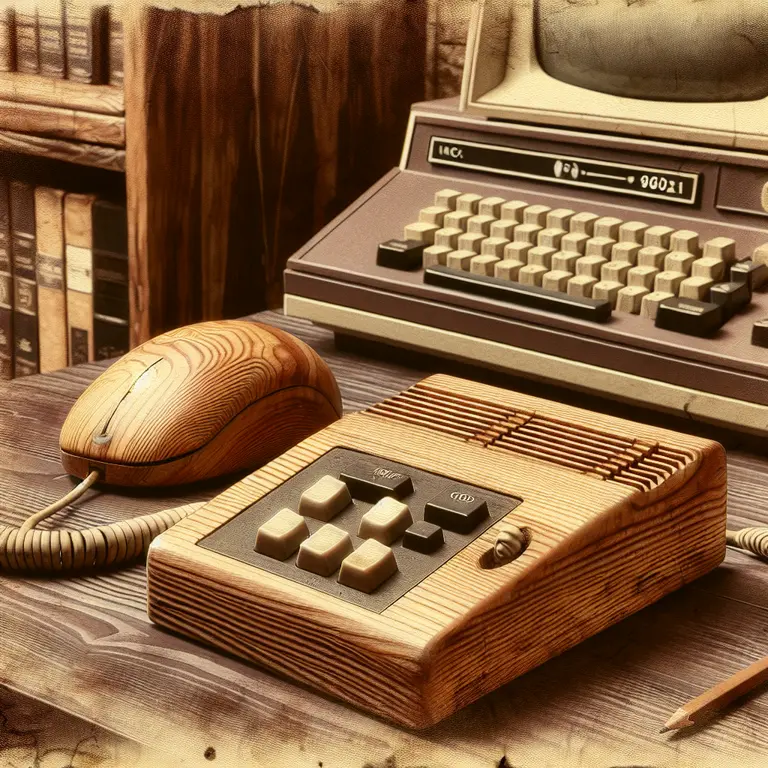
The first computer mouse was, by any modern standard, a remarkably primitive object. Engelbart’s prototype was a rectangular wooden box, roughly the size of a bar of soap, housing two metal wheels on its underside that rolled along a flat surface. A single button sat in the top-right corner, and a wire extended from the back of the device to connect it to the computer. It was this wire, trailing behind the device like an appendage, that reportedly inspired the informal nickname that would eventually become universal. Engelbart himself had a far more technical name for it: the “X-Y position indicator for a display system,” a label that captured its mechanical purpose but said nothing about its revolutionary potential.
The internal mechanism relied on the two perpendicular wheels to track movement along horizontal and vertical axes. As a user moved the device across a surface, the wheels registered displacement in each direction, translating physical motion into a corresponding shift in the cursor's position on the display screen. This was not a small thing. The ability to move a pointer fluidly across a screen with the natural motion of the hand was something entirely new in computing. There were no scrolling wheels, no secondary buttons, no optical sensors, and certainly no wireless connectivity. Yet the essential logic of the device, that physical hand movement could be mapped directly and intuitively onto on-screen navigation, was already fully present in that first crude prototype.
A Revolutionary Step Toward Modern Interfaces
To appreciate the significance of Engelbart’s mouse, it is necessary to understand the computing environment into which it was introduced. In the early 1960s, interacting with a computer meant typing commands into a terminal using a specific and unforgiving syntax. A misplaced character could invalidate an entire instruction. There were no icons, no windows, no menus to browse. The computer responded to what it was told in precise textual language, and the burden of learning that language fell entirely on the user. Computing was, in this sense, an activity reserved for trained specialists. The idea that an average person might one day sit down at a computer and navigate it with ease was not yet part of the mainstream imagination.
Engelbart’s mouse was a direct challenge to this paradigm. It was a central component of his broader vision for augmenting human intellect through technology, a vision he outlined in a landmark 1962 paper and demonstrated publicly in what has since been called “The Mother of All Demos” in 1968. During that demonstration, Engelbart showed a live audience not only the mouse but also hypertext, video conferencing, and collaborative real-time editing, technologies that would not become commonplace for another two or three decades. The mouse made all of this navigable. It was the physical bridge between the human hand and the graphical environment on screen, enabling users to point, select, and manipulate objects without needing to know a single line of code.
This shift toward graphical user interfaces changed who could use a computer. By allowing interaction through visual metaphors rather than typed commands, the GUI made computing accessible to people with no technical training. The mouse was the instrument that made the GUI functional. Without a device that could translate natural hand movement into precise on-screen positioning, the graphical interface would have remained a theoretical curiosity. Together, the mouse and the GUI democratized computing in a way no previous development had.
The Evolution of the Mouse
Engelbart’s wooden prototype was a beginning, not an endpoint. Over the following decades, the mouse underwent continuous refinement as it moved from research laboratories into commercial products and eventually into homes around the world. The wooden housing gave way to molded plastic. The mechanical wheel system was first replaced by a rolling rubber ball, which offered smoother, more reliable tracking across a wider variety of surfaces, and later by optical sensors that used light to detect movement with far greater precision.
The 1970s saw Xerox PARC develop its own version of the mouse as part of the Alto computer system, one of the first machines to feature a graphical interface designed around point-and-click interaction. When Apple launched the Lisa in 1983 and the Macintosh in 1984, the mouse came bundled with the computer as a standard input device, signaling a decisive shift in the industry. Microsoft followed suit, and by the late 1980s, the mouse had become an expected feature of personal computers rather than an experimental accessory.
The 1990s brought further innovation, including the introduction of the scroll wheel, which allowed users to navigate long documents and web pages without repeatedly clicking scroll bars. Wireless technology eventually cut the cord entirely, freeing the device from the constraints of cable length and desk arrangement. Gaming culture drove the development of high-precision optical and laser mice with adjustable sensitivity settings, multiple programmable buttons, and ergonomic designs tailored to extended use. Each of these developments built upon the foundational concept Engelbart had established: that the most natural way for a human being to interact with a computer display is through direct physical hand movement.
The Legacy of Douglas Engelbart’s Invention
Douglas Engelbart received the Association for Computing Machinery’s Turing Award in 1997, often described as the Nobel Prize of computing, for his foundational contributions to the field. Yet for much of his career, his ideas were considered ahead of their time to the point of impracticality. The institutions he worked within did not always share his vision, and he spent years advocating for a philosophy of human-computer collaboration that the industry was slow to embrace. History has been considerably kinder to him than it was to many of his contemporaries.
The wooden mouse he built in 1964 is now held as a historical artifact, a relic that marks a turning point in the story of how human beings relate to information and to machines. Its significance lies not in its materials or its mechanics, but in the idea it embodied: that technology should conform to human intuition, not the other way around. Every touchscreen, every trackpad, every gesture-based interface owes something to the conceptual breakthrough that Engelbart made when he decided that a person should be able to point at something on a screen and have the computer respond.
Conclusion
The computer mouse began as a simple rectangular block of wood with a single button and a wire. It was invented by Douglas Engelbart in 1964 at a moment when the very idea of ordinary people using computers seemed remote. Yet that modest device carried within it a transformative principle: that human beings should be able to interact with digital information in ways that feel natural, direct, and intuitive. From that principle emerged the graphical user interface, the personal computer revolution, and, ultimately, the digital world that billions of people inhabit today.
The mouse has changed enormously since Engelbart first built it, gaining buttons, losing its cord, and trading mechanical parts for optical precision. But its essential purpose has never changed. It remains a tool for translating the movement of the human hand into meaningful action on a screen, just as it was in 1964. In that continuity lies the true measure of Engelbart’s achievement. He did not merely invent a device. He established a way of thinking about the relationship between people and computers that has shaped every interface designed in the decades since, and that continues to influence how we imagine the interfaces of the future.