
Pigeons Show Self-Awareness by Recognizing Their Reflections
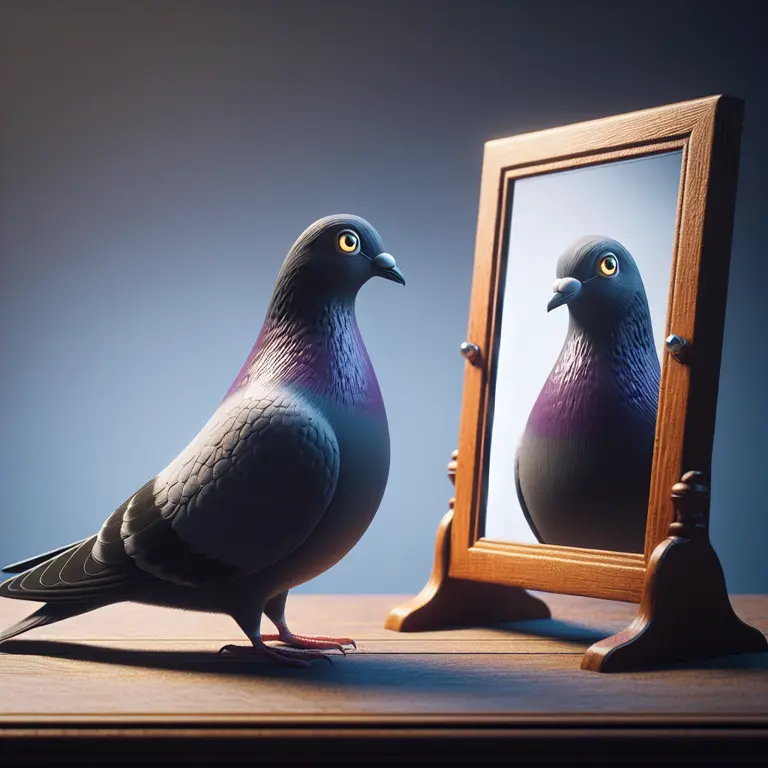
Pigeons are one of the few species that can pass the 'mirror test' - a test of self-recognition.
Introduction
For much of the twentieth century, the scientific community operated under a relatively comfortable assumption: that self-awareness, the capacity to recognize oneself as a distinct individual entity, was a privilege reserved for humans and perhaps a handful of our closest evolutionary relatives. Birds, with their comparatively small brains and reputations as creatures of instinct, sat comfortably near the bottom of the cognitive hierarchy in popular imagination. Then, in the 1980s, a researcher named Richard D. Griffin conducted a series of experiments with pigeons that quietly dismantled that assumption. His findings did not simply add pigeons to a list of clever animals. They forced a fundamental reconsideration of how intelligence, consciousness, and self-awareness are distributed across the animal kingdom, and what those concepts even mean when applied beyond the human experience.
The Mirror Test: A Tool for Measuring Self-Awareness
To understand why Griffin’s work was so significant, it helps to examine the tool he used. The mirror test, formally known as the mark test or mirror self-recognition test, was developed in 1970 by psychologist Gordon Gallup Jr. at Tulane University. Gallup’s original insight was elegant in its simplicity. If an animal sees a reflection and interprets it as another individual, it will behave socially toward that reflection, perhaps approaching it, vocalizing at it, or displaying dominance behaviors. But if the animal understands that the reflection is itself, it will use the mirror instrumentally, as a tool to gather information about its own body.
To test this, researchers place a mark on an area of the animal’s body that is visible in a mirror but not directly visible to the animal without one, such as the forehead, cheek, or upper back. The mark is typically odorless and applied while the animal is sedated or distracted, so the animal has no sensory awareness of it other than through sight. When the animal is then given access to a mirror, researchers observe whether it touches, investigates, or attempts to remove the mark from its own body. Doing so indicates that the animal has connected the image in the mirror to its own physical self, a feat that requires a representational model of the self that goes far beyond basic environmental awareness.
Since Gallup’s initial work with chimpanzees, the mirror test has become one of the most widely applied and debated tools in comparative psychology. It is not without its critics, who argue that it may be biased toward species with a strong visual orientation and dexterous limbs, potentially underestimating the self-awareness of animals that rely more heavily on smell, sound, or other senses. Nevertheless, it remains a cornerstone of research into animal cognition and continues to generate some of the most provocative findings in the field.
Griffin’s Experiment with Pigeons
Richard Griffin’s decision to apply the mirror test to pigeons was itself a bold move. Pigeons had long been studied in behavioral psychology, most famously by B.F. Skinner, who used them as subjects in operant conditioning experiments. In that tradition, pigeons were valued precisely because they were thought to operate on relatively simple stimulus-response mechanisms. They were ideal subjects for studying learned behavior, but not the kind of animal anyone expected to demonstrate self-awareness.
Griffin carefully designed his experiment, placing colored dots on parts of the pigeons’ bodies in locations the birds could not see directly. The pigeons were then given access to mirrors, and their behavior was recorded and analyzed. What Griffin observed confounded expectations. The pigeons pecked at and attempted to remove the marks from their own bodies after viewing their reflections, behavior that closely mirrored what had been observed in chimpanzees and other animals known to pass the mirror test. They were not treating the reflection as a rival bird or an unknown entity. They were using the mirror as a window onto themselves.
The implications were immediate and significant. If pigeons, birds with brains the size of a walnut and no neocortex, the brain region long assumed to be the seat of higher cognition in mammals, could demonstrate self-recognition, then the neurological prerequisites for self-awareness were clearly more flexible than scientists had believed. Griffin’s work suggested that the architecture of self-awareness might not depend on any single brain structure but could emerge through different evolutionary pathways across lineages.
Other Species and the Mirror Test
Griffin’s findings with pigeons were groundbreaking, but they did not stand alone for long. Over the decades that followed, researchers extended the mirror test to a growing roster of species, and the results continued to challenge tidy assumptions about which animals are and are not self-aware.
Great apes, including chimpanzees, bonobos, and orangutans, were among the first non-human animals to pass the mirror test, a result that seemed to confirm the intuition that cognitive sophistication tracks closely with evolutionary proximity to humans. Dolphins followed, demonstrating self-recognition in mirror tests conducted in aquatic environments, which required creative adaptations of the original methodology. Their performance was notable not only for what it revealed about dolphin intelligence but also for showing that self-awareness could evolve in an entirely different ecological context and body plan than our own.
Elephants presented another compelling case. Researchers at the Bronx Zoo placed a large mirror in front of three Asian elephants and observed that one of them, a female named Happy, repeatedly touched a painted mark on her forehead while looking at her reflection. Elephants have long been known for their complex social behaviors, apparent grief responses, and capacity for long-term memory, and the mirror test result added another dimension to the picture of their inner lives.
Perhaps the most philosophically interesting case, particularly in light of Griffin’s pigeon research, is that of the European magpie. Magpies are members of the corvid family, a group that also includes crows, ravens, and jays, birds that have demonstrated remarkable problem-solving abilities in a range of contexts. When researchers placed colored stickers on magpies in positions only visible in a mirror, the birds scratched at the marks on their own bodies, passing the test convincingly. The significance of this result is that magpies and pigeons are both birds, both lack a neocortex, and yet both appear capable of self-recognition. This strongly suggests that self-awareness evolved independently in the avian lineage, a phenomenon scientists call convergent evolution, where similar traits arise in unrelated groups through different developmental paths.
Implications for Animal Cognition and the Broader Understanding of Mind
The cumulative weight of these findings has profound implications that extend well beyond any single species or experiment. Self-recognition in a mirror is not merely a party trick. It is considered a marker of what psychologists call a theory of mind, the capacity to understand that one has a perspective distinct from others, and to model the mental states of other individuals. This capacity is linked to empathy, deception, cooperation, and social learning, all of which are critical to the complex social lives of many animals.
For birds specifically, Griffin’s work helped catalyze a broader reassessment that has only accelerated in the decades since. Researchers have documented crows manufacturing and using tools, ravens planning for future events, and scrub jays appearing to protect their food caches differently depending on whether they were watched by other birds, a behavior that implies an understanding of what others can and cannot see. None of this would have been predicted by the old model of avian cognition, which treated the absence of a neocortex as a definitive ceiling on bird intelligence. It is now understood that birds achieve comparable cognitive feats through a brain structure that is differently organized but functionally analogous.
More broadly, these findings invite a reconsideration of how we define intelligence and consciousness. For centuries, humans have used themselves as the implicit reference point, measuring other animals by how closely their minds resemble our own. The growing evidence for diverse forms of self-awareness across the animal kingdom suggests that this framework is too narrow. Intelligence may not be a single ladder with humans at the top but a vast, branching landscape in which many different kinds of minds have found many different solutions to the challenges of survival and social life.
Conclusion
Richard Griffin’s experiments with pigeons in the 1980s were a turning point in the history of animal cognition research, not because they answered all the questions about animal self-awareness, but because they made those questions impossible to ignore. By demonstrating that a bird long associated with mundane urban life could recognize itself in a mirror, Griffin cracked open a door that has never fully closed. The research that followed, encompassing dolphins, elephants, magpies, and many others, has built a picture of the animal mind that is far richer, stranger, and more morally significant than the one it replaced.
The mirror test continues to be refined and debated, and new methodologies are constantly being developed to probe the inner lives of creatures whose experiences we can only partially imagine. What Griffin’s work ultimately teaches us is that the capacity for self-awareness, once considered the exclusive hallmark of human consciousness, may be one of nature’s more common inventions. The pigeon staring back at its own reflection is not a curiosity. It is a reminder that the line between self and other, between mind and mere mechanism, is far less clear than we once supposed.