
Misconception Alert: Banana Plants Are Herbaceous, Not Trees
Bananas are not grown on trees, they are actually the world's tallest herbaceous plant.
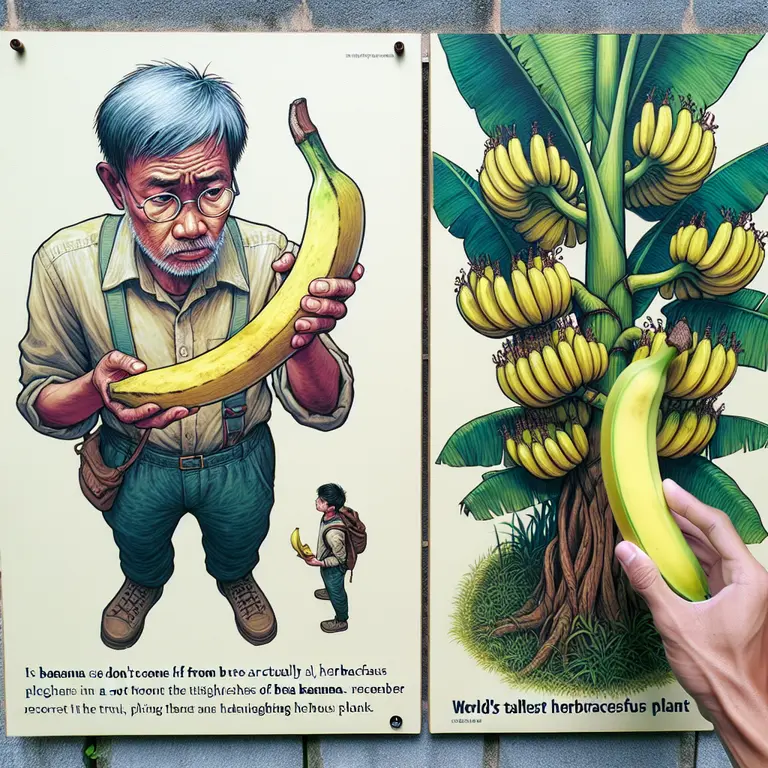
The Banana Plant: Why the World’s Favorite Fruit Grows on an Herb, Not a Tree
Few plants in the world are as widely recognized and economically significant as the banana plant, yet few are as consistently misunderstood. Standing tall in tropical gardens, commercial plantations, and botanical parks around the globe, banana plants project an unmistakable sense of arboreal authority. Their towering height, broad, sweeping leaves, and thick central column all suggest the presence of a tree. Yet botanists are unequivocal on the matter: banana plants are not trees at all. They are herbaceous plants, and understanding why this is the case reveals a genuinely surprising aspect of how we perceive and classify the natural world.
What Actually Makes a Tree a Tree
To appreciate why banana plants fall outside the definition of a tree, it helps to first understand what that definition actually requires. From a botanical standpoint, a tree is a perennial plant with a single, self-supporting woody stem known as a trunk. This trunk is produced through a process called secondary growth, in which specialized cells called cambium cells continuously generate new layers of wood tissue. This is what allows trees to grow taller and wider across many years, and it is what gives wood its characteristic density, rigidity, and durability. Trees also typically produce branches from that central trunk, and they carry leaves, flowers, and seeds in arrangements specific to their species.
Herbaceous plants, by contrast, do not produce this kind of woody tissue. Their stems remain relatively soft and flexible throughout their life cycle, and they rely on other structural mechanisms to maintain their shape and height. Many herbaceous plants die back to the ground at the end of a growing season, though some, like the banana plant, are perennial in the sense that their underground root systems persist and regenerate. The critical distinction is not size or lifespan but the presence or absence of true woody tissue produced through secondary growth.
The Anatomy of a Banana Plant’s False Trunk
Perhaps the most visually deceptive feature of the banana plant is what most people casually call its trunk. This structure, which can reach diameters of several inches and support a plant standing up to 9 meters, or approximately 29 feet tall, is not a trunk in any botanical sense. It is technically called a pseudostem, and it is composed entirely of tightly packed, overlapping leaf bases. Each new leaf that the plant produces grows up through the center of the pseudostem, and the whole structure is essentially a cylinder of layered leaf sheaths pressed so firmly together that they create the impression of a solid, unified column.
If you were to cut through a pseudostem horizontally, you would find no rings, no heartwood, and no cambium layer. Instead, you would see concentric layers of moist, fibrous leaf material. This structure is surprisingly strong and can support considerable weight, but it achieves that strength through compression and density rather than through the biochemical hardening process that creates true wood. The banana plant’s real stem is actually the corm, an underground structure from which both the pseudostem and the root system emerge. Everything visible above ground, impressive as it may appear, is essentially a highly organized arrangement of leaves.
The Genus Musa and the Diversity of Banana Species
Banana plants belong to the genus Musa, a group within the family Musaceae that contains dozens of species distributed across tropical and subtropical regions of the world. The plants we most commonly encounter in grocery stores are typically cultivars of Musa acuminata or hybrids between Musa acuminata and Musa balbisiana, but the genus as a whole encompasses a remarkable range of forms. Some species produce small, intensely sweet fruit. Others grow primarily as ornamental plants valued for their dramatic foliage. A few are cultivated not for their fruit at all but for their fiber, which has been used for centuries in textile production across parts of Asia.
All members of the genus Musa share the fundamental herbaceous characteristics that distinguish them from trees. They all produce pseudostems rather than true woody trunks, and they all reproduce through offshoots called suckers or pups that emerge from the base of the parent plant. After a banana plant flowers and produces fruit, the pseudostem that bore the fruit dies back. The plant then continues its life cycle through these offshoots, which grow up to replace the parent stem. This reproductive strategy is quite different from that of trees, which continue to grow from the same woody trunk year after year.
Bananas as Botanical Berries
The surprises embedded in banana plant biology do not end with the pseudostem. The fruit itself carries an equally counterintuitive classification. From a strict botanical perspective, bananas are berries. This claim tends to provoke disbelief, and understandably so, since bananas share almost no superficial resemblance with the fruits most people associate with that word. Strawberries, raspberries, and blackberries are the cultural archetypes of berries, yet none of these are technically berries in the botanical sense. Bananas, on the other hand, meet every criterion the classification requires.
In botanical terminology, a berry is a fleshy fruit that develops from a single ovary and contains seeds embedded within the flesh rather than enclosed in a hard inner layer. Bananas develop from a single flower ovary, their flesh surrounds the seeds rather than encasing them in a separate compartment, and they lack any internal division into distinct sections. The seeds in commercially cultivated bananas are largely vestigial due to centuries of selective breeding, but wild banana varieties contain clearly visible, hard seeds distributed throughout the flesh. Interestingly, fruits commonly called berries in everyday language, including strawberries, raspberries, and blackberries, fail the botanical test on technical grounds, while bananas, watermelons, and even avocados qualify as true berries. This inversion of common expectation is a useful reminder that scientific classification and everyday language often operate according to entirely different logic.
Why Plant Classification Matters Beyond the Classroom
Understanding the distinction between trees and herbaceous plants, such as the banana, is not purely an exercise in academic precision. It carries meaningful consequences for agriculture, conservation, and our broader relationship with the natural world. Farmers who cultivate bananas must account for the specific vulnerabilities of herbaceous plants. Because banana plants do not produce hardened woody tissue, they are susceptible to damage from strong winds, flooding, and physical injury in ways that trees are not. Commercial banana cultivation requires careful management of spacing, drainage, and structural support to prevent pseudostem collapse.
The classification also has implications for disease management. The global banana industry has faced repeated crises linked to the spread of fungal pathogens, most notably Panama disease, caused by the soil fungus Fusarium oxysporum. Understanding the biology and anatomy of banana plants at a fundamental level is essential for developing effective disease-resistant cultivars and containment strategies. Without that foundational knowledge, agricultural interventions would lack the scientific grounding necessary to be effective.
From a conservation standpoint, recognizing the unique biological status of banana plants and their wild relatives is important for protecting genetic diversity. Many wild Musa species are threatened by habitat loss, and they represent a reservoir of genetic material that could prove invaluable for developing hardier, disease-resistant cultivated varieties in the future.
Conclusion
The banana plant stands as one of nature’s most instructive examples of the gap between appearance and botanical reality. It looks like a tree, it is often called a tree in casual conversation, and it produces fruit that most people would never dream of calling a berry. Yet on every one of these points, closer scientific examination reveals something more interesting than the surface impression suggests. The pseudostem is not a trunk but a construction of leaves. The plant itself is not a tree but an herb. And the fruit is not what common language would have us believe, but a berry in the most technically rigorous sense of the word. Engaging with these distinctions does more than satisfy botanical curiosity. It cultivates the habit of looking past familiar assumptions to find the more complex and often more fascinating truth that careful observation and classification can reveal.