
Casu Martzu: The Cultural and Scientific Enigma of Cheese
Casu martzu, Sardinia's infamous living cheese, is produced through a process involving a specific blowfly species whose larvae break down fat in ways that mirror decomposition biology — raising questions about the fine line between fermentation and putrefaction.
 Watch on YouTube
 Watch on Rumble
Introduction
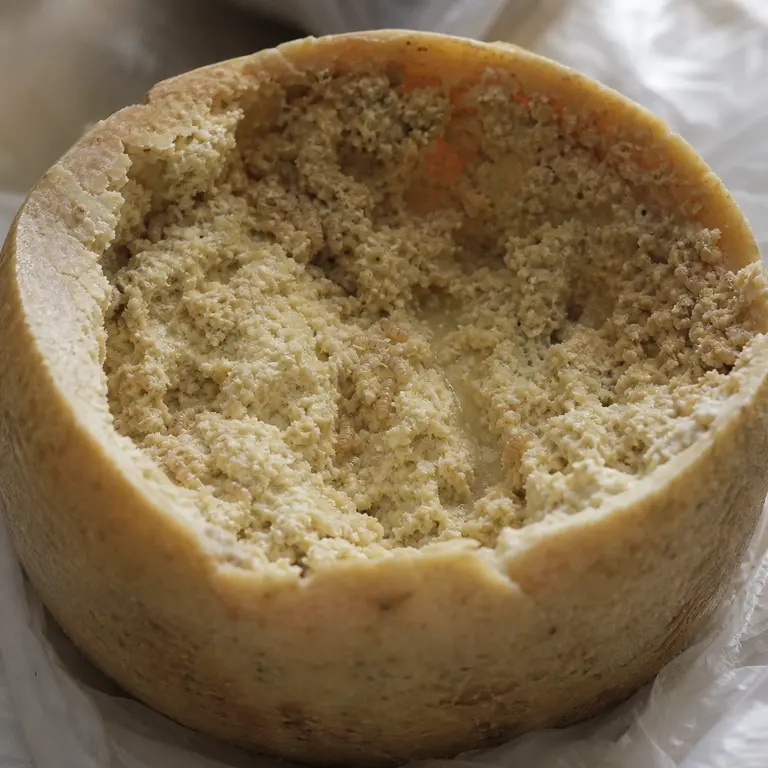
In the mountainous interior of Sardinia, a cheese has repeatedly been sought to be banned by Italian and European food safety authorities. Casu martzu, which translates roughly as “rotten cheese,” is a traditional pecorino whose transformation depends entirely on the larvae of Piophila casei, the cheese skippers. These translucent maggots, each roughly eight millimeters long, are introduced deliberately into aging wheels of sheep’s milk cheese, where they consume the fat and excrete enzymes that break down the pecorino to a soft, almost liquid consistency. The cheese is considered ready to eat only when the larvae are still alive and writhing inside it. Once the maggots die, the cheese is considered unsafe even by the standards of those who make it.
The practice is ancient enough that no clear origin date exists, though it appears in Sardinian records stretching back at least several centuries. Its continued production is technically illegal under European Union food hygiene regulations, yet it persists as a black-market delicacy, sold quietly at local markets at prices that can reach several times those of conventional aged pecorino. In 2009, the European Commission granted a temporary exemption allowing traditional foods predating EU food law to continue production under certain conditions, and casu martzu was briefly considered for protected status under that provision, though its legal situation remains ambiguous. That ambiguity captures something essential about the cheese itself: it occupies a space between tradition and transgression, between craft and contamination, that no regulatory category has yet managed to resolve.
The Biology of Controlled Rot
What makes Casu Marzu scientifically remarkable is how closely its production chemistry mirrors the early stages of adipocere formation and corpse decomposition. Piophila casei larvae secrete lipases, which are fat-cleaving enzymes, at concentrations far exceeding what standard microbial fermentation achieves. These lipases hydrolyze the triglycerides in the cheese’s fat into free fatty acids and glycerol, a process identical in mechanism to what occurs when blowfly larvae colonize a carcass. The resulting texture, the near-liquid creaminess that Sardinian aficionados prize, is a product of lipolysis so aggressive it would be classified as spoilage in any other food context.
Researchers studying the microbial ecology of Casu Marzu have found that the larval activity also dramatically alters the cheese’s bacterial community. A 2010 study published in the International Journal of Food Microbiology found that Piophila casei larvae significantly suppress certain spoilage bacteria while inadvertently selecting for lactic acid bacteria strains that contribute to flavor complexity. The result is a microbial community that is simultaneously more dangerous by conventional metrics and more aromatic by sensory ones. The free fatty acids produced, particularly butyric and capric acids, are the same compounds responsible for the characteristic pungency of many aged cheeses, though in casu martzu they are present at concentrations that most food scientists would flag as markers of spoilage rather than craft.
What this means in practical terms is that the line the larvae walk is extraordinarily fine. The cheese moves from under-fermented to optimally transformed to genuinely dangerous across a continuum that experienced Sardinian producers learn to read through texture, smell, and the behavior of the larvae themselves. This kind of embodied knowledge, accumulated over generations and impossible to fully codify in a food safety manual, is precisely what regulatory frameworks struggle to accommodate. The cheese is not simply a curiosity. It demonstrates that some food traditions encode biological knowledge in practices rather than in writing, and that the loss of those traditions can represent a genuine loss of expertise.
The Hazard Hidden in the Leap
Casu Martzu carries a genuine medical risk that its advocates do not entirely dismiss. Piophila casei larvae are uniquely adapted to survive passage through the human gastrointestinal tract. Unlike most insect larvae, which are destroyed by stomach acid, cheese skippers have demonstrated resistance to acidic environments, and documented cases of intestinal myiasis, which is the infestation of the gut by living fly larvae, have been associated with their consumption. Symptoms include nausea, vomiting, abdominal pain, and bloody diarrhea, and the larvae have been recovered alive from human stool samples in clinical case reports from Sardinia and neighboring Italian regions.
The larvae are also capable of jumping up to 15 centimeters when disturbed, which is the origin of their common English name. Sardinian tradition holds that consumers should shield their eyes while eating the cheese, or, alternatively, place the cheese inside a sealed bag to suffocate the larvae before consumption, though this latter approach is considered by purists to diminish the flavor. The tension between authentic preparation and harm reduction is not merely folkloric but reflects a genuine biological trade-off: the same larval vitality that signals the cheese has not yet crossed into dangerous putrefaction is also the property that creates the risk of myiasis.
This paradox places casu martzu in an unusual category among risky traditional foods. Most such foods carry passive risks, meaning they may harbor pathogens or toxins that can cause harm without any active behavior on the part of the organism. Casu Martzu is different. The hazard is alive, motile, and capable of persisting inside the consumer’s body. The risk is not incidental to the food’s character but is structurally bound up with the very quality that makes the cheese worth eating in the first place. Removing the living larvae removes both the marker of freshness and the mechanism of transformation. This is not a food where the dangerous element can simply be filtered out without changing what the food fundamentally is.
What Casu Martzu Reveals About Fermentation
The existence of casu martzu forces a reconsideration of where fermentation ends, and decomposition begins. Conventional food science draws the line at whether a transformation is controlled and predictable, but the larvae of Piophila casei are neither fully controlled nor entirely predictable. Their activity depends on temperature, humidity, the fat content of the specific cheese, and the density of larval colonization, all of which vary between wheels and between seasons. What Casu Martzu demonstrates is that the boundary between a celebrated fermented food and a rotting one is partly cultural, partly biochemical, and partly a matter of who is doing the classifying.
This observation is not as relativistic as it might first appear. Kimchi, natto, hákarl, and surströmming are all foods that involve microbial or enzymatic transformations that would be considered spoilage if they occurred outside a cultural frame of intentional production. The difference between a deliberately fermented shark and a rotten one is, in chemical terms, often a matter of degree rather than kind. Casu Martzu simply pushes this point further than most Western palates are comfortable following. It makes visible what other fermented foods allow consumers to ignore: that the flavor compounds we find most complex and satisfying in aged foods are frequently the products of exactly the same biochemical processes that make decomposition smell the way it does.
This ambiguity has attracted the attention of food scientists studying the extremes of fermentation for potential applications in enzyme production. The lipases secreted by Piophila casei larvae are unusually thermostable and active across a wide pH range, properties that make them theoretically interesting for industrial fat processing, detergent manufacture, and even pharmaceutical lipid modification. A living Sardinian tradition condemned by food safety regulators may, in a quiet irony, contain enzymes worth isolating for biotechnology. The maggot in the cheese is, depending on one’s perspective, a hazard, a heritage, or an unexplored biochemical resource.
Conclusion
Casu Martzu resists easy categorization because it genuinely belongs to multiple categories at once. It is a food with deep cultural roots and a living community of producers and consumers who understand it on its own terms. It is also a microbiological system of unusual complexity that science has only partially characterized. It is a regulatory problem that the European Union has not resolved and may never resolve cleanly. And it is a small but genuine argument against the assumption that modernizing food safety always represents progress without loss.
What the cheese ultimately illustrates is that human relationships with food are older, stranger, and more biochemically sophisticated than the frameworks we use to govern them. Sardinian shepherds did not develop casu martzu solely out of ignorance or desperation. They developed it through centuries of observation, trial, and accumulated knowledge about what the larvae do to the cheese and when the results are worth eating. That knowledge is not written in any scientific journal. It lives in practice, in the hands and noses and eyes of the people who still make it, and in the improbable, writhing interior of a wheel of sheep’s milk cheese that the modern world has not quite managed to kill off.
Sources & Further Reading
- Montinaro, G. et al. Microbial characterization of casu marzu, a traditional Sardinian cheese. International Journal of Food Microbiology, 2010.
- Riparbelli, M.G. et al. Piophila casei larval biology and gastrointestinal myiasis risk. Parasitology Research, 2004.
- European Commission. Regulation (EC) No 852/2004 on the hygiene of foodstuffs. Official Journal of the European Union, 2004. https://eur-lex.europa.eu/legal-content/EN/TXT/?uri=CELEX:32004R0852
- Marcone, M.F. Characterization of the edible bird's nest and other exotic foods. Food Research International, 2005.