
The Quantum Battery That Charges Faster the Bigger It Gets
Physicists have demonstrated that quantum batteries — theoretical energy storage devices governed by quantum mechanics — can charge exponentially faster as they scale up, defying every classical intuition about energy storage.
 Watch on YouTube
 Watch on Rumble
When Physics Breaks Its Own Rules
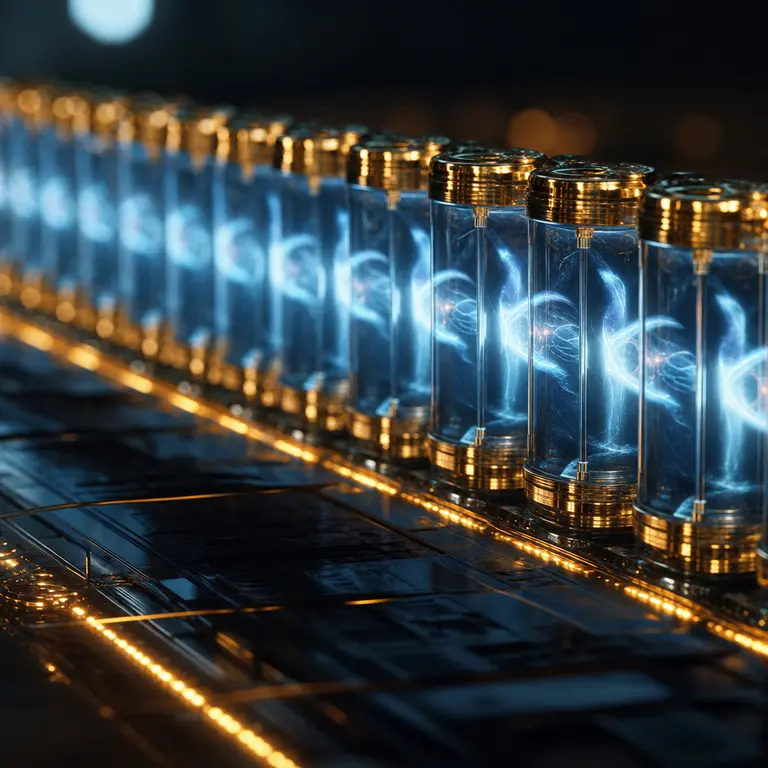
Most technologies get slower, heavier, or less efficient as they grow larger. A bigger conventional battery takes longer to charge, dissipates more heat, and requires more complex thermal management. This is so fundamental to engineering that entire industries are organized around it — from the thermal regulation systems inside electric vehicles to the cooling infrastructure of large-scale grid storage facilities. Engineers accept this as a baseline constraint, a kind of tax imposed by physical reality on any attempt to scale up energy storage. Quantum mechanics, however, does not care about engineering intuitions. A class of theoretical and now experimentally probed devices called quantum batteries appears to violate this scaling logic entirely — the more quantum cells you add, the faster the entire system charges. This phenomenon, rooted in quantum entanglement and coherence, is attracting serious attention in 2025 as researchers at institutions including the University of Adelaide and groups in Italy and South Korea push the concept from thought experiment toward physical demonstration. What makes this development remarkable is not merely that it challenges conventional battery design, but that it forces a rethinking of what energy storage even means at the quantum scale.
What Makes a Battery Quantum
A conventional battery stores energy through electrochemical reactions — lithium ions migrating between electrodes, chemical potential converting to electrical potential. The process is governed by classical chemistry and classical thermodynamics, and it scales predictably. Double the number of cells, double the capacity, and double the charging time at a fixed power input. A quantum battery, by contrast, stores energy in the quantum states of a physical system: the spin states of atoms, the excitation levels of two-level quantum systems called qubits, or the photon occupation states of optical cavities. The energy is deposited and extracted not through chemistry but through carefully controlled quantum operations, often involving precisely shaped electromagnetic pulses that drive transitions between quantum energy levels.
The key distinction is that quantum systems can exist in superpositions — multiple energy states simultaneously — and can be entangled with one another. Entanglement is a correlation with no classical analogue, in which the quantum state of one particle cannot be described independently of another, regardless of the physical distance between them. When quantum cells are entangled during charging, they do not behave as independent units. They behave as a single correlated system, and the charging power scales not linearly with the number of cells N, but, in some theoretical models, as N^2 or even faster. A landmark 2017 paper by Ferraro and colleagues in Physical Review Letters formalized this advantage, showing that collective quantum operations on entangled batteries produce what physicists call a quantum speedup in charging. The more cells, the more dramatic the advantage over classical storage.
This counterintuitive result follows from a property known as quantum parallelism — the ability of entangled systems to explore multiple configurations simultaneously. When a charger interacts with a classically arranged battery, it must address each cell sequentially or in parallel but independently. When it interacts with an entangled quantum battery, it effectively addresses all cells through a single correlated operation, compressing the charging process in a way that has no classical equivalent. The mathematics of this speedup is well established; the engineering challenge lies in actually building systems that can exploit it before the quantum correlations dissolve.
The Experimental Frontier in 2025
For years, quantum batteries remained a theoretical curiosity confined to the pages of physics journals. The challenge was building a system clean enough to maintain quantum coherence — the fragile condition in which quantum correlations survive — long enough to actually charge and discharge the device before environmental noise destroys the quantum state. This process, called decoherence, is the primary enemy of all quantum technologies. A quantum system interacting with its environment leaks information into that environment, and as it does, the superpositions and entanglements that define its quantum character collapse into ordinary classical behavior. The battery, in effect, forgets it is quantum before it can do anything useful.
In 2023, a team at the University of Adelaide reported what they described as the first demonstration of a solid-state quantum battery, using an organic semiconductor microcavity to store and retrieve energy via light-matter coupling. The device exploited a phenomenon called strong coupling between photons and molecular excitons — hybrid light-matter states that can carry and transfer energy with remarkable efficiency. By 2025, follow-on experiments will have been refining the efficiency and coherence times of such systems, with particular attention to identifying materials that naturally suppress decoherence through their molecular structure. Separately, groups working with superconducting qubit architectures — the same hardware underpinning quantum computers from IBM and Google — have been exploring whether existing quantum processors can serve as energy-storage testbeds. The overlap between quantum computing hardware and quantum battery research is not coincidental: both require the same exquisite control over quantum states, and the diagnostic tools developed for one translate directly to the other.
One particularly striking 2024 result from a collaboration between Italian and German physicists demonstrated that even under realistic decoherence conditions, a quantum battery advantage persists for small system sizes, suggesting that the technology does not require perfect isolation to outperform classical alternatives at the micro and nanoscale. This finding significantly shifted the field’s outlook. Earlier theoretical work had sometimes assumed near-perfect coherence as a prerequisite for any practical advantage, which made experimental realization seem perpetually out of reach. The 2024 result implies that partial coherence is sufficient — that quantum batteries can tolerate a degree of environmental noise and still outperform their classical counterparts, at least within carefully defined regimes of size and temperature.
Why It Matters Beyond the Laboratory
The immediate application of quantum batteries is not replacing the lithium-ion pack in an electric vehicle. The energy densities currently achievable in quantum systems are minuscule by macroscopic standards, and maintaining coherence at room temperature and at scale remains an unsolved engineering problem of considerable depth. The realistic near-term targets are devices operating at cryogenic temperatures inside quantum computers themselves — charging the quantum processor’s own operational components — or nanoscale energy harvesters embedded in future quantum sensors and quantum communication nodes. In these contexts, the relevant figure of merit is not total stored energy but charging speed and on-demand availability, which is precisely where quantum batteries show their most credible advantage.
The longer-term implications are more provocative. If coherence problems are eventually solved through better materials, error-correcting architectures, or topological protection strategies that make quantum states inherently resistant to environmental disturbance, quantum batteries could become relevant for any application where charging speed matters more than total stored energy. Medical implants that recharge in microseconds rather than hours, satellites that harvest and deploy solar energy in ultrafast bursts timed to communication windows, or distributed quantum networks that require on-demand energy pulses synchronized to quantum communication protocols are all plausible future use cases. None of these applications requires a quantum battery to store large amounts of energy — they require it to store and release energy with extraordinary speed and precision, which is exactly what the entanglement-based speedup provides.
Quantum Batteries as a Window Into Deeper Physics
There is also a fundamental physics payoff independent of any application. Quantum batteries are becoming a laboratory for testing the thermodynamics of quantum systems — a field called quantum thermodynamics that is systematically rewriting classical assumptions about heat, work, and entropy at the smallest scales. Classical thermodynamics was developed in the nineteenth century to describe steam engines and industrial processes, and its laws were formulated with macroscopic systems in mind. Whether those laws hold without modification when the system in question contains only a handful of atoms, or when its components are entangled with one another, is not a settled question.
Whether the second law of thermodynamics holds in its classical form for quantum systems, whether quantum coherence constitutes a thermodynamic resource that can be systematically exploited, and how entanglement relates to the extraction of useful work are all questions that quantum battery experiments are uniquely positioned to answer. A quantum battery is, in this sense, not just a storage device but a precision instrument for probing the boundary between quantum and classical physics. Each charging and discharging cycle is a controlled thermodynamic experiment, and the data accumulating from these experiments is beginning to constrain theoretical models in ways that thought experiments alone never could.
The story of quantum batteries is ultimately a story about what happens when the rules of the very small collide with the engineering assumptions of the very large. For now, the devices exist at the scale of laboratory curiosities and proof-of-concept demonstrations. But the physics underlying them is real, the experimental evidence is accumulating, and the researchers pursuing them are asking questions that matter far beyond the immediate goal of faster charging. In probing how energy, information, and quantum correlations interact at the smallest scales, they are not just designing a better battery — they are mapping the operating principles of the universe itself.
Sources & Further Reading
- Ferraro, D. et al. High-Power Collective Charging of a Solid-State Quantum Battery. Physical Review Letters, 2018. https://journals.aps.org/prl/abstract/10.1103/PhysRevLett.120.117702
- Quach, J.Q. et al. Superabsorption in an organic microcavity: Toward a quantum battery. Science Advances, 2022. https://www.science.org/doi/10.1126/sciadv.abk3160
- Campaioli, F. et al. Enhancing the Charging Power of Quantum Batteries. Physical Review Letters, 2017. https://journals.aps.org/prl/abstract/10.1103/PhysRevLett.118.150601
- Vinjanampathy, S. and Anders, J. Quantum thermodynamics. Contemporary Physics, 2016. https://www.tandfonline.com/doi/full/10.1080/00107514.2016.1201896