
Cross-Kingdom Rna Warfare Threatens Global Food Security
A newly characterized mechanism reveals how parasitic fungi rewrite the gene expression of living host plants to suppress immunity and redirect nutrients, raising alarms for global food security.
 Watch on YouTube
 Watch on Rumble
A Silent Hijacking Happening in Every Field
In the spring of 2025, plant pathologists working across institutions in Europe and East Asia published converging findings on a mechanism that had long been suspected but never fully mapped. Certain parasitic fungi, it turned out, do not merely attack plant tissue from the outside. They actively manipulate their hosts' transcriptomes, effectively rewriting which genes the plant turns on or off, to suppress immune responses and reroute nutrients toward fungal growth. The organism at the center of much of this research is Fusarium oxysporum, a soil-borne pathogen responsible for devastating wilt diseases across dozens of economically critical crops, including tomatoes, bananas, and chickpeas.
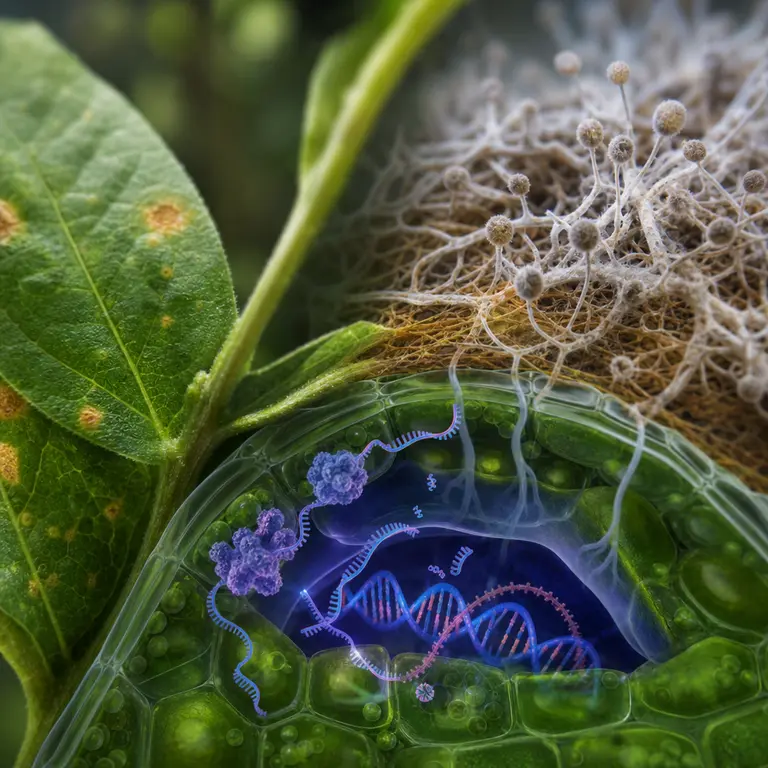
What makes the new findings particularly striking is the precision of the manipulation. The fungus does not simply overwhelm plant defenses through brute biological force. Instead, it delivers small RNA molecules, known as effector sRNAs, directly into plant cells, where they silence specific defense-related genes with surgical accuracy. This process, called cross-kingdom RNA interference, means the fungus is essentially speaking the plant’s own molecular language to shut it down from within. It is a form of biological espionage so refined that researchers spent years debating whether it could actually be happening at the scale the evidence now suggests.
The discovery sits at the intersection of molecular biology, evolutionary ecology, and agricultural science, and its implications ripple outward into each of those fields in ways that researchers are only beginning to trace. To understand why this finding matters, it helps to grasp both the machinery involved and the stakes of getting it wrong.
The Molecular Machinery of Manipulation
The mechanism works through a class of molecules called small interfering RNAs (siRNAs). In healthy plants, siRNAs are part of the internal immune system, which silences viral genes and regulates developmental processes throughout the plant’s life cycle. Fusarium and related fungi produce their own siRNAs that mimic this system with remarkable fidelity. Once inside the plant cell, these fungal siRNAs bind to the plant’s RNA-induced silencing complex, known as RISC, hijacking the very machinery the plant uses to defend itself. It is the molecular equivalent of a foreign agent using a government’s own encryption keys to send false orders through its command structure.
Researchers at Wageningen University in the Netherlands identified at least fourteen distinct fungal siRNA sequences that specifically target genes in the plant’s jasmonic acid and salicylic acid signaling pathways. These pathways are the two primary chemical alarm systems plants use to mount responses to pathogens and herbivores. Jasmonic acid tends to govern defenses against insects and necrotrophic pathogens, while salicylic acid is more central to responses against biotrophic invaders that keep host tissue alive while feeding on it. By silencing both simultaneously, the fungus creates a window of vulnerability that can last days or even weeks, long enough for the infection to become systemic and, in many cases, irreversible.
Adding another layer of complexity, the fungus also appears to upregulate plant genes involved in sugar transport, effectively turning the plant’s own vascular system into a delivery network for fungal nutrition. Phloem vessels that ordinarily carry photosynthate from leaves down to roots are redirected to supply the growing fungal colony with a steady stream of carbohydrates. This is not passive parasitism. It is active metabolic redirection with a degree of specificity that rivals anything seen in animal parasitology, including the well-documented behavioral manipulation performed by Ophiocordyceps fungi on carpenter ants, which compel their hosts to climb vegetation before killing them at an optimal height for spore dispersal.
What distinguishes the Fusarium findings is that the manipulation occurs at the level of gene regulation rather than behavior, and it operates continuously across millions of cells simultaneously. The fungus is not flipping a single switch. It is conducting a molecular orchestra, coordinating dozens of silencing events across multiple signaling pathways in real time.
Why This Matters for Global Food Supply
The implications for agriculture are serious and immediate. Fusarium wilt alone is estimated to cost global agriculture between one billion and three billion dollars annually, and that figure does not account for the cascading effects of crop failure on food prices and regional food security. The banana variety most consumed worldwide, the Cavendish, is currently under existential threat from Fusarium oxysporum f.sp. cubense Tropical Race 4, known as TR4, which has spread from Southeast Asia through South Asia, the Middle East, and into Africa and Latin America over the past two decades. The Cavendish itself rose to dominance after TR4’s predecessor, Race 1, wiped out the Gros Michel variety that dominated the global banana trade through the mid-twentieth century. The industry is, in a sense, watching history repeat itself in slow motion.
Conventional fungicides are largely ineffective against soil-borne Fusarium strains because the fungus can persist in soil as resistant spores called chlamydospores for decades, even in the absence of a living host. Contaminated farmland can remain hostile to susceptible crops for 30 years or more after the initial outbreak, making geographic containment the primary tool and a deeply imperfect one. Breeding resistant crop varieties has been the dominant defense strategy, but new research suggests that, as long as the fungus evolves new effector sRNAs, it may be able to overcome even genetically modified resistance genes over time. This is sometimes called the effector-resistance arms race, and it is one of the central challenges of modern plant pathology.
The arms race framing is not merely metaphorical. Plants under sustained pressure from Fusarium strains have been observed to develop resistance by accumulating new R genes that recognize specific fungal effector proteins. But fungal populations, which reproduce rapidly and generate enormous genetic diversity, can lose or modify the recognized effectors, thereby evading detection. The new RNA-based effectors described in the 2025 research further complicate this picture because siRNA sequences are smaller, more numerous, and potentially easier for the fungus to vary than protein-based effectors.
Some research groups are now exploring whether the same RNA interference machinery could be turned against the fungus. Spray-induced gene silencing, or SIGS, involves applying double-stranded RNA molecules to crop surfaces that specifically target essential fungal genes. Early field trials in wheat against Fusarium graminearum, which causes head blight and contaminates grain with dangerous mycotoxins, including deoxynivalenol, showed meaningful reductions in infection rates. However, stability of RNA molecules under field conditions, including degradation by UV light, rainfall, and soil microbes, along with the cost of production at an agricultural scale, remains a significant barrier to practical deployment.
A New Frontier in the War Between Kingdoms
What the latest research ultimately reveals is that the boundary between plant and fungus, long thought of as a physical frontier of cell walls and immune barriers, is in fact a highly dynamic molecular conversation conducted across species lines. Fungi have been co-evolving with land plants for at least 400 million years, a relationship that predates the first forests and likely shaped the conditions under which complex terrestrial ecosystems became possible. The sophistication of mechanisms like cross-kingdom RNA interference suggests that this relationship has always been more intimate and more adversarial than the simple image of mold growing on a leaf implies.
The broader scientific significance extends well beyond agriculture. Understanding how one organism can commandeer another's gene expression machinery raises questions directly relevant to cancer biology, synthetic biology, and the design of RNA-based therapeutics in human medicine. The same principles that allow a fungus to silence a plant’s immune genes could, in theory, be adapted to silence overactive oncogenes or inflammatory signaling pathways in human disease contexts. Several biotechnology startups are already exploring fungal-derived RNA effectors as scaffolds for next-generation gene-silencing drugs, building on the conceptual framework that the plant pathology findings have helped clarify.
There is also a deeper philosophical implication worth sitting with. The idea that organisms can rewrite each other’s gene expression across kingdom boundaries challenges a view of biological individuality that has been foundational to life sciences for over a century. If a plant’s genome can be functionally altered by molecules produced by a fungus living in its roots, then the question of where one organism ends and another begins becomes genuinely complicated. Some researchers working at the interface of ecology and philosophy of biology have begun to argue that the individual organism, as a unit of analysis, may be less useful than the concept of the holobiont, the collective of host and associated microbes and pathogens that together determine phenotype and fitness.
For now, the most urgent application remains protecting the crops that feed billions of people. As climate change expands the geographic range of soil-borne pathogens and reduces the genetic diversity of commercial monocultures, the molecular arms race between plants and their fungal parasites is likely to intensify in ways that existing agricultural infrastructure is poorly equipped to handle. The fungus, it turns out, has been a far more sophisticated adversary than anyone gave it credit for. And recognizing that sophistication is the first step toward building defenses capable of matching it.
Sources & Further Reading
- Weiberg, A. et al. Fungal Small RNAs Suppress Plant Immunity by Hijacking Host RNA Interference Pathways. Science, 2013. https://www.science.org/doi/10.1126/science.1239705
- De Coninck, B. et al. Spray-Induced Gene Silencing as a Tool for Crop Protection. Trends in Plant Science, 2020. https://www.cell.com/trends/plant-science/fulltext/S1360-1385(20)30175-3
- FAO. Banana Fusarium Wilt Tropical Race 4: A Mounting Threat to Food Security. Food and Agriculture Organization of the United Nations, 2021. https://www.fao.org/3/cb4890en/cb4890en.pdf
- Wageningen University and Research. Fusarium Research Group. https://www.wur.nl/en/research-results/chair-groups/plant-sciences/phytopathology.htm