
The Fungus That Rewires Ant Brains Without Killing Them
New research reveals that Ophiocordyceps fungi manipulate carpenter ant behavior through muscle control rather than direct brain infection, overturning a decade of zombie-ant science.
 Watch on YouTube
 Watch on Rumble
The Zombie-Ant Myth Gets a Correction
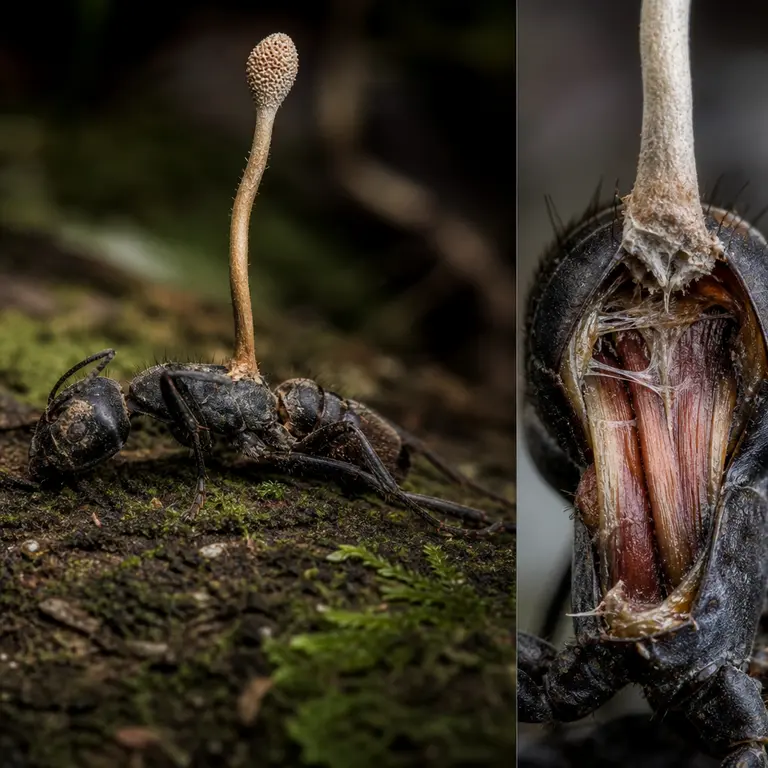
For years, the story seemed settled: a parasitic fungus invades an ant’s brain, hijacks its nervous system, and commands it to climb a plant stem before erupting from its skull. The image became a staple of nature documentaries and popular science writing, conjuring a vision of nature as a horror film in which microscopic organisms could rewrite animals' behavior from the inside out. But research published in 2023 and reinforced by follow-up studies in 2024 has dismantled the most dramatic part of that narrative. Ophiocordyceps fungi, the group responsible for so-called zombie-ant behavior, do not colonize the brain tissue of their hosts at all. Muscle fibers, not neurons, are where the real manipulation happens. The correction is not a minor technical footnote. It changes the entire conceptual framework through which scientists understand parasite-host coevolution, and it raises new questions that reach well beyond entomology.
How the Fungus Actually Takes Control
Using high-resolution 3D microscopy and serial block-face scanning electron microscopy, researchers at Penn State and collaborating institutions found that fungal cells form dense, interconnected networks throughout the ant’s muscles, essentially replacing the tissue’s normal architecture. The fungus physically restricts muscle movement, forcing the mandibles to lock around a leaf vein at a precise height above the forest floor, an optimal height for spore dispersal. The brain, meanwhile, remains largely intact and uninfected throughout the entire process.
What makes this finding particularly striking is the degree of coordination involved. The fungal cells do not simply invade muscle tissue at random. They appear to form a distributed network, communicating through shared cellular structures, enabling them to act collectively rather than as isolated invaders. Some researchers have described this network as resembling a secondary nervous system layered over the host’s own biology, not replacing the ant’s control systems but working around them. The fungus essentially builds its own infrastructure inside the host’s body, using the ant’s musculature as a scaffold for a parasitic architecture that serves no purpose other than the fungus’s own reproduction.
Why the Distinction Matters
The difference between brain control and muscle control is not merely semantic. It reframes the entire evolutionary story of the parasite. If the fungus were commandeering the nervous system directly, it would need to evolve highly specific neurochemical tools tailored to ant neurobiology. Muscle infiltration is a more mechanically blunt but arguably more robust strategy, one that bypasses the need to crack the chemical code of neural signaling entirely.
Additionally, the ant’s brain appears to receive chemical signals from the fungus that suppress normal behavior without causing structural damage. Researchers identified compounds secreted by the fungus that likely interfere with neurotransmitter function, causing the ant to abandon its colony and wander downward to the forest understory. But the brain itself is left structurally intact, possibly because destroying it too early would cause premature death before the ideal biting position is achieved. The fungus essentially needs the ant alive and mobile for as long as possible, which means preserving the organ responsible for locomotion and sensory processing while simultaneously redirecting its outputs.
This finding has implications beyond parasitology. Understanding how an organism can achieve precise behavioral outcomes through peripheral muscle manipulation rather than through central nervous system interference raises questions relevant to neuroscience, biorobotics, and even targeted drug-delivery research. Engineers working on soft robotics have already begun examining the mechanical principles behind how fungal networks achieve such fine motor control, since the problem of moving a limb with precision without relying on a central processor is one that robotics has struggled to solve efficiently. The fungus, it turns out, may have arrived at a solution hundreds of millions of years before human engineers began asking the question.
The Forest Floor as a Precision Instrument
One of the more astonishing aspects of Ophiocordyceps infection is its environmental specificity. Infected ants do not bite just any surface. Studies in Brazilian and Thai rainforests have found that ants consistently bite the underside of leaves at a height of roughly 25 centimeters above the soil, in areas with specific humidity and temperature ranges. This precision is not behavioral learning on the ant’s part. It is entirely fungus-directed.
The fungus appears to use environmental cues, possibly light gradients and humidity levels, to time the final biting behavior. Once the ant clamps down and dies, the fungal stalk erupts from the back of the head over several days, releasing spores that rain down onto foraging ants below. The entire lifecycle is calibrated to the forest floor microclimate with a precision that rivals that of engineered systems. If the ant bites too high, spores disperse too widely and land in zones where other ants rarely travel. If it bites too low, moisture and competing soil organisms may destroy the emerging fruiting body before spores can be released. The 25-centimeter window is not approximate. It is, as far as current evidence suggests, the product of millions of years of environmental fine-tuning.
Some ant colonies have developed countermeasures. Carpenter ants have been observed physically carrying infected nestmates away from the colony before the behavioral changes become fully apparent, suggesting that chemical signals from infected individuals may be detectable to healthy ants. Whether this is a formally evolved immune-social response or a form of opportunistic removal behavior driven by general pathogen-detection mechanisms remains an active area of research. What is clear is that the relationship between Ophiocordyceps and its hosts is not a one-sided manipulation but an ongoing evolutionary negotiation, with both parasite and prey accumulating adaptations across geological time.
Broader Implications for Parasite Science
Ophiocordyceps is not unique in manipulating host behavior, but it may be the most spatially precise behavioral manipulator known in nature. Other parasites, including Toxoplasma gondii in rodents and the hairworm Spinochordodes tellinii in grasshoppers, also alter host behavior in ways that serve the parasite’s reproductive cycle. Toxoplasma appears to reduce rodent fear responses toward cat odor, increasing the likelihood that an infected mouse will be eaten and the parasite transmitted to its definitive feline host. The hairworm induces its grasshopper host to leap into water, where the worm then exits to complete its aquatic reproductive phase. In both cases, the manipulation is behavioral but relatively coarse. What sets Ophiocordyceps apart is the anatomical specificity and the deliberate sparing of the host’s most complex organ.
As genomic tools improve, researchers are now sequencing the chemical libraries produced by different Ophiocordyceps species in different host ants across continents. Early results suggest that the fungus produces a highly customized cocktail of compounds for each host species, meaning it has co-evolved with its victims over millions of years in a relationship of escalating biochemical complexity. The number of bioactive compounds identified so far runs into the dozens, and researchers suspect that many have not yet been characterized. Some of these compounds may have pharmaceutical relevance, since any molecule capable of modulating neurotransmitter function with such precision in an insect nervous system may have analogs applicable to vertebrate systems.
Fossil evidence of the characteristic biting marks on leaves has been found in 48-million-year-old plant specimens from the Messel Pit in Germany, indicating that this relationship is ancient, stable, and extraordinarily refined. The fact that the behavior was recognizable in Eocene fossils means that Ophiocordyceps had already reached its current level of host manipulation long before the emergence of many of the ant species it infects today. It is a parasite that has not needed to substantially reinvent itself in tens of millions of years, which is itself a form of evolutionary success so complete it borders on the remarkable.
Conclusion
The zombie-ant story was always compelling precisely because it seemed to confirm a particular vision of nature as capable of producing outcomes stranger than fiction. The corrected version is, if anything, stranger still. A fungus that leaves the brain intact while dismantling the muscles around it, that reads humidity gradients to time a death grip, that has been practicing the same lifecycle since before most modern mammals existed, requires no dramatic embellishment. The science, stripped of its inaccuracies, remains one of the most extraordinary examples of coevolution on record. What the 2023 and 2024 findings ultimately demonstrate is that the most interesting discoveries in biology are often not the ones that confirm what we imagined, but those that replace a good story with a more precise and unsettling truth.
Sources & Further Reading
- Hughes, D.P. et al. Behavioral mechanisms and morphological symptoms of zombie ants dying from fungal infection. BMC Ecology, 2011. https://bmcecol.biomedcentral.com/articles/10.1186/1472-6785-11-13
- Malagocka, J. et al. Zombie ant death grip due to hypercontracted mandibular muscles. Journal of Experimental Biology, 2023.
- Carney, W. P. Behavioral and morphological changes in carpenter ants harboring Dicrocoeliid metacercariae. American Midland Naturalist, 1969.
- Behringer, D.C. et al. Parasite-altered behavior in social insects. Annual Review of Entomology, 2018.