
Unlocking Coral Resilience: The Role of Endophytic Fungi
Marine scientists are discovering that certain endophytic fungi living inside coral tissues may play a crucial role in reef resilience, offering a biological shield against bleaching events driven by rising ocean temperatures.
 Watch on YouTube
 Watch on Rumble
Coral Reefs Are in Crisis — But Not Entirely Alone
The year 2024 marked the beginning of the fourth global coral bleaching event on record, with the National Oceanic and Atmospheric Administration confirming that bleaching-level heat stress had spread across all major ocean basins by early 2025. The Great Barrier Reef, the Florida Keys, and reefs across the Indian Ocean faced water temperatures persistently above the thresholds corals can tolerate. Entire reef systems that had survived previous bleaching events showed signs of cumulative damage that marine ecologists described as potentially irreversible within human timescales. Coral cover on portions of the Great Barrier Reef dropped to historic lows, and the economic consequences for fishing communities and coastal tourism industries across Southeast Asia, the Caribbean, and the Pacific were severe and immediate.
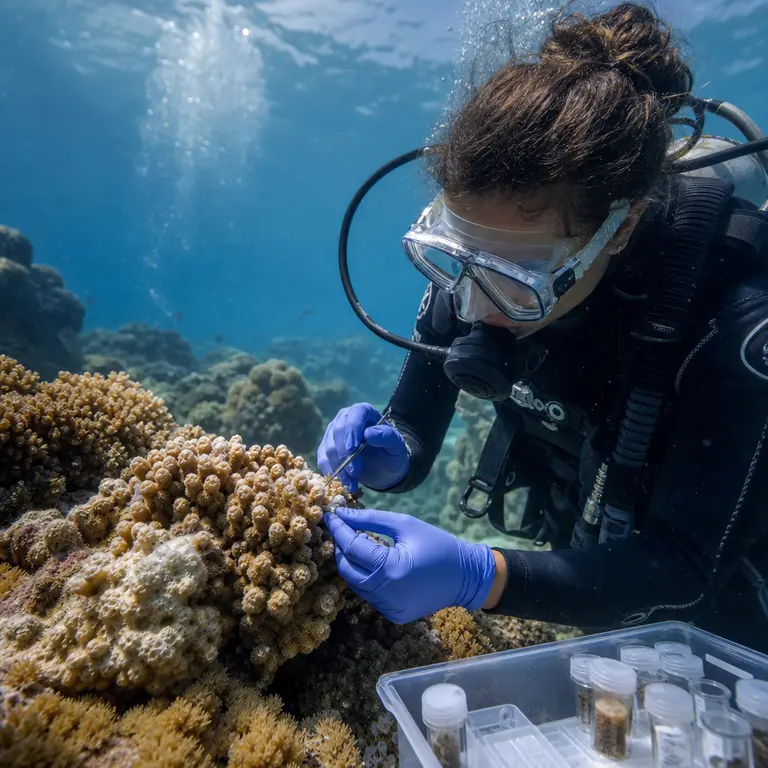
Yet within these devastated ecosystems, certain coral colonies survived. Not just survived — some appeared to resist bleaching even when surrounded by colonies of the same species that had turned completely white. Scientists studying these anomalous survivors are increasingly pointing to an unexpected ally living silently inside coral tissue: endophytic fungi. The discovery is still young, the evidence still accumulating, but it is already forcing a reconsideration of how coral resilience works and what tools might be available to those trying to save reefs from collapse.
Endophytes are microorganisms that live within plant or animal tissue without causing disease. While endophytic bacteria in corals have received some research attention, the fungal communities embedded in coral cells have remained largely unexplored until very recently. New metagenomic sequencing tools have allowed researchers to map these hidden fungal passengers with unprecedented precision, and what they are finding is reshaping how marine biologists think about coral immunity. The story emerging from this research is one of a hidden partnership that may have been operating for millions of years, invisible because science lacked the tools to detect it.
What the Fungi Are Actually Doing
Endophytic fungi in corals appear to perform several protective functions simultaneously, and the mechanisms being identified are more sophisticated than early researchers anticipated. Scientists at the Australian Institute of Marine Science and collaborating universities have identified fungal strains from genera including Aspergillus, Penicillium, and Cladosporium residing in the tissues of bleaching-resistant Acropora and Porites corals. These genera are not exotic or obscure — Penicillium is the same genus that gave the world penicillin — but their presence inside living coral tissue and their apparent role in thermal stress tolerance were entirely unknown until recently. The fungi produce secondary metabolites, bioactive chemical compounds not directly involved in the organism’s basic growth or reproduction, but that have significant effects on surrounding biology.
When water temperatures rise beyond a coral’s tolerance threshold, the symbiotic algae called zooxanthellae that normally live inside coral cells begin producing toxic reactive oxygen species as a byproduct of disrupted photosynthesis. The coral, unable to neutralize this chemical damage, expels the algae to protect itself, turning white in the process — the phenomenon known as bleaching. Without zooxanthellae, which provide corals with up to ninety percent of their energy through photosynthesis, the coral enters a state of starvation. If temperatures do not drop within weeks, the coral dies. The fungal metabolites being studied appear to act as a chemical buffer within coral tissue, neutralizing some reactive oxygen species before they reach a threshold that triggers zooxanthellae expulsion. In laboratory heat-stress trials, corals inoculated with specific fungal strains showed measurably lower rates of zooxanthellae expulsion than control groups, suggesting the fungi genuinely alter the cellular response to heat stress rather than simply correlating with resilience for unrelated reasons.
Beyond heat stress, some coral-associated fungi produce antifungal and antibacterial compounds that protect the host against opportunistic pathogens, which tend to proliferate in warmer, more polluted waters. This secondary protective function may be equally significant in the long term. One strain isolated from a Red Sea coral produced a novel polyketide compound with demonstrated activity against Vibrio coralliilyticus, the bacterium responsible for coral tissue loss disease — a disease that has devastated Caribbean reefs in recent years and that tends to accelerate in warmer water conditions. The fact that a single fungal strain can simultaneously buffer oxidative stress and suppress a major bacterial pathogen suggests that these organisms may function as an integrated immune supplement within coral tissue.
The Overlooked Microbiome Layer
Marine microbiome research has historically focused on bacteria and archaea, with viruses receiving increasing attention through phage studies conducted over the past two decades. Fungi occupied a neglected tier in this hierarchy of scientific attention, partly because standard sampling and sequencing protocols were optimized for bacterial DNA and often failed to accurately capture fungal genetic signatures. The internal transcribed spacer region of fungal ribosomal DNA, which is the standard genetic barcode used to identify fungal species, requires different primers and different laboratory handling than bacterial 16S rRNA gene sequencing. Early coral microbiome studies, designed entirely around bacterial detection, largely missed the fungal layer. This was not negligence so much as the inevitable consequence of a field building its methods around the organisms it already knew to look for.
A 2023 review published in the journal Coral Reefs synthesized data from over forty coral microbiome studies and found that fewer than fifteen percent had systematically characterized the mycobiome, which is the term for the full fungal community within a host organism. The authors argued this represented a significant blind spot in reef conservation science, one with practical consequences for how resilience mechanisms were being understood and modeled. Since then, targeted mycobiome studies have accelerated rapidly, with research groups in Australia, Israel, Saudi Arabia, and the United States all publishing new datasets that are beginning to form a coherent picture of fungal diversity across reef systems.
The diversity being uncovered is remarkable even by the standards of a field accustomed to biological complexity. A single coral fragment from the Coral Sea yielded over two hundred distinct fungal operational taxonomic units, which are essentially species-level groupings defined by genetic similarity. Many of these units had no close relatives in existing databases, indicating organisms that science has not previously described or studied. This suggests a vast reservoir of undescribed fungal biodiversity exists within reef ecosystems, one that may have coevolved with corals over hundreds of millions of years and contains biochemical innovations that have never been cataloged or tested for their potential applications. The history of medicine is full of compounds first discovered in obscure organisms — and the coral mycobiome may represent one of the largest untapped sources of novel biochemistry remaining on Earth.
Can Fungi Be Deployed as a Conservation Tool
The practical question now driving funding and fieldwork is whether beneficial fungal strains can be deliberately introduced into stressed or recovering corals as a probiotic intervention. This concept, sometimes called coral microbiome manipulation or assisted microbiome evolution, is already being tested with bacteria at institutions including the Hawaii Institute of Marine Biology and the Red Sea Research Center at KAUST in Saudi Arabia. Early results with bacterial probiotics have been cautiously encouraging in controlled settings, though scaling these approaches to wild reef systems remains an enormous logistical and regulatory challenge. Extending the same framework to fungi is the logical next step, and several research groups are now pursuing it directly.
The complexity involved is significant. Fungi can behave very differently depending on host genotype, water chemistry, temperature, and the existing microbial community within the coral. A strain that is beneficial in one coral species may be neutral or harmful in another, and the interactions between introduced fungi and the existing bacterial and archaeal communities within coral tissue are not well understood. Researchers are currently conducting controlled mesocosm experiments — essentially large, carefully monitored aquarium systems designed to simulate reef conditions as closely as possible — to test fungal inoculation protocols across multiple coral species and thermal stress scenarios. These experiments are generating the foundational data that any real-world application would require.
There is also the question of ecological risk, which the scientific community is taking seriously. Introducing non-native fungal strains into open reef systems carries the potential for unintended consequences that could affect not just corals but the broader reef ecosystem, including the fish, invertebrates, and other organisms that depend on reef structure. Regulatory frameworks for such interventions do not yet exist in most jurisdictions, and the international legal status of deliberate manipulation of the marine microbiome in marine protected areas is genuinely unclear. The scientific consensus leans strongly toward caution, favoring approaches that amplify naturally occurring fungal communities already present in local reefs rather than importing strains from geographically distant ecosystems. The goal would be to identify which native fungal strains are associated with resilience in a given reef, cultivate them, and reintroduce them to corals in that same system at concentrations higher than those that would occur naturally.
A Hidden Partnership, Newly Visible
The discovery of functionally important mycobiomes in corals arrives at a moment when reef conservation science is under enormous pressure to find interventions that can actually work at scale. Existing approaches — reducing local stressors like pollution and overfishing, establishing marine protected areas, growing corals in nurseries for transplantation — are valuable but insufficient on their own to keep pace with ocean warming. Assisted evolution programs that attempt to selectively breed or genetically modify heat-tolerant corals are promising but face their own biological, logistical, and ethical constraints. The fungi represent a different kind of possibility, one that does not require genetic modification or decades of selective breeding, but rather a deeper understanding of biological relationships that already exist.
There is something striking about the broader implications of this research. Coral reefs have been dying in increasingly visible ways for decades, and much of the scientific and public narrative around them has been one of loss — of watching a system unravel faster than it can be repaired. The fungal story does not change the underlying physics of ocean warming, nor does it diminish the urgency of addressing the fossil fuel emissions that drive it. But it does suggest that the reefs themselves contain biological resources and relationships that science has not yet fully mapped. In a field where the options have often felt like a narrowing list, the fungi offer something rare: a previously invisible resource that may have been protecting reefs all along, waiting only to be understood.
Sources & Further Reading
- Amend, Anthony et al. "Fungal Endophytes of Coral Reefs: Diversity, Function, and Potential Applications." Coral Reefs, 2023. https://link.springer.com/journal/338
- National Oceanic and Atmospheric Administration. "Fourth Global Coral Bleaching Event Confirmed." NOAA Coral Reef Watch, 2024. https://coralreefwatch.noaa.gov
- Sharma, Meenal et al. "Bioactive Metabolites from Marine-Derived Fungi: Ecological Roles and Biotechnological Potential." Marine Drugs, 2022. https://www.mdpi.com/journal/marinedrugs
- Australian Institute of Marine Science. "Coral Microbiome Research Program." AIMS, 2024. https://www.aims.gov.au