
The Fungus That Turns Cicadas into Zombie Sex Machines
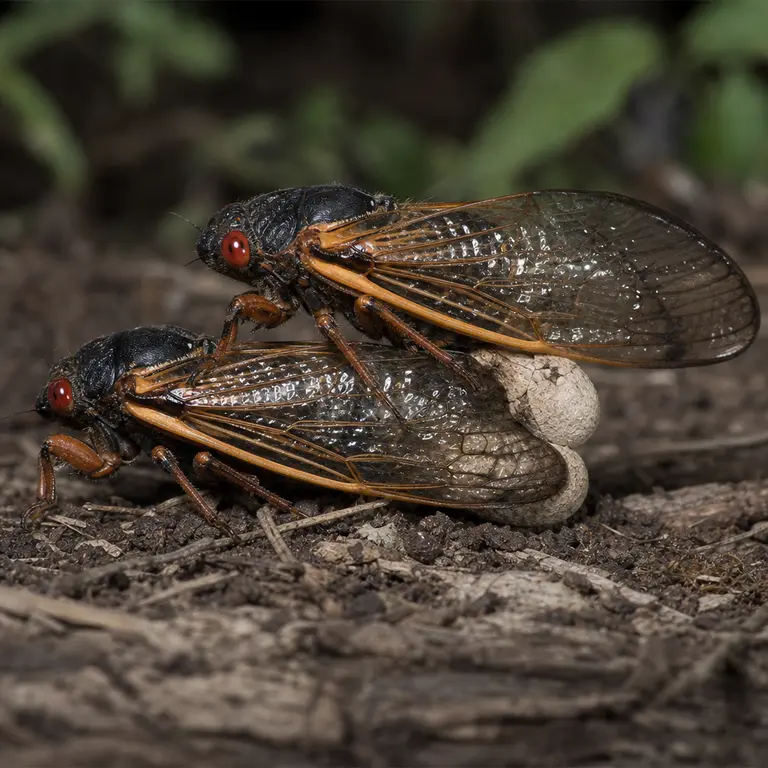
Massospora cicadina, a parasitic fungus, hijacks the bodies and behavior of periodical cicadas, compelling infected insects to spread spores through compulsive mating even as their abdomens are replaced by fungal plugs.
 Watch on YouTube
 Watch on Rumble
Introduction
When periodical cicadas emerge from the soil after 13 or 17 years underground, most people focus on the spectacle of billions of insects flooding forests and suburbs simultaneously. The sheer scale of the event tends to dominate attention — the noise, the shed exoskeletons littering sidewalks, the brief and overwhelming abundance of a creature that spends the overwhelming majority of its life invisible beneath our feet. Far fewer observers notice the ones behaving strangely, dragging themselves across branches, attempting to mate relentlessly, and missing the entire rear portion of their bodies. These are the victims of Massospora cicadina, a fungal pathogen so sophisticated in its manipulation of host behavior that researchers have compared it to a pharmacological engineer.
The story of Massospora is not simply a curiosity from the margins of entomology. It sits at the intersection of mycology, neuroscience, evolutionary biology, and pharmaceutical chemistry, raising questions that challenge foundational assumptions about why certain molecules exist in nature at all. In 2019, a study led by West Virginia University mycologist Matt Kasson and published in Fungal Ecology confirmed that Massospora produces two psychoactive compounds: psilocybin, the same hallucinogen found in so-called magic mushrooms, and cathinone, a stimulant chemically related to amphetamine. Massospora is the only known organism outside the genus Psilocybe and related fungi to produce psilocybin naturally, and the only known fungus to produce cathinone at all. The working hypothesis is that these compounds do not merely coincidentally appear in infected tissue. They actively reprogram cicada neurology to suppress normal responses to catastrophic injury and amplify mating drive, turning a dying insect into an extraordinarily effective vehicle for fungal reproduction.
How the Infection Unfolds
The life cycle of Massospora is tightly synchronized with its host, revealing millions of years of coevolution. Spores deposited in soil during previous cicada emergences lie dormant for up to 17 years, germinating only when the soil temperature and the emergence of the correct cicada brood coincide. This precision is not incidental. The fungus has, over deep evolutionary time, calibrated its dormancy to match the unusual reproductive schedule of periodical cicadas, a schedule that itself evolved in part as a predator-satiation strategy. As juvenile cicadas tunnel upward through the soil, they ingest or come into contact with resting spores. The fungus then quietly colonizes the insect’s body during the weeks before full emergence, spreading through internal tissues without triggering the kind of visible external symptoms that might alert the host or reduce its survival long enough to reach the surface.
By the time an infected cicada is active above ground, the fungus has consumed the abdomen and replaced it with a dense mass of spores called a plug. Despite losing roughly a third of its body mass to fungal tissue, the cicada continues to fly, sing, and attempt to copulate. This persistence in the face of what should be a lethal wound is one of the most striking features of the infection and the point at which the chemical manipulation becomes most relevant. A cicada with a missing abdomen has no biological reason, under normal neurological conditions, to continue engaging in energy-intensive social behavior. The psychoactive compounds produced by Massospora appear to suppress the signaling pathways that would ordinarily register this damage and induce behavioral shutdown.
Male cicadas infected with Massospora have been observed mimicking the wing-flick signals of females, a behavior that attracts other males and dramatically increases the number of insects that come into contact with the spore plug. When the plug ruptures during these interactions, spores transfer to new hosts. The infected cicada, in effect, becomes a mobile spore-dispersal device optimized for social contact, and the fungus has engineered that optimization at the neurochemical level.
The Broader Science of Behavioral Manipulation
Massospora belongs to a broader category of organisms that scientists call behavior-manipulating parasites, a group that has attracted serious scientific attention precisely because the mechanisms involved are so difficult to explain through conventional models of infection. The most famous example is Ophiocordyceps unilateralis, the so-called zombie-ant fungus, which compels carpenter ants to climb vegetation, clamp their mandibles onto leaf veins at a precise height above the forest floor, and then kill them and emerge from their heads. The positioning is not random. It places the fungal fruiting body at an optimal height for spore dispersal onto the foraging trails below. The ant’s final act is choreographed by the pathogen for maximum transmission efficiency.
But Massospora differs from Ophiocordyceps in a critical way: it does not kill its host immediately. Instead, it keeps the cicada alive and behaviorally active for days or weeks, maximizing the window for spore dispersal across a population that is itself only present above ground for a matter of weeks. This distinction places Massospora in an even more unsettling category. The cicada is not merely a vehicle for a parasite that has taken over a corpse. It is a living organism whose nervous system has been chemically redirected while the organism remains, in some functional sense, operational.
Research published in PLOS Pathogens in 2020 expanded on the chemical findings and noted that the presence of psychoactive compounds in a fungus that infects insects rather than mammals challenges assumptions about why these molecules evolved in the first place. The conventional explanation for psilocybin production in Psilocybe mushrooms is that it functions as a chemical deterrent against insect grazing, with the hallucinogenic effect being an incidental disorientation or aversion to invertebrate nervous systems. If that explanation holds, then the presence of psilocybin in Massospora represents something categorically different. Here, the compound is not repelling insects but controlling them, suggesting an independent evolutionary origin with an entirely different ecological function. This kind of convergent biochemical evolution, where the same molecule arises in distantly related lineages to serve opposite purposes, is rare enough to be genuinely surprising even to specialists in fungal chemistry.
What This Means for Emerging Research
The 2024 simultaneous emergence of Brood XIII and Brood XIX cicadas across the central and eastern United States brought renewed and unusually broad scientific attention to Massospora. The dual emergence, which last occurred in 1803, created overlapping population zones in parts of Illinois where two genetically distinct broods with different prime-number cycles occupied the same physical space for the first time in over two centuries. Citizen science platforms and university field teams collected infected specimens across these zones, raising questions about whether the fungus could transfer between the two broods and potentially alter the genetic or chemical profile of future infections. If Massospora strains adapted to a 13-year cycle can successfully infect and reproduce within a 17-year brood, the implications for fungal evolution and host specificity are considerable.
Beyond cicada biology, the discovery of novel biosynthesis of psychoactive compounds in Massospora has opened a small but growing field of inquiry into fungal secondary metabolites and their potential applications in medicine and biotechnology. The independent biosynthesis of psilocybin in a phylogenetically distant fungus strongly suggests that horizontal gene transfer may have played a role in distributing the relevant enzymatic pathways across the fungal kingdom. Horizontal gene transfer, the movement of genetic material between organisms outside of normal parent-to-offspring inheritance, is well documented in bacteria but has historically been considered rare in complex organisms. Its apparent role in spreading psilocybin biosynthesis pathways across distantly related fungal lineages has significant implications for synthetic biology, suggesting that the enzymatic machinery for producing these compounds is more portable and adaptable than previously understood.
This matters practically for the emerging therapeutic psilocybin industry. Clinical research into psilocybin as a treatment for depression, post-traumatic stress disorder, and addiction has accelerated substantially over the past decade, and with it has come growing interest in scalable, efficient biosynthetic production methods that do not rely on cultivating Psilocybe mushrooms directly. Understanding how a fungus as evolutionarily distant from Psilocybe as Massospora independently arrived at the same biosynthetic pathway could inform the design of more efficient microbial production systems, potentially enabling pharmaceutical-grade psilocybin to be manufactured at an industrial scale by engineered organisms.
Conclusion
None of this diminishes the strangeness of the phenomenon at its core. There is something genuinely difficult to process about a fungus that has spent millions of years refining a chemical strategy precise enough to override the survival instincts of a living animal, suppress its response to catastrophic physical damage, and redirect its remaining energy toward behavior that serves the pathogen’s reproductive interests. The cicada does not know it has been reprogrammed. It continues trying to mate in the same forests where its ancestors emerged, carrying a payload it did not choose, enacting a script written entirely by something growing inside it.
Massospora cicadina is a reminder that the boundary between pharmacology and ecology is less stable than it appears, and that some of the most consequential biochemical innovations in nature were not developed in the service of any human interest but in the slow, indifferent competition between organisms that most of us never think to look for. The next time a periodical emergence draws crowds of curious observers to suburban tree lines and forest edges, it may be worth looking past the spectacle to the ones moving strangely at the margins, still trying, chemically compelled, to complete a life cycle that ended some time ago.
Sources & Further Reading
- Kasson, M.T., et al. An Zombie Cicadas and Psychoactive Compounds: Massospora cicadina. Fungal Ecology, 2019. https://doi.org/10.1016/j.funeco.2019.06.002
- Stajich, J.E., et al. Psychoactive Compounds in the Entomopathogenic Fungus Massospora. PLOS Pathogens, 2020. https://doi.org/10.1371/journal.ppat.1008922
- West Virginia University. Zombie Cicadas Hijacked by Sexually Transmitted Fungus. WVU Research News, 2019. https://wvutoday.wvu.edu/stories/2019/06/05/zombie-cicadas-hijacked-by-sexually-transmitted-fungus
- National Geographic. Cicada-Killing Fungus Makes Insects into Sex-Crazed Zombies. National Geographic, 2019. https://www.nationalgeographic.com/animals/article/cicada-killing-fungus-zombie-sex