
Exploring Somatoparaphrenia: When the Brain Rejects the Body
Somatoparaphrenia is a rare neurological disorder in which patients deny ownership of their own body parts, sometimes insisting the limb belongs to a stranger — revealing how the brain constructs the self.
 Watch on YouTube
 Watch on Rumble
When the Brain Disowns the Body
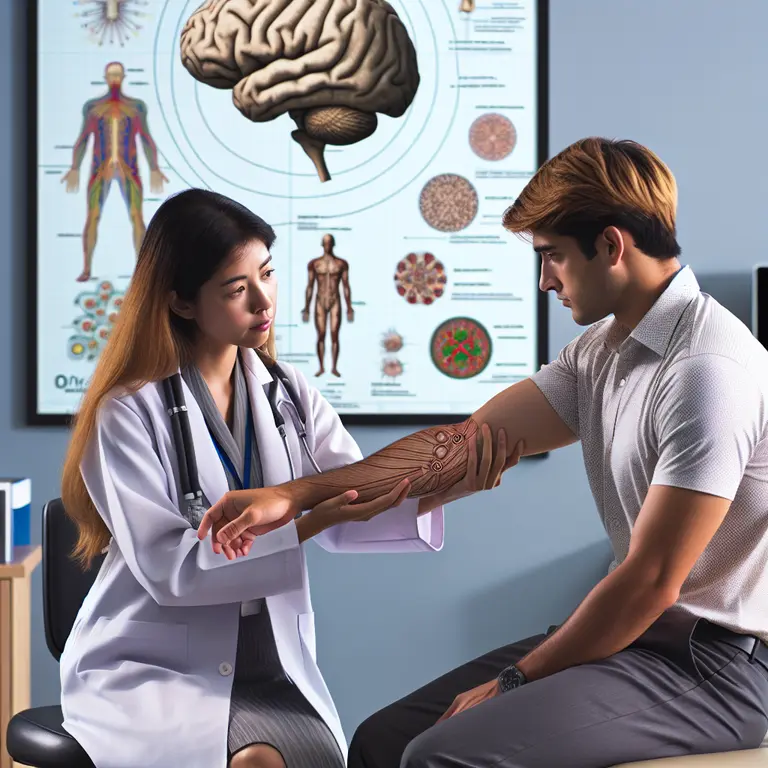
In 1942, neurologist Josef Gerstmann described patients who, following strokes or brain injuries, flatly refused to acknowledge that a paralyzed arm belonged to them. Some insisted the limb was a piece of medical equipment left in the bed. Others named a specific person — a nurse, a spouse, a stranger — as its rightful owner. This condition, now called somatoparaphrenia, sits at one of the most disquieting intersections of neuroscience and philosophy: the question of what makes a body feel like yours.
Somatoparaphrenia is distinct from anosognosia, the more commonly discussed condition in which patients are simply unaware of their paralysis. In somatoparaphrenia, patients are fully aware that the limb exists and that it is paralyzed — they simply deny it has anything to do with them. The delusion is often elaborately defended. When confronted with evidence, such as being shown that the arm is physically attached to their shoulder, patients may become agitated, confabulate explanations, or calmly maintain their position with an almost philosophical certainty. What makes the condition so intellectually unsettling is precisely this: the patients are not globally confused, not hallucinating, and not unintelligent. They are reasoning clearly about an incorrect premise, one installed not by faulty logic but by a disrupted brain process that most of us never notice because it has never failed us.
The Neural Architecture of Body Ownership
The condition almost exclusively follows damage to the right hemisphere of the brain, particularly the right parietal lobe and its surrounding regions. This is not a coincidence. The right parietal cortex is central to constructing what neuroscientists call the body schema — an internal, continuously updated model of the body’s position, boundaries, and ownership in space.
Research published in journals including Brain and Cortex has shown that the right temporoparietal junction, the insula, and portions of the premotor cortex form a network that integrates multisensory signals — touch, vision, proprioception, and motor intention — into a unified sense of bodily self. When this network is disrupted, the brain may fail to claim a limb as part of the self, even when all sensory data points to its physical attachment.
Functional MRI studies of patients with somatoparaphrenia have found abnormal connectivity between the right parietal cortex and the limbic system, suggesting that emotional processing of body ownership may be as critical as sensory integration. In healthy individuals, the body is not just perceived — it is felt as one’s own through a continuous affective signal that researchers have begun calling the sense of mineness. This term, borrowed partly from phenomenological philosophy, captures something that neuroscience is only beginning to formalize: the idea that ownership is not a cold cognitive judgment but something closer to an ongoing emotional claim. The brain does not merely register that an arm is present and functional. It continuously asserts that the arm is mine, and this assertion is underwritten by circuits that connect perception to affect, sensation to identity.
The lateralization of the disorder to the right hemisphere also connects to a broader pattern in how the brain divides its labor. The right hemisphere is disproportionately involved in holistic, integrative processing — the kind that binds disparate sensory streams into a coherent whole. Left-hemisphere strokes of comparable size rarely cause somatoparaphrenia. This asymmetry suggests that the left hemisphere either does not perform this particular integration or does so in a way that is more easily compensated. Some researchers have proposed that the right hemisphere maintains a bilateral body map — representing both sides of the body — while the left hemisphere represents only the right side, which would explain why right-hemisphere damage can produce ownership failures for the left limb without a mirror-image condition appearing in left-hemisphere patients.
The Rubber Hand Illusion and Its Disturbing Implications
The rubber hand illusion, first demonstrated experimentally by Matthew Botvinick and Jonathan Cohen in 1998, offers a controlled window into how fragile body ownership actually is. In the classic setup, a participant’s real hand is hidden while a rubber hand is placed in view. When both the rubber hand and the hidden real hand are stroked synchronously, most participants within minutes begin to feel that the rubber hand is their own, and show measurable skin conductance responses when the fake hand is threatened.
This illusion works because the brain prioritizes the coherent integration of visual and tactile signals over prior knowledge. It reveals that ownership is not a fixed property of the body but an inference the brain makes moment to moment. Somatoparaphrenia can be understood as this inference mechanism failing catastrophically and permanently on one side of the body.
More recently, researchers have extended the rubber hand paradigm to full-body illusions using virtual reality, inducing temporary out-of-body experiences in healthy participants by manipulating the synchrony of visual and tactile feedback. These experiments, conducted in part by Henrik Ehrsson’s laboratory at the Karolinska Institute, have demonstrated that the sense of inhabiting a body at a particular location in space is equally constructed and equally vulnerable to disruption.
What these experiments collectively reveal is that the brain is not a passive receiver of bodily information but an active modeler, constantly generating predictions about what sensory input should look and feel like and updating its ownership claims accordingly. The technical term for this framework, predictive processing, has become one of the more influential ideas in contemporary cognitive neuroscience. Under this view, somatoparaphrenia is not a hallucination or a delusion in the traditional psychiatric sense. It is a prediction that has become locked in place, unable to update in response to contradictory evidence, because the very machinery responsible for generating and revising that prediction has been damaged. The patient who insists their paralyzed arm belongs to a nurse is not fabricating a story. They are reporting, with complete sincerity, what their brain’s model of the world is telling them.
The skin-conductance findings from rubber-hand experiments deserve particular attention. When the fake hand is struck with a hammer or threatened with a needle, participants who have incorporated it into their body schema show a stress response — a measurable, involuntary physiological reaction to a threat against something that is not, by any objective measure, part of their body. This is not a conscious choice. It demonstrates that the brain’s ownership signal, once established, recruits the entire defensive architecture of the organism. The self, in this sense, is not just a philosophical concept. It is a target that the nervous system has learned to protect.
Treatment, Recovery, and What the Disorder Reveals About Identity
There is no established pharmacological treatment for somatoparaphrenia. In some patients, the delusion resolves partially as the underlying stroke or lesion stabilizes and the surrounding neural tissue compensates. In others, it persists for years. A small number of case studies have documented temporary remission following caloric vestibular stimulation — a procedure in which cold or warm water is irrigated into the ear canal to activate the vestibular system — suggesting that artificially altering multisensory input can briefly restore normal body ownership processing.
The fact that vestibular stimulation can produce even temporary relief is itself theoretically significant. The vestibular system, which governs balance and spatial orientation, contributes to the brain’s model of the body's position in space and its orientation relative to the environment. Its involvement in body ownership was not initially obvious, but the clinical evidence points toward a system in which multiple sensory streams, including ones not traditionally associated with touch or limb awareness, must be properly weighted and integrated for ownership to function correctly. When cold water disrupts normal vestibular signaling, it apparently introduces enough noise into the system to temporarily dislodge the locked prediction and allow a more accurate model to surface. That the effect is temporary rather than curative suggests how deeply entrenched the faulty model becomes once established, and how much of the brain’s architecture may need to be recruited to sustain a normal sense of bodily self.
The philosophical implications of somatoparaphrenia extend well beyond clinical neurology. If the sense of owning one’s body is a neural construction rather than a given, then the self — at least in its most basic physical form — is something the brain actively produces rather than passively registers. Patients with somatoparaphrenia are not confused about the external world. They are confused about the boundary between self and world, which turns out to be one of the most fundamental computations the brain performs. Philosophers from Descartes onward have treated the body as the one thing a person cannot coherently doubt belongs to them. Somatoparaphrenia suggests this intuition; however reasonable it feels from the inside, it is entirely dependent on a specific set of neural processes continuing to function correctly.
For researchers working on prosthetic limbs, brain-computer interfaces, and embodied robotics, the disorder is both a warning and a guide. Building a device that a person genuinely feels is part of their body requires understanding not just motor signals but the full architecture of self-attribution — the quiet, unconscious process by which the brain decides, thousands of times a day, what belongs to it and what does not. Several research groups are now using insights from somatoparaphrenia and the rubber hand illusion to design prosthetics that deliver precisely timed sensory feedback, attempting to trigger the same multisensory integration that produces natural body ownership. The goal is not merely functional replacement but phenomenological incorporation — building a limb the brain will claim as its own.
Somatoparaphrenia, rare and strange as it is, ultimately holds up a mirror to something universal. Every person walking through the world carries a body they feel is unambiguously theirs, and this feeling is so constant and basic that it rarely rises to conscious notice. What the condition reveals is that this certainty is not a fact about the body. It is an achievement of the brain — one that requires continuous, coordinated effort from circuits spanning sensation, emotion, prediction, and memory. When that effort fails, the body does not disappear. It simply becomes, in the most literal neurological sense, someone else’s problem.