
The Corpse Roads: Ancient Paths That Carried the Dead
Before modern roads and motorized transport, communities across Europe maintained secret, sacred routes dedicated solely to carrying the dead to distant burial grounds — routes governed by strange laws, folklore, and spatial logic that still shape landscapes today.
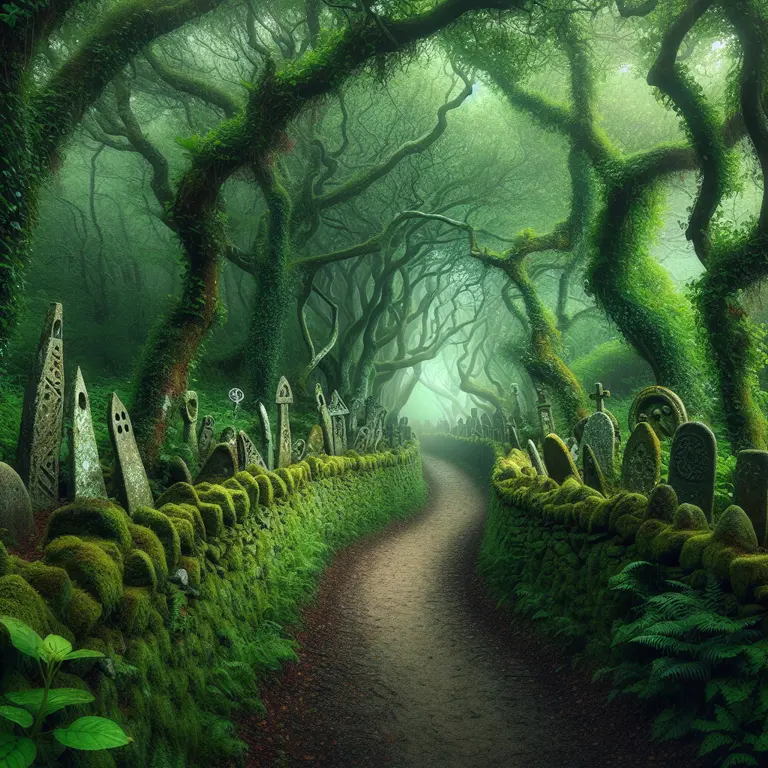
 Watch on YouTube
 Watch on Rumble
The Forgotten Infrastructure of Death
Long before any government agency mapped road networks or urban planners drew transportation corridors, communities across medieval and early modern Europe were quietly engineering a parallel infrastructure — one built not for commerce or conquest, but exclusively for the dead. Known variously as corpse roads, lych ways, bier roads, or coffin lines, these paths connected remote settlements to the parish churches that held legal monopolies over Christian burial. For centuries, they were among the most carefully maintained and socially regulated routes in the rural landscape, and yet today they are almost entirely absent from popular historical consciousness.
The existence of these routes is not metaphorical or mythological. They were practical necessities born from ecclesiastical law. In medieval England, the parish system granted specific churches the exclusive right to bury the dead within their territory. Outlying hamlets, farms, and villages that lacked their own consecrated ground were legally obligated to carry their deceased to the mother church, sometimes across distances of ten or fifteen miles. In the Lake District of northern England, some corpse roads crossed mountain passes that remained treacherous even in summer. Mourners would carry the coffin on their shoulders, stopping at designated resting stones — large flat boulders placed at intervals specifically for this purpose — to set the body down and recover. These stones were not incidental features of the landscape. They were engineered rest stops, placed deliberately and maintained communally, as essential to the journey as the road itself.
What is easy to overlook, from a modern vantage point, is how much physical and emotional labor these journeys demanded. A winter crossing of the Lakeland fells with a coffin on your shoulders, in wind and rain, over ground that offered no shelter and little mercy, was not a solemn ritual performed at a comfortable distance from hardship. It was an act of grueling physical devotion. That communities sustained this practice for centuries, across generations and across the full range of seasonal conditions, speaks to the depth of the obligation they felt — both to the dead and to the ecclesiastical authority that structured their world.
The Laws That Shaped the Landscape
The legal architecture surrounding corpse roads was elaborate and, in some regions, surprisingly specific. In parts of Scandinavia, particularly Norway and Sweden, laws stipulated that a coffin carried along a road automatically transformed that road into a public right of way. This created an unusual legal incentive: landowners who did not wish to lose control of their property would sometimes actively obstruct or redirect funeral processions, while communities seeking to establish access rights would deliberately route their dead through contested land. The body of a deceased neighbor became, in this sense, a legal instrument. Property disputes that had simmered for years could be resolved, or decisively escalated, by the route chosen for a single funeral.
In England, the common law principle was somewhat different but equally consequential. Once a corpse road was established through repeated use, it became a permanent right-of-way that could not be legally extinguished. Some of these routes have survived as public footpaths to the present day, their original purpose entirely forgotten by the walkers who use them. The Lych Way on Dartmoor, stretching roughly eleven miles across open moorland, is still walkable and still marked on Ordnance Survey maps, though the last funeral procession to use it occurred centuries ago. Hikers who traverse it on a clear afternoon, enjoying the views across the moor, are following a corridor of grief worn into the land by the feet of the bereaved.
The routes were also subject to directional customs that varied by region but shared a common logic. In many parts of England and Germany, it was considered essential that the corpse be carried in a straight line whenever terrain allowed, or that the procession never double back on itself. The reasoning was partly theological — the soul was thought to follow the body, and a wandering route might confuse or trap it — and partly practical, since the shortest path across open country was often the most passable. This preference for straight lines occasionally produced the curious phenomenon of corpse roads that ran directly through the middle of fields, over walls, and through the interiors of later-built structures. There are documented cases in England of buildings constructed across established lych ways that were subsequently required, by local custom if not always by law, to maintain a passage through their ground floors so that the route could continue uninterrupted. The dead, in effect, held an easement.
Folklore at the Threshold of Death
The cultural weight carried by these routes generated an extraordinarily rich body of folklore, much of it centered on the anxiety of transition — the fear that the dead might not complete their journey cleanly, and might instead linger at the threshold between the living world and whatever lay beyond it. In northern England and Wales, the concept of the fetch or wraith held that a ghostly double of a person about to die would be seen traveling the corpse road before the actual death occurred. Communities near well-used lych ways reported seeing phantom funeral processions — lights moving in the darkness, the sound of bells, the impression of many feet — sometimes weeks before an actual death in the village. These were not regarded as hallucinations but as reliable omens, and certain individuals were believed to possess the hereditary ability to witness them. To see the phantom procession and recognize your own face among the mourners was considered an unambiguous announcement of your imminent death.
In Wales, this preoccupation with spiritual danger at the moment of death found one of its most striking expressions in the figure of the sin-eater, a social outcast hired to consume food and ale placed on the chest of the corpse, symbolically absorbing the sins of the deceased to ease their passage into heaven. The sin-eater would then be driven away from the community, carrying the spiritual burden of the dead. Though the practice has sometimes been romanticized or exaggerated in popular accounts, there is genuine historical evidence for sin-eating in the Welsh border counties as late as the early nineteenth century, with a man named Richard Munslow of Ratlinghope in Shropshire identified as one of the last known practitioners, who was buried in 1906. His grave was restored by public subscription in 2010, a belated recognition of a role that his own society had treated with a mixture of necessity and contempt.
German-speaking regions developed the concept of the Leichenweg (Totenweg) with distinctive customs. It was widely believed that the dead, if not properly guided along their designated route, would return to haunt the living. Carrying the coffin feet-first — so the deceased could not look back toward the home — was one precaution. Closing all mirrors in a house during mourning, a practice still observed in some communities, originated partly from the belief that a reflected image of the corpse could anchor the soul to the living world rather than releasing it toward the burial ground. These customs were not superstitions in the dismissive sense that word now implies. They were systematic responses to a genuine theological problem: how to ensure that the boundary between the living and the dead remained firm, and that the journey of the dead was completed rather than interrupted.
Persistence in the Modern Landscape
What makes corpse roads genuinely remarkable from a contemporary perspective is their demonstrable influence on modern geography. Landscape historians and archaeologists have identified dozens of cases in England, Ireland, Germany, and Scandinavia where current roads, footpaths, and property boundaries follow the precise alignments of medieval funeral routes. In some instances, the resting stones remain in situ, moss-covered and unlabeled, serving now as informal seating for hikers who have no idea they are resting where generations of mourners once set down their dead. The continuity is not symbolic. The same physical surface, worn by the same repeated human passage, has simply accumulated new purposes over time while quietly retaining the old one underneath.
The field of archaeotopography — the study of how ancient cultural practices shaped physical landscapes — has increasingly turned to corpse roads as a source of data on pre-modern settlement patterns, population distribution, and social organization. Because these routes were established based on where people actually lived and died, they preserve a kind of demographic record that official documents often lack. A corpse road running toward an isolated farmstead confirms habitation at that location even when no written record survives. The routes are, in this sense, a form of unintentional census — a record of who existed, where, and in sufficient numbers to require a formal relationship with the nearest consecrated ground.
Satellite imaging and LiDAR surveys have, in recent years, revealed previously unknown sections of these routes in heavily forested or heavily developed areas. A 2019 survey of the English Peak District identified three previously unrecorded resting stones along a suspected lychway corridor, confirmed by their alignment with known parish boundaries and their distinctive flat-topped morphology. These discoveries suggest that the surviving record of corpse roads is still incomplete, and that further systematic survey work could substantially expand what is known about the extent and density of this forgotten network.
There is something worth sitting with in the broader implications of all this. Modern infrastructure is designed to be legible — roads are labeled, routes are documented, and the purposes of public works are recorded in planning registers and government archives. The infrastructure of death that preceded it was different. It was built through practice rather than decree, maintained through social obligation rather than institutional management, and recorded not in documents but in the landscape itself. That so much of it has survived — in footpaths, in resting stones, in property boundaries, in the alignments of country lanes — is a testament to the persistence of use over time. The dead, it turns out, left marks on the earth that outlasted nearly everything else their communities built: their homes, their fields, and in many cases even their churches. The roads built to carry them remain, still pointing in the same direction, still waiting to be walked.