
Stellar Superflares: When Quiet Stars Turn Violent
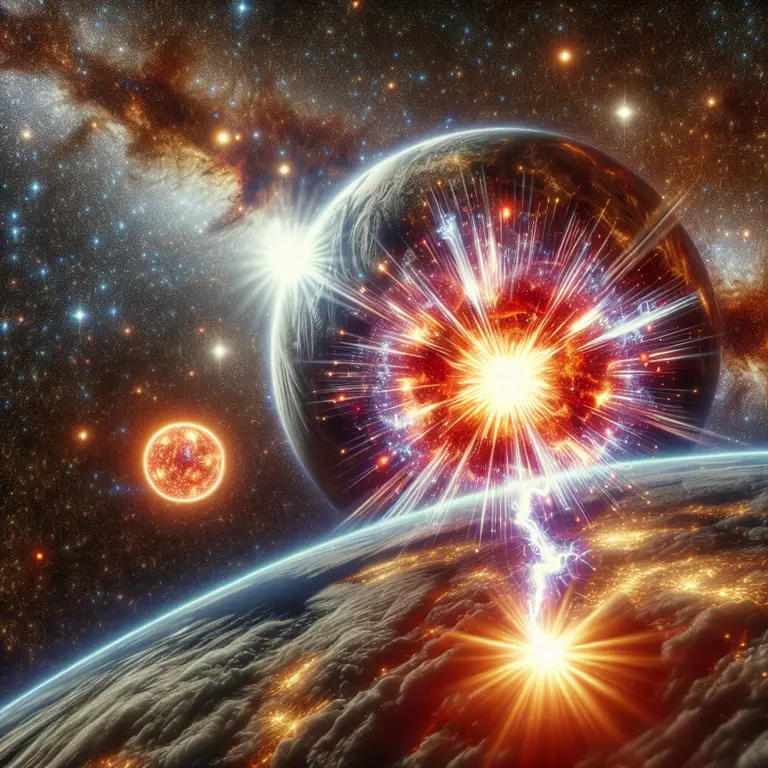
Some of the most stable-looking stars in the galaxy periodically unleash superflares thousands of times more powerful than anything our Sun has ever produced — and Earth-like planets in their orbits may be paying the price.
 Watch on YouTube
 Watch on Rumble
Introduction
In 2012, NASA’s Kepler space telescope recorded something deeply unsettling. A star cataloged as KIC 9655129, a G-type yellow dwarf nearly identical to our own Sun, suddenly released a flare roughly 10,000 times more energetic than the most powerful solar flare in recorded human history. The Carrington Event of 1859, which melted telegraph wires and lit the sky over Cuba with auroras, is considered the benchmark for solar violence. What Kepler witnessed dwarfed it by several orders of magnitude. The star had given no prior warning. It was, by all observable metrics, ordinary.
This was not an isolated incident. Between 2009 and 2013, Kepler observed over 365 superflare events across 148 Sun-like stars. The frequency and intensity of these events shattered a long-held assumption in stellar physics: that mature, slowly rotating, magnetically quiet stars like our Sun were essentially safe, their most dramatic outbursts bounded by well-understood physical limits. The data suggested otherwise, and the implications for planetary habitability, including for Earth itself, have been unsettling researchers ever since. What began as an anomaly in a telescope’s data archive has since grown into one of the more quietly alarming open questions in modern astrophysics, touching on everything from the deep history of our planet to the long-term survivability of technological civilization.
What Makes a Superflare Different
Ordinary solar flares are the product of magnetic reconnection, a process where tangled magnetic field lines in the Sun’s corona snap and realign, releasing stored energy as radiation across the electromagnetic spectrum. The largest solar flare ever directly measured, classified X28 in November 2003, released energy equivalent to roughly one billion hydrogen bombs. It was powerful enough to temporarily blind the sensors designed to measure it. Yet even that extraordinary event falls well within the range of what solar physicists consider normal stellar behavior for a middle-aged, slowly rotating star.
A superflare operates by the same magnetic reconnection mechanism but at a scale that requires a fundamentally different source of stored magnetic energy. For a star to produce a flare 10,000 times more powerful than an X28-class event, it must accumulate magnetic flux on a scale that our Sun, at its current age and rotation rate, appears incapable of generating. One leading hypothesis involves a close-orbiting giant planet, sometimes called a hot Jupiter, whose gravitational interaction with the host star amplifies and distorts the stellar magnetic field, acting as an energy reservoir. The tidal forces exerted by such a massive companion could theoretically sustain magnetic structures far larger and more energetically loaded than anything our solitary Sun could produce on its own.
Another hypothesis suggests that even Sun-like stars occasionally generate enormous starspots, dark and magnetically intense regions far larger than anything recorded on our Sun, that serve as the trigger sites for catastrophic reconnection events. Sunspots on our star typically span a few tens of thousands of kilometers. The starspots hypothesized to underlie superflares on Sun-like stars would need to be orders of magnitude larger, covering a significant fraction of the stellar surface. Whether our Sun retains the capacity to generate such structures, given its age and the gradual weakening of its magnetic activity over billions of years, remains an open and deeply consequential question.
Research published in The Astrophysical Journal in 2019 by Yuta Notsu and colleagues at the University of Colorado Boulder confirmed that older, slower-rotating Sun-like stars do produce superflares, though less frequently than their younger counterparts. The estimated recurrence rate for a superflare on a star like our Sun was calculated at roughly once every few thousand years, a timeframe that is geologically brief and historically plausible. On the scale of a human lifetime, it sounds remote. On the scale of civilization, it sounds uncomfortably close.
The Geological Fingerprint of Ancient Superflares
Here, the story becomes genuinely eerie. If the Sun produced a superflare within the last 10,000 years, it might have left a detectable mark in Earth’s geological record. Researchers examining ice cores from Greenland and Antarctica have identified sharp spikes in radioactive isotopes, specifically carbon-14 and beryllium-10, at several points in the past. These isotopes are produced when high-energy cosmic radiation or energetic solar particles strike atmospheric nitrogen and oxygen molecules. A sudden global surge in their concentration indicates an extraordinary burst of radiation striking the planet, one powerful enough to leave a chemical signature preserved in ice and wood across multiple continents simultaneously.
The most famous of these anomalies is known as the Miyake Event of 774 to 775 CE, named after the Japanese researcher Fusa Miyake, who identified it in 2012. Within a single year, carbon-14 concentrations in tree rings worldwide jumped by approximately 1.2 percent, a spike roughly 20 times larger than typical solar cycle variations. A second comparable event was identified at 993 to 994 CE, and subsequent research has tentatively identified additional candidates reaching back further into prehistory. The cause of the 774-775 spike remains debated among specialists. A gamma-ray burst from a distant source, a nearby supernova, and a massive solar proton event have all been proposed. But a superflare remains among the most credible explanations, and a 2019 study in the Proceedings of the National Academy of Sciences estimated the energy of the 774 to 775 event at roughly 100 times that of any modern observed solar flare.
What makes the Miyake Event particularly striking is its apparent lack of any corresponding historical record. The year 774 CE falls within the early medieval period, an era with sufficient written documentation across Europe, the Islamic world, and East Asia that an event dramatic enough to produce visible auroras at low latitudes or widespread crop failures from radiation damage might plausibly have been recorded. The silence in the historical sources is itself a puzzle. Either the event was more localized in its atmospheric effects than the isotope data implies, or it occurred in a way that was visually unremarkable despite its chemical footprint. Neither explanation is entirely satisfying.
If such an event occurred today, the consequences would cascade across interconnected systems in ways that dwarf the 1989 Quebec blackout caused by a comparatively modest geomagnetic storm. That event, triggered by a solar disturbance far smaller than a superflare, left six million people without power for nine hours and caused permanent damage to high-voltage transformers that took months to replace. Satellite communications, GPS infrastructure, power grids at high latitudes, and the global financial systems that depend on synchronized timing signals would all be at severe risk from a true superflare. The modern world has constructed an extraordinarily complex technological nervous system with essentially no shielding against the kind of electromagnetic assault that the geological record suggests our star may be capable of delivering.
Superflares and the Habitability Equation
The discovery of superflares has introduced a troubling variable into the search for habitable exoplanets. M-dwarf stars, small and cool red stars that make up roughly 70 percent of all stars in the Milky Way, are among the most common targets in the search for Earth-like worlds. They are also among the most prolific producers of superflares. Because habitable zones around M-dwarfs are much closer to the star than Earth’s orbit around the Sun, any planet in that zone is exposed to flare radiation at intensities that could strip away atmospheric ozone layers, bombard surface life with ultraviolet radiation, and gradually erode the atmosphere entirely through a process called atmospheric sputtering. A planet that might otherwise appear to sit comfortably within the liquid water zone of its star could be rendered sterile at the surface by the sheer regularity of stellar outbursts.
Data from the Transiting Exoplanet Survey Satellite released between 2020 and 2024 has only deepened this concern. Observations of nearby M-dwarfs like Proxima Centauri, host to the much-celebrated Proxima b, a roughly Earth-mass planet in the habitable zone, have recorded superflares occurring multiple times per year. A 2021 study using the Hubble Space Telescope found that Proxima Centauri produces ultraviolet flares so intense and frequent that any unshielded surface on Proxima b would receive radiation doses hostile to most known life forms, regardless of the planet’s distance from the star. The romantic notion that Proxima b might host oceans and continents bathed in the dim red light of its parent star has become considerably harder to defend in light of this data.
This does not rule out life in subsurface oceans or underground environments, and some researchers have proposed that repeated exposure to flares could paradoxically accelerate certain chemical reactions relevant to the origin of life. The ultraviolet radiation delivered by intense flares can drive the synthesis of hydrogen cyanide and other precursor molecules implicated in the formation of RNA nucleotides, the building blocks of the earliest self-replicating chemistry. It is possible, in other words, that superflares are not only destructive but also, under the right conditions, generative. The same energy that sterilizes a surface might catalyze the chemistry that eventually produces life in a nearby sheltered niche. This is a minority position in astrobiology, but it is not a frivolous one. It substantially complicates the picture of M-dwarf systems as either the galaxy’s most promising or most hopeless reservoirs of habitable worlds.
Preparing for the Inevitable
The practical urgency of superflare research has begun to filter into policy discussions at space agencies. The European Space Agency’s Vigil mission, currently scheduled for launch in the late 2020s, will position a spacecraft at the L5 Lagrange point to provide earlier warning of solar activity approaching Earth. NASA’s Parker Solar Probe, now making record-close passes of the Sun, is gathering data on the magnetic structures that precede large flare events. These missions were designed primarily for ordinary solar weather, but their data will also inform models of the conditions that might precede a superflare. The scientific infrastructure being built to monitor routine solar behavior is, almost incidentally, beginning to address a hazard several orders of magnitude more severe.
What remains absent, however, is any serious engineering response to the superflare scenario at the level of critical infrastructure. The transformers that form the backbone of high-latitude power grids are largely unshielded against extreme geomagnetic disturbance. Replacing a damaged extra-high-voltage transformer typically takes between 1 and 3 years because they are custom-built and manufactured in limited quantities worldwide. A superflare capable of simultaneously damaging dozens of such transformers across North America and Europe would trigger cascading failures across interconnected systems, including water treatment, hospital backup power, fuel distribution, and supply chains, on a timescale measured in weeks rather than hours.
The honest scientific consensus is that we do not yet know whether our Sun is capable of producing a superflare in its current state, or what the precise recurrence interval might be if it is. What the Kepler data and the ice core record together suggest is that the question warrants more than a theoretical treatment. Stars nearly identical to ours have done it. The geological record hints that ours may have done it within historical memory. The infrastructure of modern civilization, from satellite navigation to global finance to power distribution, has been built with no meaningful protection against such an event.
Conclusion
There is something philosophically unsettling about the particular nature of this risk. Unlike asteroid impacts or volcanic super-eruptions, a superflare would arrive from the object we depend on most completely, the star that drives our climate, powers our biosphere, and has been burning steadily for 4.6 billion years with a reliability so total that it has become invisible to us. We have built our entire technological civilization in the shadow of a star we have never fully understood, during a period of relative solar calm that may or may not be representative of what the Sun is capable of. The gap between what we know and what we have prepared for is, for the moment, one of the quieter risks embedded in the physics of the star we orbit. Whether it remains quiet is, ultimately, not a question we get to answer.