
Stellar Cannibalism: When Stars Devour Their Companions
How binary star systems engage in mass transfer, theft, and outright destruction — and what these cosmic feeding events reveal about supernovae, novae, and the fate of our own sun.
 Watch on YouTube
 Watch on Rumble
The Universe’s Most Violent Dining Habit
Most stars in the Milky Way do not live alone. Roughly half of all sun-like stars exist in binary or multiple systems, bound gravitationally to one or more companions. For billions of years, many of these pairs orbit each other peacefully, tracing slow ellipses through the dark with no more drama than two ice skaters circling a common center. But when one star begins to age and swell into a red giant, the gravitational balance shifts in ways that can be catastrophic — and extraordinarily illuminating for astronomers trying to understand some of the most energetic events in the cosmos.
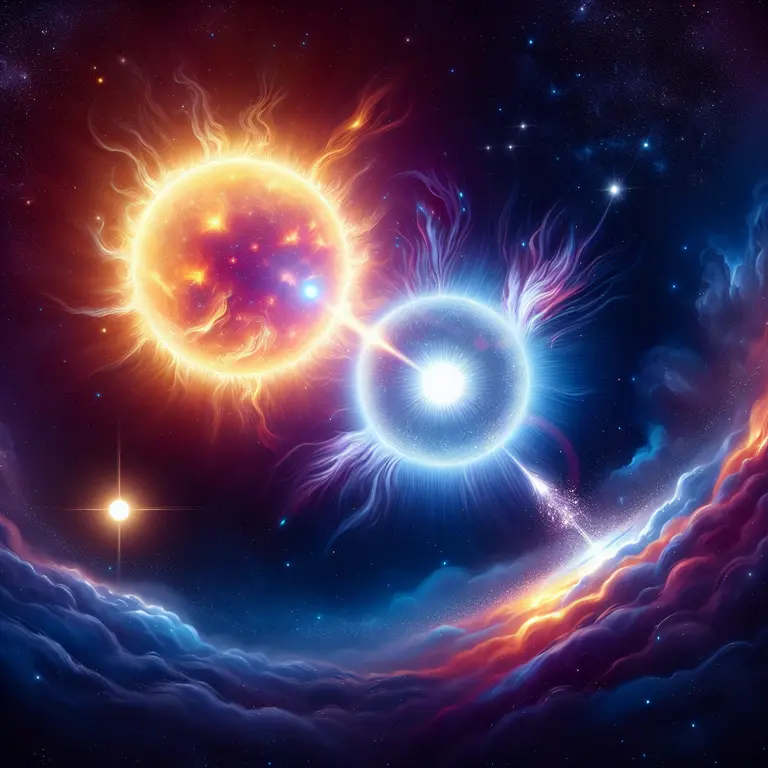
The process is known as stellar mass transfer, though in its most extreme forms, astrophysicists have taken to calling it stellar cannibalism. When a red giant expands beyond its Roche lobe — the teardrop-shaped region of space within which its own gravity dominates — material begins to spill across the gravitational boundary toward its companion. What follows can range from a slow, steady siphoning of gas to a runaway cascade that ends in one star consuming the other entirely. The range of outcomes is staggering: a quiet dimming, a repeating explosion visible to the naked eye, or a detonation bright enough to briefly rival an entire galaxy. All of it begins with one aging star simply growing too large to keep its own atmosphere to itself.
The Roche Lobe and the Architecture of Theft
The concept of the Roche lobe was formalized in the 19th century by French astronomer Edouard Roche, who calculated the precise geometries governing gravitational dominance in two-body systems. His work was theoretical in origin, developed to understand how planetary satellites could be torn apart by tidal forces, but it found its most spectacular application in binary star physics. The inner Lagrange point, labeled L1, sits at the saddle between the two gravitational fields of a binary pair — a precise location where the pulls of both stars cancel each other out. Once a star’s outer envelope crosses this threshold, gas flows through L1 and forms an accretion disk around the companion — a swirling, superheated ring of stolen material that radiates intensely across the X-ray spectrum.
This is not merely a theoretical construct. The binary system Algol, known since antiquity as the Demon Star for its regular dimming, was one of the first systems in which astronomers identified evidence of past mass transfer. The dimming that gave Algol its ominous reputation is caused by a partial eclipse as the dimmer companion passes in front of the brighter primary, a geometry that ancient observers could not have explained but found unsettling enough to name. Paradoxically, the more massive star in the Algol system is actually the younger-looking of the two — a phenomenon called the Algol paradox. The explanation is that the originally more massive star evolved faster, became a red giant, and transferred so much of its mass to its companion that it is now the lighter, dimmer partner. The companion effectively ate its way to dominance.
What makes this paradox so instructive is that it forced astronomers to reckon with mass transfer as a real, large-scale phenomenon rather than a theoretical curiosity. Before the Algol paradox was properly explained in the mid-20th century, stellar evolution models assumed that the most massive star in any binary would always remain the most massive. Algol demonstrated that this assumption was incorrect, thereby opening an entirely new chapter in the study of how stars age and interact. The geometry of gravitational theft, it turned out, could rewrite the biography of an entire star system.
Nova, Supernova, and the Chandrasekhar Limit
When the companion receiving stolen mass is a white dwarf — the dense, Earth-sized remnant of a dead star — the consequences become even more dramatic. White dwarfs are composed primarily of carbon and oxygen, compressed to extraordinary densities by electron degeneracy pressure, a quantum mechanical effect that prevents electrons from occupying the same energy state and thereby resists further collapse. As hydrogen-rich gas accretes onto the white dwarf’s surface, it compresses and heats until it reaches thermonuclear ignition temperatures of around 10 million Kelvin. The result is a classical nova: a sudden, brilliant brightening visible across thousands of light-years, caused not by the destruction of the white dwarf but by an explosive surface detonation. Crucially, the white dwarf survives intact, and the cycle can repeat, sometimes on timescales of decades, as the companion star continues to supply fresh material.
The recurrent nova RS Ophiuchi, for example, has been observed erupting in 1898, 1933, 1958, 1985, and 2006, each event briefly making it visible to the naked eye before fading back into obscurity. Each eruption is essentially the same mechanism replaying: enough hydrogen accumulates, the pressure and temperature at the base of the accreted layer reach critical values, and the surface ignites. The white dwarf beneath is unchanged, waiting for the next delivery.
If accretion continues long enough, however, the white dwarf’s total mass may approach the Chandrasekhar limit of approximately 1.4 solar masses — the maximum mass a white dwarf can sustain before electron degeneracy pressure fails. This limit was calculated by Indian astrophysicist Subrahmanyan Chandrasekhar in 1930, a result so radical that his senior colleague Arthur Eddington publicly dismissed it as absurd. Chandrasekhar was eventually vindicated, and the limit that bears his name now sits at the center of one of the most important tools in modern cosmology. At this threshold, the entire star ignites in a runaway thermonuclear explosion: a Type Ia supernova. These events release energy equivalent to roughly 1 to 2 times 10^44 joules, briefly outshining entire galaxies.
Because Type Ia supernovae occur at a consistent mass threshold, they produce nearly uniform peak luminosities, making them invaluable as standard candles for measuring cosmic distances. Astronomers can observe one of these explosions in a distant galaxy, compare its apparent brightness to its known intrinsic brightness, and calculate its distance with remarkable precision. It was precisely this tool that led to the 1998 discovery that the universe’s expansion is accelerating — a finding so unexpected that it required the reintroduction of Einstein’s cosmological constant and the coining of the term dark energy to explain it. That discovery earned the 2011 Nobel Prize in Physics, and its foundation rested entirely on the predictable violence of a white dwarf being fed past its limits by a cannibalistic binary relationship.
Symbiotic Stars and the Slow Burn of Cosmic Intimacy
Not all stellar cannibalism is explosive. Symbiotic stars represent a quieter but equally strange class of binary interaction, one that rewards patient observation with some of the most physically complex behavior in the known universe. In these systems, a red giant and a white dwarf orbit each other at relatively large separations, sometimes spanning hundreds of times the Earth-Sun distance. The white dwarf accretes material not through Roche lobe overflow but through the stellar wind — the constant outflow of gas that all giant stars exhale into space across their lifetimes. The white dwarf sits within this wind and captures a fraction of it gravitationally, feeding without ever making direct contact with its companion.
The resulting systems glow in an unusual combination of spectral signatures: the cool, red emission of the giant and the hot, ultraviolet radiation of the accreting white dwarf, sometimes accompanied by nebular emission lines from ionized gas surrounding the system. The name symbiotic is something of a misnomer, borrowed from biology to describe the apparent coexistence of two very different stellar environments in a single system — though unlike biological symbiosis, the relationship is not mutually beneficial. The giant is slowly being drained.
Systems like R Aquarii and CH Cygni have been observed producing collimated jets of material — narrow, high-velocity streams of plasma ejected perpendicular to the accretion disk — a phenomenon more commonly associated with black holes and neutron stars. The jets in R Aquarii have been imaged directly by the Hubble Space Telescope, revealing intricate knotted structures extending across light-years, the fossilized record of repeated ejection events over centuries. That a white dwarf, the humblest of stellar remnants, can produce jets of this kind was not anticipated and remains only partially understood. The mechanisms driving these jets in white dwarf systems remain an active area of research, with competing models involving magnetic fields, disk instabilities, and the geometry of the accretion flow. What is clear is that the boundary between the physics of white dwarfs and the physics of far more exotic objects is less firm than once believed.
What Stellar Cannibalism Teaches Us About the Future
Beyond their intrinsic drama, cannibalistic binary systems serve as laboratories for physics that cannot be replicated on Earth. The extreme densities, temperatures, and magnetic field strengths involved push matter into regimes where quantum mechanics and general relativity both matter simultaneously, and where the behavior of plasma, radiation, and gravity becomes deeply entangled. Observations from X-ray observatories such as NASA’s Chandra and ESA’s XMM-Newton have catalogued hundreds of interacting binaries, revealing a menagerie of behaviors including quasi-periodic oscillations in the brightness of accreting systems, thermonuclear bursts on neutron star surfaces caused by the same runaway ignition process that drives classical novae, and magnetic propeller effects that halt accretion entirely when a compact object’s magnetic field spins fast enough to fling incoming material away rather than capture it.
Each of these phenomena tests physical models in ways that controlled experiments never could. The universe, in its violence, becomes a particle accelerator and a pressure vessel beyond anything human engineering can approach.
For our own solar system, the long-term picture carries a distant but real relevance. In approximately five billion years, the sun will exhaust its hydrogen fuel and expand into a red giant, swelling to a radius that may reach or exceed Earth’s current orbital distance. While the sun has no stellar companion to cannibalize, its expansion will subject the inner planets to extreme conditions: intense radiation, powerful stellar winds, and tidal forces that will reshape or destroy whatever remains of the planetary system as it exists today. The study of red giant mass transfer in binary systems provides the most detailed physical models available for understanding how planetary systems respond to the death throes of their host stars.
In a sense, every interacting binary that astronomers observe is a preview of a process that is universal to stellar evolution. Stars age, swell, and lose their boundaries. In isolation, that process ends quietly. In a company, it can light up the cosmos. The universe’s most violent dining habit is also, ultimately, one of its most instructive — a reminder that even the slow, patient business of stellar aging contains within it the seeds of some of the most energetic events that physics permits.