
The Quiet War Happening Inside Your Drinking Water
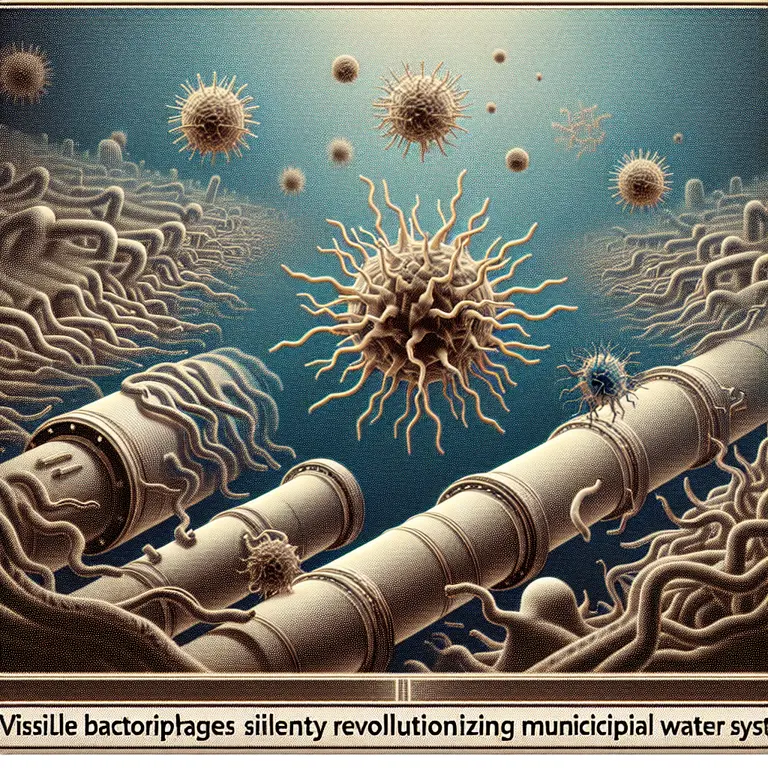
Bacteriophages — viruses that hunt and kill bacteria — are staging a silent revolution inside municipal water systems, and scientists are only beginning to understand the ecological and public health implications of this invisible arms race.
 Watch on YouTube
 Watch on Rumble
The Ocean Inside Your Tap
Every liter of treated municipal water that flows from your kitchen faucet contains between 10,000 and 10 million viral particles. The overwhelming majority of these are bacteriophages, viruses so ancient and numerous that they predate multicellular life itself. They do not infect humans. They infect bacteria. And right now, inside the pipes beneath your city, they are waging a continuous, relentless, and largely invisible war that shapes the microbial ecology of the water you drink every day. This is not a contamination story. It is an ecological story, spanning from the earliest chapters of life on Earth to the cutting edge of medical research.
Bacteriophages, often shortened to phages, were independently discovered in 1915 by Frederick Twort and in 1917 by Felix d’Herelle, a French-Canadian microbiologist who initially believed they could be weaponized against bacterial disease in humans. He was not wrong about their lethality toward bacteria, but the complexity of deploying them medically shelved the idea for nearly a century. What nobody anticipated was that these same organisms would become central players in the infrastructure of modern civilization, quietly embedded in every water treatment system on Earth. Understanding how they got there, what they are doing, and why it matters requires stepping back from the familiar story of water purification and looking at what treatment systems actually produce rather than simply what they remove.
How Chlorination Changed the Game
The introduction of chlorine disinfection to municipal water systems in the early twentieth century is widely credited with eliminating cholera and typhoid from developed nations. Jersey City, New Jersey, became the first American city to continuously chlorinate its water supply in 1910, and within two decades, waterborne disease mortality in the United States had plummeted by more than seventy percent. The public health achievement was genuine and enormous. What the engineers of that era did not anticipate, however, was that chlorination would not sterilize water. It would select it.
Chlorine kills the most vulnerable bacteria rapidly, but resistant strains and spore-forming organisms survive at low levels. Phages, being far simpler in structure than bacteria, are largely unaffected by standard chlorination at typical municipal concentrations. They lack the complex cellular machinery that chlorine disrupts, and their protein coats are chemically robust enough to withstand the doses used in routine treatment. The result is a treated-water environment where phages outnumber their bacterial hosts by roughly 10 to 1. This is actually higher than the ratio observed in untreated surface water, indicating that the treatment process has inadvertently created conditions that favor viral predation on bacteria. The water is cleaner in terms of pathogenic bacteria, but it is teeming with phage activity in ways that were never planned and are still being mapped by researchers who only recently developed the genomic tools to see it clearly.
A 2021 study published in the journal Water Research found that drinking water distribution systems harbor distinct and surprisingly stable phage communities, with specific phage populations tied to the local bacterial ecology of each city. Chicago’s water phage profile looks measurably different from London’s, which differs again from Singapore’s. These communities are not random contamination. They are structured ecosystems with internal logic, shaped by the local source water, the treatment chemistry, the age of the pipe infrastructure, and the seasonal fluctuations in temperature and flow. The pipes beneath a city are not inert conduits. They are habitats, and the organisms living in them are following ecological rules as consistent as those governing any forest or reef.
The Resistome Problem and Phage Surveillance
One of the most pressing concerns in contemporary public health is the spread of antibiotic resistance genes through water systems. Bacteria can share genetic material through a process called horizontal gene transfer, and water distribution networks are now recognized as significant highways for this exchange. Resistance genes that originate in agricultural runoff, hospital wastewater, or pharmaceutical manufacturing discharge can enter municipal systems and spread through bacterial populations that never had direct contact with antibiotics. Phages complicate this picture enormously, and in ways that cut in both directions simultaneously.
Some phages engage in a process called transduction, in which they accidentally carry fragments of bacterial DNA from one host to another during the infection cycle. If a phage picks up a resistance gene from one bacterial strain and injects it into another during its next infection, it can inadvertently accelerate the spread of antibiotic resistance through a water system without requiring direct bacterial contact. Researchers at the Swiss Federal Institute of Aquatic Science and Technology identified this mechanism in treated drinking water as recently as 2022, finding that phage-mediated transduction occurred at measurable rates even in water that met all regulatory safety standards. The water was legally safe to drink. The genetic exchange was happening anyway.
However, the same phage surveillance tools developed to study this risk are now being proposed as a monitoring system for pathogen detection, and this is where the story becomes genuinely useful rather than merely alarming. Because certain phages are extraordinarily host-specific, their presence in water can serve as a sensitive indicator of their bacterial targets, even before those bacteria reach detectable concentrations. Phages that exclusively infect Salmonella, for instance, can be detected at concentrations that would allow health authorities to identify contamination events days before conventional bacterial culture methods would flag a problem. The phage, in effect, acts as a biological early warning system, amplifying the signal of a threat that has not yet grown large enough to be seen by other means.
The European Union’s revised Drinking Water Directive, which came into force in 2023, has begun incorporating phage-based indicator organisms into its monitoring framework for the first time, a regulatory acknowledgment that these organisms are not noise in the system but meaningful data. The shift represents a fundamental change in how water safety is conceptualized, moving from a model based purely on chemical treatment and bacterial absence toward one that reads the biological community of the water itself as a source of information.
Phage Therapy’s Unexpected Water Connection
The global antibiotic resistance crisis has renewed serious scientific interest in phage therapy, the practice of using targeted bacteriophages to treat bacterial infections in humans. Georgia, the former Soviet republic, never abandoned phage therapy after the West pivoted to antibiotics in the 1940s, and the Eliava Institute in Tbilisi has maintained an active phage therapy program for over eighty years, treating patients with phage cocktails tailored to the specific bacterial strains causing their infections. Western medicine is now racing to catch up, with clinical trials underway in the United States, Belgium, and the United Kingdom for conditions ranging from drug-resistant urinary tract infections to prosthetic joint infections caused by Staphylococcus aureus.
What connects this medical frontier to water infrastructure is the sourcing question, one of the more counterintuitive connections in contemporary biology. Many of the most therapeutically promising phages are being isolated not from clinical environments but from sewage and treated water systems, precisely because these are the environments where phages have been under the most intense evolutionary pressure to become efficient bacterial killers. A phage that has spent generations competing against resistant bacterial populations in a chlorinated distribution system is, in a meaningful sense, a more refined weapon than one isolated from a less pressured environment.
Researchers at UC San Diego’s Center for Innovative Phage Applications and Therapeutics have described municipal wastewater as one of the richest known repositories of therapeutically viable phage diversity on the planet. The infrastructure built to remove biological contamination from water turns out to be one of the best libraries of biological weapons against the bacteria that pose the greatest threat to human life. There is something almost paradoxical about this: the systems designed to produce clean water are also producing the raw material for a new generation of medicine, and the two functions are inseparable because they arise from the same ecological pressure.
What Comes Next
Several research groups are now working toward what might be called engineered phage ecology in water systems, the deliberate introduction of specific phage populations into distribution networks to suppress particular bacterial threats without the chemical side effects of additional disinfectants. The concept is not unlike probiotic logic applied to infrastructure. Rather than simply killing everything indiscriminately with escalating doses of biocides, the goal would be to cultivate a phage community that maintains microbial balance, suppresses pathogens, and reduces the selective pressure that drives antibiotic resistance. The water system would be managed not as a chemical environment but as a living one.
This approach faces significant regulatory and public perception hurdles that should not be underestimated. Deliberately adding viruses to drinking water, even those that pose no known risk to humans and have been naturally present throughout the history of water treatment, is a communication challenge that water utilities are understandably cautious about. Public trust in water systems is fragile and historically contingent, shaped by disasters like the Flint, Michigan, lead crisis and the Milwaukee Cryptosporidium outbreak of 1993. Introducing intentional biological additions to that system requires a level of public scientific literacy and institutional transparency that most utilities have not yet built.
But the science is advancing faster than the policy. A pilot program in the Netherlands, operating under strict containment protocols, has already demonstrated that phage augmentation can reduce Legionella colonization in building water systems by more than 90%, a result that conventional biocides have struggled to match without damaging pipe infrastructure or generating chemical byproducts. Legionella is responsible for thousands of deaths annually in the developed world, primarily through contaminated building water systems like cooling towers and hospital plumbing, and the inability of current methods to reliably suppress it represents a genuine and ongoing public health failure. If phage augmentation can achieve what chlorine cannot, the regulatory conversation will eventually have to follow the evidence.
The water coming out of your tap has never been simply water. It has always been an ecosystem, carrying within it the compressed history of every environment it passed through, every treatment it received, and every organism that shaped it along the way. The difference now is that scientists are beginning to read that ecosystem clearly enough to manage it intentionally rather than accidentally. The organisms doing the most important work in that system are those discovered over a century ago, briefly celebrated, largely forgotten by mainstream medicine, and quietly persistent in the infrastructure of civilization the entire time. They were always there. We are only now learning how to pay attention.