
Rethinking Time: The Hidden Complexity and Vulnerabilities
Modern GPS satellites are quietly redefining how humanity measures time, exposing cracks in our most fundamental assumptions about synchronization, relativity, and the nature of the second itself.
 Watch on YouTube
 Watch on Rumble
The Second Is Not What You Think It Is
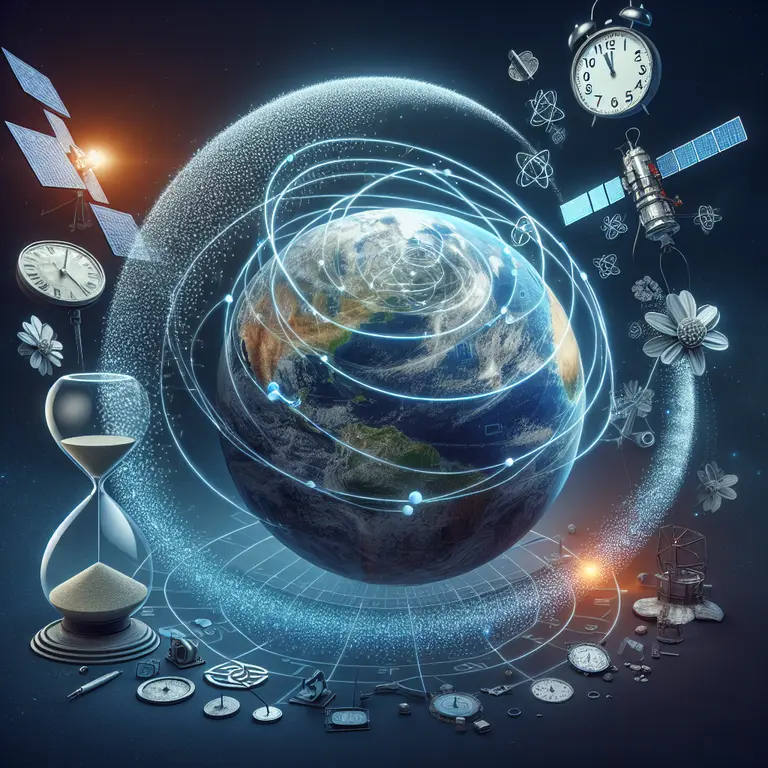
Most people assume a second is a second — a fixed, universal unit that ticks forward at the same rate everywhere on Earth and beyond. That assumption is wrong, and the global network of satellites orbiting 20,000 kilometers above your head proves it every single day. The GPS constellation, operated by the United States Space Force, currently consists of 31 operational satellites, each equipped with atomic clocks accurate to roughly 1 nanosecond per day. These clocks do not agree with the ground clocks. Not because they are broken, but because Einstein was right.
Gravitational time dilation, predicted by general relativity in 1915, causes clocks in weaker gravitational fields to tick faster. At GPS orbital altitude, where gravity is noticeably weaker than at sea level, satellite clocks gain approximately 45.9 microseconds per day relative to ground-based clocks. Special relativity partially counteracts this because the satellites are moving at roughly 14,000 kilometers per hour; their clocks lose about 7.2 microseconds per day due to velocity-based time dilation. The net result is that GPS satellite clocks run fast by about 38.4 microseconds per day. Engineers correct for this with deliberate offset programming, but the correction itself reveals something unsettling: time is not a background constant. It is a physical variable, one that bends and stretches depending on where you are and how fast you are moving through space.
This is not an abstract philosophical point. It is an engineering reality that underpins every turn-by-turn navigation instruction, every precision airstrike coordinate, and every timestamp embedded in a financial transaction. The fact that we have quietly built a civilization on top of relativistic physics — and that most people have no idea — is one of the more remarkable hidden stories of the modern age. Understanding what time actually is, how we measure it, and how fragile that measurement has become is no longer a matter of scientific curiosity. It is a matter of infrastructure, security, and geopolitical consequences.
Leap Seconds and the Coming Reckoning
While GPS manages relativistic drift with algorithmic precision, another timekeeping crisis has been building for decades, largely out of public view. Earth’s rotation is not perfectly uniform. Tidal friction from the Moon gradually slows the planet, meaning that astronomical time — measured by where the Sun appears in the sky — slowly diverges from atomic time, which is defined by the oscillation of cesium-133 atoms at exactly 9,192,631,770 cycles per second. To keep these two systems aligned, the International Earth Rotation and Reference Systems Service has periodically inserted leap seconds into Coordinated Universal Time since 1972. There have been 27 leap seconds added so far, each one a small bureaucratic patch applied to a growing structural problem.
Leap seconds are an engineering nightmare. In 2012, a single leap second insertion caused Reddit, LinkedIn, Yelp, and several airline booking systems to crash simultaneously. The problem is that most software treats time as a monotonically increasing number — a smooth, unbroken sequence of values that only ever moves in one direction. Inserting an extra second breaks that assumption catastrophically, causing systems that depend on precise timing to fall out of synchronization with one another, from mildly disruptive to genuinely dangerous. The 2012 crashes were embarrassing. A similar failure propagating through air traffic control software or hospital infrastructure management systems would be something far worse.
In response to accumulating pressure from the technology industry, a landmark decision was made in November 2022 at the General Conference on Weights and Measures: Leap seconds will be abolished by 2035. After that date, atomic time and astronomical time will be allowed to drift apart — potentially by as much as a full minute within a century. This sounds like a technical footnote, but it carries real consequences. Astronomical observatories, legal timekeeping systems, and satellite tracking networks all rely on the assumption that clock time and Earth’s rotational position remain coupled. When they no longer are, the question of which time is the real time — the one the atom keeps, or the one the planet keeps — becomes genuinely unresolved. Humanity has never had to answer that question before.
The Quantum Clock Revolution Already Underway
The cesium atomic clock that has defined the second since 1967 is itself approaching obsolescence, outpaced by a generation of instruments so precise they have begun to blur the boundary between timekeeping and physics. Optical lattice clocks, which measure the oscillation of strontium or ytterbium atoms at frequencies roughly 100,000 times higher than cesium, have already achieved accuracy levels that would neither gain nor lose one second over 15 billion years — longer than the current age of the universe. The National Institute of Standards and Technology and several European metrology labs have been running these clocks in parallel with international timekeeping infrastructure since the early 2020s, quietly preparing for a redefinition of the second that most people do not yet know is coming.
What makes this more than an engineering curiosity is what these clocks can detect beyond time itself. Because gravitational time dilation is measurable even at small altitude differences, an optical lattice clock can detect a change in elevation of just one centimeter by observing the resulting frequency shift. This transforms timekeeping into geodesy — the science of measuring Earth’s shape. Geophysicists are now exploring chronometric leveling, a technique where networks of ultra-precise clocks map gravitational potential across continents with unprecedented resolution. A clock placed near a dense underground rock formation ticks measurably slower than one sitting above a void. The difference is real, repeatable, and detectable with instruments that already exist in laboratory settings.
The implications extend well beyond academic cartography. Chronometric leveling could allow geologists to identify subsurface mineral deposits or underground aquifers without drilling a single exploratory well. It could provide early warning signals for volcanic activity by detecting subtle changes in the density distribution of magma chambers. It could monitor the slow movement of tectonic plates and the redistribution of mass caused by melting ice sheets with a granularity that current satellite gravity missions cannot match. The clock, in other words, is becoming a sensor — one that reads the interior of the planet the way a stethoscope reads a heartbeat. The second generation of atomic timekeeping will not just tell us when we are. It will tell us where we are, what is beneath us, and how the Earth itself is changing.
When Time Itself Becomes a Security Vulnerability
The dependency of modern infrastructure on GPS-derived timing signals has created an attack surface that security researchers describe as critically underappreciated, even among professionals who work directly with the systems in question. Financial trading systems, cellular networks, power grid synchronization, and internet routing protocols all rely on GPS timestamps accurate to within microseconds. These timestamps are not optional features or quality-of-life improvements. They are structural requirements. Without them, the sequencing logic that prevents cascading failures in electrical grids, the cryptographic handshakes that authenticate banking transactions, and the coordination protocols that allow cellular base stations to share spectrum without interfering with one another all begin to degrade or fail.
GPS signals, however, are extraordinarily weak by the time they reach Earth’s surface — roughly equivalent to the power of a 25-watt light bulb viewed from 20,000 kilometers away. This makes them trivially easy to spoof or jam with relatively inexpensive equipment, some of which is commercially available and fits inside a backpack. A spoofing device does not block the GPS signal. It overwhelms it with a counterfeit signal that receivers accept as genuine, feeding them false position and timing data while the receivers remain entirely unaware that anything is wrong. The attack is silent, difficult to detect without specialized monitoring equipment, and potentially devastating in its downstream effects.
The documented cases are already alarming. In 2016, ships in the Black Sea reported GPS positions placing them inland at Gelendzhik Airport — a classic signature of spoofing, almost certainly state-sponsored. In 2019, the U.S. Maritime Administration issued warnings about widespread GPS manipulation near the Strait of Hormuz, affecting dozens of commercial vessels. In 2024, aviation authorities across Europe began documenting a sharp increase in GPS interference events affecting commercial aircraft over the Baltic and Eastern Mediterranean, with some flights losing reliable positioning for extended periods. The concern is not merely navigational misdirection. If a spoofed timestamp corrupts a financial exchange’s time server, trades executed in the affected window may be legally unverifiable, creating liability exposure that existing regulatory frameworks were never designed to handle.
Several national governments, including the United Kingdom, South Korea, and Norway, have begun investing seriously in eLoran — a ground-based, low-frequency radio navigation system that serves as a GPS backup precisely because its signals are far stronger and orders of magnitude harder to manipulate. The race to secure time itself has become a dimension of geopolitical competition that most citizens never see, even as every digital transaction they make, every phone call they place, and every kilowatt-hour delivered to their home depends on its outcome.
Conclusion
Time, it turns out, is not the simple backdrop against which events occur. It is a physical quantity that curves under gravity, stretches with velocity, drifts with the planet’s slowing spin, and can be counterfeited by a hostile actor with a radio transmitter and a laptop. The systems we have built to measure it are simultaneously among the greatest achievements in the history of science and among the most fragile dependencies in modern civilization. The next generation of optical clocks will redefine the second with a precision that makes the current standard look crude by comparison, and in doing so will open entirely new ways of seeing the world beneath our feet. The abolition of the leap second will sever a link between human timekeeping and astronomical reality that has existed since people first looked at shadows to tell the hour. And the ongoing effort to protect GPS timing infrastructure from electronic warfare will shape the security landscape of the coming decades in ways that most national security conversations have barely begun to address.
The second is not what most people think it is. It never was. We have simply built a world that depends on pretending otherwise, and the pretense is becoming harder to maintain.