
Europa: Unveiling the Ocean Beneath Its Icy Surface
Jupiter's moon Europa harbors a vast saltwater ocean beneath miles of ice, and new NASA missions are preparing to probe it for signs of life in one of the solar system's most promising habitats.
 Watch on YouTube
 Watch on Rumble
A World Encased in Ice
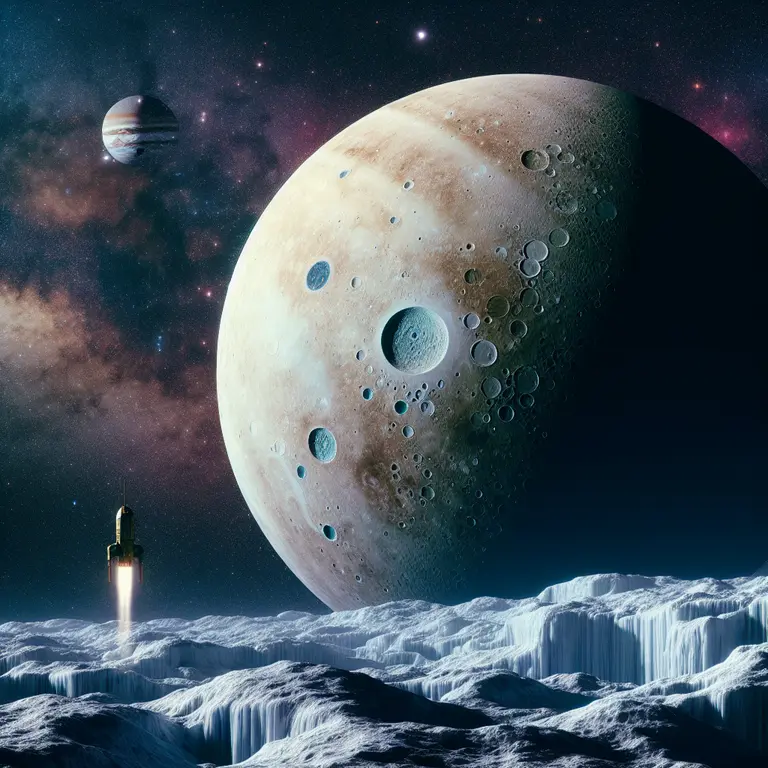
At first glance, Europa looks like a cracked billiard ball — a sphere of pale, fractured ice drifting 485 million miles from Earth in the shadow of Jupiter. It is slightly smaller than Earth’s Moon, receives almost no sunlight, and sits well outside the traditional habitable zone where liquid water can exist on a planetary surface. By every superficial measure, it should be a dead, frozen rock. But Europa is one of the most scientifically tantalizing objects in the entire solar system, because beneath that icy crust — estimated to be between 10 and 30 kilometers thick — lies a global saltwater ocean containing roughly twice the volume of all Earth’s oceans combined.
The existence of this ocean was first strongly inferred from data collected by the Voyager and Galileo spacecraft in the 1970s and 1990s. The Voyager 2 flyby in 1979 returned the first high-resolution images of Europa’s surface, revealing a strikingly smooth terrain crisscrossed with dark lines that puzzled planetary scientists immediately. Unlike the heavily cratered surfaces of most moons in the outer solar system, Europa had almost no large impact craters — a sign that its surface was geologically young and actively resurfaced. The Galileo mission, which orbited Jupiter from 1995 to 2003, then delivered the critical evidence. It detected a magnetic signature around Europa that fluctuated in a way that could only be explained by a highly conductive fluid beneath the surface — almost certainly a salty, liquid ocean responding dynamically to Jupiter’s powerful magnetic field. The ice shell’s surface, riddled with reddish-brown streaks called lineae, suggests that material from below is constantly cycling upward through tectonic-like activity, reshaping the moon’s exterior over geological timescales. Those reddish stains are thought to contain salts, sulfur compounds, and possibly organic molecules dragged up from the ocean below, painting the surface with chemistry that originated in the deep.
The Energy Source That Makes It Possible
The obvious question is how liquid water can exist so far from the Sun, in a region where temperatures on Europa’s surface plunge to around minus 160 degrees Celsius. The answer lies not in solar radiation but in tidal forces. Europa is locked in a gravitational tug-of-war between Jupiter and the other large Galilean moons — Io, Ganymede, and Callisto. These moons are caught in what is called a Laplace resonance, a precise orbital relationship in which Io completes four orbits of Jupiter for every two completed by Europa and every one completed by Ganymede. This resonance prevents the moons from settling into perfectly circular orbits, keeping Europa’s path around Jupiter slightly elliptical. As a result, the gravitational pull Europa experiences from Jupiter varies as it moves closer and farther during each orbit. The planet’s immense gravity stretches and squeezes the moon’s interior rhythmically, generating frictional heat deep within the rock. This process, called tidal flexing or tidal heating, is the same mechanism that makes Io the most volcanically active body in the solar system, a world so geologically tortured that its surface is repaved by lava on a continuous basis.
For Europa, this internal heat is sufficient to maintain a liquid ocean for billions of years without any input from the Sun. Scientists estimate the ocean floor may host hydrothermal vents similar to those found at mid-ocean ridges on Earth, where tectonic plates pull apart, and superheated water laden with dissolved minerals erupts from the seafloor. On Earth, these vents support entire ecosystems of organisms — tube worms, shrimp, chemosynthetic bacteria, and a host of other creatures — that derive energy not from sunlight but from chemical reactions between superheated water and rock. This process, called chemosynthesis, was only discovered in 1977 when the submersible Alvin descended to the Galapagos Rift and found thriving biological communities in total darkness at crushing pressures. The discovery fundamentally changed biology’s understanding of where life can exist. Before 1977, photosynthesis was considered the foundational energy source for virtually all ecosystems on Earth. The hydrothermal vent communities proved otherwise. If analogous vents exist on Europa’s seafloor, they could supply the energy and chemical gradients necessary to sustain microbial life, entirely independent of photosynthesis and entirely independent of the Sun.
What NASA’s Europa Clipper Will Attempt to Find
Launched in October 2024 aboard a SpaceX Falcon Heavy rocket, NASA’s Europa Clipper spacecraft is currently en route to the Jovian system, scheduled to arrive in 2030 after a gravity-assisted trajectory that will swing it past Mars and Earth before it gains enough velocity to reach Jupiter. It is the largest planetary science spacecraft NASA has ever built, with solar panels spanning more than 30 meters from tip to tip — a necessary design choice given how little sunlight reaches Jupiter’s distance. The spacecraft carries a suite of nine scientific instruments designed to characterize Europa’s ice shell, ocean, and surface chemistry without actually landing. The mission will perform approximately 49 close flybys of Europa, some passing within just 25 kilometers of the surface, accumulating data across multiple passes rather than from a single orbital insertion, partly to limit the spacecraft’s exposure to Jupiter’s intense radiation belts, which can damage electronics over time.
Among its instruments, the spacecraft carries a magnetometer to precisely map the ocean’s depth and salinity by measuring how Europa’s induced magnetic field changes during each flyby. A mass spectrometer will analyze the thin atmosphere and any plumes of water vapor that may erupt from the surface, cataloging the chemical composition of material that has escaped from the ocean below. Ice-penetrating radar will map the internal structure of the shell, potentially identifying pockets of liquid water closer to the surface — so-called lenticulae or chaos terrain features that some scientists believe form when subsurface lakes temporarily melt through from below. Thermal imaging instruments will search for warm spots on the surface that might indicate active geological processes underneath. Critically, scientists believe Europa may be actively venting water vapor into space — the Hubble Space Telescope detected tentative evidence of plumes in 2012 and 2016, though the detections were not conclusive. If confirmed, these plumes could allow Europa Clipper to sample ocean material directly without ever needing to drill through kilometers of ice, in much the same way the Cassini spacecraft sampled Enceladus’s plumes by flying directly through them. The mission’s estimated cost is approximately 5 billion dollars, reflecting both its extraordinary technical complexity and the weight of the scientific questions it is designed to answer.
The Broader Implications for Life in the Universe
Europa’s potential habitability carries consequences that extend far beyond a moon orbiting a single planet. For most of the history of astrobiology, the search for life beyond Earth has been organized around the concept of the habitable zone—the orbital distance from a star at which liquid water can exist on a rocky surface. This framework implicitly assumed that life requires a star in roughly the same way that Earth requires the Sun, and that any world too far from its parent star would simply be too cold to be biologically interesting. Europa demolishes this framework. It demonstrates that liquid water, and therefore potentially life, can exist in environments entirely decoupled from stellar radiation, driven instead by gravitational mechanics and geochemical processes operating entirely within a moon’s interior.
This realization has transformed how scientists think about the distribution of life in the universe. Ocean worlds are now understood to be extraordinarily common across the solar system, and by extension, across the galaxy. Saturn’s moon Enceladus has a confirmed subsurface ocean and active plumes already sampled by the Cassini spacecraft during its mission between 2004 and 2017. Those plumes were found to contain water ice, salts, silica nanoparticles, and hydrogen gas — the hydrogen being a particularly significant find, because it suggests ongoing hydrothermal reactions on the seafloor that could serve as a chemical energy source for microorganisms. Titan, also orbiting Saturn, presents an entirely different category of possibility: it has a subsurface ocean of water in addition to its surface lakes and rivers of liquid methane and ethane, raising the possibility of two entirely separate chemical environments that might independently support life. Ganymede and Callisto, Europa’s neighbors in the Jovian system, likely harbor deep oceans sandwiched between layers of ice at high pressure. Even Pluto, long dismissed as a frozen relic at the edge of the solar system, shows geological evidence suggesting that a subsurface liquid layer persists beneath its nitrogen-ice plains.
The cumulative picture is striking. Rather than being rare exceptions, ocean worlds may represent one of the most common planetary environments in the galaxy. Astronomers estimate there are hundreds of billions of star systems in the Milky Way alone, and many of those systems will contain moons orbiting large gas giants in configurations similar to Jupiter’s. If even a small fraction of those moons harbor subsurface oceans maintained by tidal heating, the number of potentially habitable environments in our galaxy alone becomes staggeringly large — possibly numbering in the billions. Europa Clipper, when it arrives at Jupiter in 2030, may not answer the question of whether life exists there. The instruments it carries are not designed to detect biology directly, but rather to determine whether the conditions biology requires are present. In the history of science, however, that distinction is rarely one that holds for long. Confirming that Europa possesses a warm, chemically active ocean in contact with a rocky seafloor would tell us that three of the four conditions scientists consider necessary for life — liquid water, chemical energy, and the right raw materials — are satisfied. The fourth condition, sufficient time, has already been met. Europa has been orbiting Jupiter for roughly 4.5 billion years. Whatever is happening in that ocean has had nearly as long to develop as life on Earth has had to evolve from its first microbial ancestors to the civilization now sending spacecraft to find out.
Conclusion
Europa is a lesson in the danger of assumption. For centuries, the search for life beyond Earth was guided by a simple and seemingly reasonable principle: look where conditions resemble those on Earth’s surface, where sunlight falls, where temperatures are moderate, and where liquid water flows openly under an open sky. Europa offers a different principle entirely. It suggests that life, if it exists elsewhere, may be hiding in darkness, beneath kilometers of ice, in an ocean warmed not by a star but by the gravitational embrace of a giant planet, sustained not by photosynthesis but by the chemistry of rock and water interacting in the deep.
Whether life is actually present in that ocean remains one of the most profound open questions in science. The Europa Clipper mission represents humanity’s most serious and sophisticated attempt to begin answering it. The spacecraft will not land, drill, or send back images of alien organisms. But the data it collects across those 49 flybys, stitched together by scientists over years of analysis, may ultimately tell us whether the solar system contains a second inhabited world — or at minimum, a world where the conditions for life are so thoroughly met that the absence of life would itself become the mystery requiring explanation. In either case, Europa has already changed how we think about where in the universe we should be looking and why the universe may be far less empty than it once appeared.