
The Quiet Collapse: Phytoplankton and Ocean Memory
How microscopic ocean organisms are losing their ancient chemical memory, and what that means for Earth's climate future.
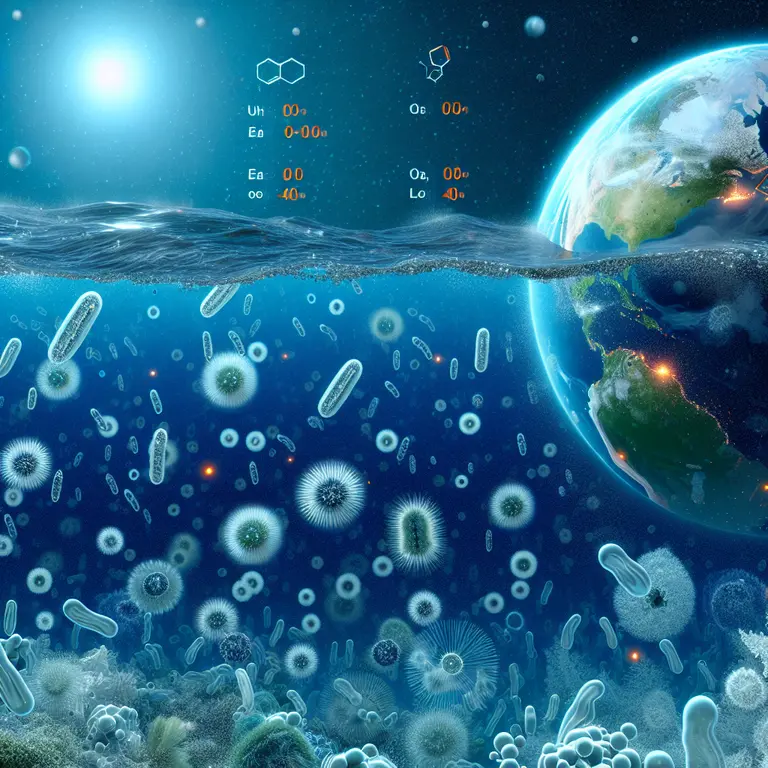
 Watch on YouTube
 Watch on Rumble
The Invisible Foundation
Phytoplankton are responsible for producing somewhere between 50 and 80 percent of the oxygen in Earth’s atmosphere. They are not plants in the terrestrial sense, but photosynthetic microorganisms drifting in the sunlit upper layers of the ocean, converting carbon dioxide into organic matter on a scale that dwarfs every forest combined. A single liter of seawater can contain tens of millions of individual cells from hundreds of species. Despite this staggering abundance, most people have never given them a thought in their lives.
What makes phytoplankton particularly fascinating, and increasingly alarming to oceanographers, is not simply their role in oxygen production. It is their function as a kind of chemical memory system for the planet. Through a process called the biological pump, dying phytoplankton sink toward the ocean floor, carrying sequestered carbon with them. Some of that carbon stays locked in deep sediment for thousands to millions of years. The ocean has been running this carbon storage program since long before complex life appeared on land, and the chemical signatures left in marine sediment cores allow scientists to reconstruct atmospheric conditions going back hundreds of millions of years.
This invisible layer of ocean life is, in a very real sense, the engine beneath the engine. Human civilization has developed on a planet shaped in part by what these microorganisms have done over geological time. They helped build the oxygen-rich atmosphere that enabled complex animal life. They helped regulate carbon cycles, stabilizing global temperatures across ice ages and warm periods alike. And yet the conversation about their fate, about what happens as the conditions sustaining them change, has remained almost entirely confined to scientific literature and specialist conferences. That gap between what the science shows and what the public understands is itself part of the problem.
Warming Oceans and the Collapse of Nutrient Upwelling
Since roughly 2019, multiple independent research groups have confirmed an accelerating trend in ocean stratification, which is the increasing separation of warm surface water from cold, nutrient-rich deep water. As the surface warms, it becomes less dense and less likely to mix downward. This is not a new concern, but the rate at which it is occurring has surprised even researchers who expected it. A 2023 study published in Nature Climate Change found that ocean stratification has increased by approximately 5.3 percent globally since 1960, with the sharpest acceleration occurring in the last two decades.
For phytoplankton, stratification is catastrophic in slow motion. These organisms depend on upwelling currents to bring nutrients such as nitrogen, phosphorus, and iron from deeper waters. When stratification intensifies, that upwelling weakens. The surface layer becomes a nutrient desert. Phytoplankton communities shift in composition, with larger, more productive species giving way to smaller, less carbon-efficient ones. The biological pump weakens. Less carbon reaches the seafloor. The ocean’s capacity to act as a long-term carbon sink quietly diminishes, even as atmospheric carbon dioxide continues to rise.
The implications of this shift extend well beyond carbon accounting. Larger phytoplankton species, such as diatoms, form the base of highly productive food webs. They are grazed by zooplankton, which are eaten by small fish, which feed larger fish, and so on up to marine mammals and seabirds. When the community composition shifts toward smaller, less nutritious picoplankton, the energy transfer efficiency across the food web degrades. Fisheries that depend on upwelling zones, including some of the most productive on Earth, such as those off the coasts of Peru, Namibia, and California, are already showing early signs of this restructuring. The connection between microscopic community composition and the food security of coastal nations is direct, even if it rarely appears in policy discussions framed that way.
There is also a timing dimension that adds complexity to the picture. Phytoplankton blooms are seasonal events, triggered by the return of sunlight after winter and the availability of nutrients near the surface. As stratification intensifies and surface waters warm earlier in the year, bloom timing is shifting. In some regions, blooms are occurring weeks earlier than historical averages. This creates what ecologists call a phenological mismatch: the zooplankton that evolved to time their own reproduction to coincide with the bloom may not be able to adjust their biological clocks fast enough. When the food arrives before the grazers are ready, or the grazers arrive after the bloom has collapsed, energy is lost at a foundational level.
The Dimethyl Sulfide Connection
There is a lesser-known chemical link between phytoplankton and global temperature regulation that most climate discussions skip entirely. Certain phytoplankton species, particularly those in the class Prymnesiophyceae, produce a compound called dimethylsulfoniopropionate, or DMSP. When these cells die or are grazed by zooplankton, DMSP is converted to dimethyl sulfide (DMS), which then escapes into the atmosphere.
In the atmosphere, DMS oxidizes and forms sulfate aerosols, which are tiny particles that act as cloud condensation nuclei. More nuclei means more clouds. More clouds over the ocean mean more sunlight is reflected back into space, leading to a cooler surface. This feedback loop, first formally proposed by Robert Charlson, James Lovelock, Meinrat Andreae, and Stephen Warren in 1987 and known as the CLAW hypothesis, suggested that phytoplankton might actively regulate Earth’s temperature through this aerosol pathway. While subsequent research has significantly complicated the picture, the core chemistry remains valid, and DMS-derived aerosols do measurably influence cloud formation over the Southern Ocean.
As warmer, more stratified oceans favor phytoplankton communities that produce less DMSP, there is potential for a self-reinforcing feedback: reduced DMSP production leads to fewer reflective clouds, which in turn leads to more warming, which further stratifies the oceans, which further reduces DMSP-producing species. The mechanism is not yet well-constrained enough to model with high confidence, but it represents one of those uncomfortable corners of climate science where the uncertainty itself is the alarming part.
What makes this feedback loop particularly difficult to study is that DMS flux from the ocean to the atmosphere is highly variable across space and time, influenced not just by phytoplankton community composition but by water temperature, wind speed, and the structure of the microbial community that processes DMSP in the water column before it can escape. Some bacteria consume DMSP without releasing DMS, effectively short-circuiting the aerosol pathway. Others facilitate the conversion. The ratio between these bacterial communities is itself sensitive to temperature and ocean chemistry, adding another layer of biological complexity to what might initially appear to be a straightforward chemical process. The CLAW hypothesis was controversial partly because it seemed to imply a kind of planetary self-regulation that made some scientists uncomfortable, but the underlying mechanisms have proven real enough to warrant continued investigation, particularly as the species producing the relevant compounds face increasing pressure.
Reading the Sediment Record
Marine sediment cores pulled from the ocean floor contain a remarkable archive. Embedded in the layers are the silica shells of diatoms, the calcium carbonate plates of coccolithophores, and the preserved lipid molecules of ancient phytoplankton communities. Paleoceanographers use these proxies to reconstruct sea surface temperatures, nutrient availability, and even the intensity of the biological pump across geological time.
One of the more unsettling findings from this record is how abruptly phytoplankton communities can reorganize. During the Paleocene-Eocene Thermal Maximum, roughly 56 million years ago, when a massive release of carbon caused global temperatures to spike by 5 to 8 degrees Celsius over a geologically brief period, the sediment record shows a dramatic restructuring of ocean ecosystems on timescales as short as a few thousand years. Species that had been dominant for millions of years vanished from certain regions within what amounts to an eyeblink in geological time.
The current rate of ocean warming and acidification is, by some measures, faster than anything recorded in that event. The sediment record cannot tell us exactly what the biological response will look like, but it suggests that the system can cross thresholds quickly and reorganize in ways that are difficult to reverse on human timescales.
The acidification dimension warrants separate consideration. As the ocean absorbs carbon dioxide from the atmosphere, it forms carbonic acid, lowering the pH of seawater. For organisms like coccolithophores, which build their protective plates from calcium carbonate, acidification directly undermines the chemistry of shell formation. Laboratory studies have shown that under projected end-of-century pH levels, some species produce thinner, more fragile plates. Others appear to adapt. The sediment record from previous acidification events is ambiguous enough that scientists cannot yet say with confidence which species will persist and which will decline, but the directional pressure is clear. A world with fewer coccolithophores is a world with a less efficient biological pump, less DMS production, and a different light-scattering profile in surface waters, since coccolithophore plates are highly reflective and influence how much solar energy the ocean absorbs.
What Comes Next
Researchers are now deploying autonomous underwater vehicles equipped with hyperspectral sensors and machine-learning classifiers to identify phytoplankton communities in near real time across ocean basins. Projects like the NASA PACE satellite mission, launched in early 2024, are providing the first global, high-resolution maps of phytoplankton community composition from orbit. These tools are producing data at resolutions and scales that were impossible even five years ago.
What they are finding is a mosaic of change. Some regions are losing biomass, while others temporarily gain it as ice retreats and new surface area becomes exposed to sunlight. The overall picture remains concerning, particularly in the subtropical gyres, which are already nutrient-poor and expanding as the climate warms. These gyres, sometimes called the ocean deserts, are growing at measurable rates, pushing productive zones toward the poles.
The data from these new observational systems are also revealing the extent to which phytoplankton dynamics are entangled with phenomena previously studied in isolation. Dust deposition from the Sahara, for instance, delivers iron to the Atlantic in quantities sufficient to trigger blooms. As land use and precipitation patterns change, the composition and volume of that dust change too. Freshwater input from melting ice sheets alters salinity gradients, thereby affecting stratification independently of temperature. Microplastic pollution has been found to interact with phytoplankton cell surfaces in ways that are only beginning to be characterized. The ocean is not a simple system perturbed by a single variable, and the organisms at its productive base respond to the full complexity of everything happening simultaneously.
The phytoplankton story is ultimately about interconnection at a scale that defies intuitive understanding. A warming atmosphere changes ocean circulation, which changes nutrient availability, which changes which microorganisms survive, which changes cloud formation chemistry, which changes how much sunlight reaches the surface. Every link in that chain is being pulled simultaneously, and the system has no obligation to respond in a linear or predictable way. The organisms doing most of the work to keep this planet habitable are invisible to the naked eye, and the conversation about their fate remains largely confined to scientific journals. That invisibility, both physical and cultural, may be the most consequential oversight of this particular moment in Earth’s history. The quiet collapse, if it comes, will not announce itself with anything the human eye can easily register. It will show up first in data, in sediment, in the chemistry of clouds, and in the slow diminishment of systems that were already running silently beneath everything we thought we understood.