
Earth's Inner Core: New Insights on Its Rotational Dynamics
Recent seismic studies suggest Earth's solid inner core has slowed, stopped, and may now be reversing its spin — a discovery that rewrites our understanding of planetary dynamics and long-term surface conditions.
 Watch on YouTube
 Watch on Rumble
A Planet Within a Planet
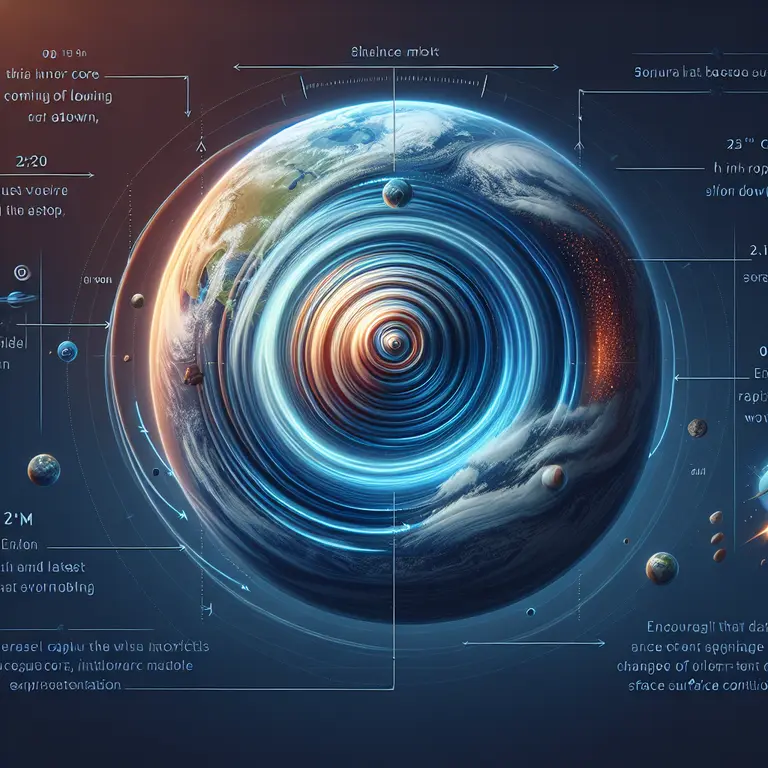
Deep beneath your feet, roughly 5,100 kilometers below the surface, sits a solid iron-nickel sphere about the size of the Moon. This is Earth’s inner core, and for decades, geophysicists have assumed it rotates slightly faster than the rest of the planet, a phenomenon called superrotation. The idea was elegant: the liquid outer core surrounding it acts like an electromagnetic bearing, allowing the solid inner core to spin independently, driven by the same convective forces that generate Earth’s magnetic field. It was a tidy model that held for nearly 30 years of scientific consensus.
Then, in early 2023, a study published in Nature Geoscience by Yi Yang and Xiaodong Song at Peking University shook that model to its foundation. By analyzing seismic waves from repeated earthquake doublets, pairs of earthquakes that occur in nearly identical locations decades apart, they found that the inner core’s superrotation had effectively halted around 2009, and that the core may now be rotating slightly slower than the mantle above it, a condition called subrotation. The implications are still being untangled, but they touch everything from the length of Earth’s day to the stability of the magnetic field that shields life from solar radiation.
What makes this discovery so disorienting is not just the technical reversal it demands, but the philosophical one. We tend to think of the ground beneath us as inert, as mere geology, as the passive stage on which biological and atmospheric dramas play out. The inner core’s behavior challenges that assumption. It suggests that the planet’s deepest interior is not a frozen relic but an active, oscillating engine whose rhythms may be quietly shaping conditions at the surface in ways we are only beginning to trace.
How You Measure Something Unreachable
No drill has ever come close to the inner core. The deepest borehole ever made, the Kola Superdeep Borehole in Russia, reached just 12.2 kilometers before heat and pressure made further progress impossible. The inner core sits more than 400 times deeper than that. So how do scientists know anything about it at all?
The answer is seismology. When a large earthquake occurs, it sends seismic waves radiating outward in all directions, including straight through the planet. These waves, called P-waves or compressional waves, travel at different speeds depending on the density and composition of the material they pass through. When they pass through the inner core, they pick up subtle directional signatures. They travel faster along the Earth’s polar axis than along the equatorial plane, a property called anisotropy, which reflects the crystalline alignment of iron under extreme pressure.
By comparing the travel times of waves from identical earthquake sources recorded decades apart, researchers can detect tiny shifts in the core’s orientation. A difference of fractions of a second in wave travel time translates to meaningful rotational displacement at that scale. Yang and Song’s dataset spanned more than sixty years of seismic records, and the pattern they found was not a steady spin but an oscillation, a back-and-forth rotation with a period of roughly seventy years. If correct, the inner core is not a runaway gyroscope but something more like a slow pendulum.
This methodology is worth appreciating in its own right. Seismologists are, in a sense, using the planet as its own instrument. Every major earthquake becomes a probe, sending energy through layers that no physical tool could penetrate. The precision required is extraordinary. Scientists must account for variations in wave paths through the mantle, correct for differences in seismograph calibration across decades and continents, and distinguish genuine rotational signals from noise introduced by structural heterogeneity within the core. That researchers can extract any coherent signal at all from this complexity is a testament to how far the field has advanced since the first global seismic networks were established in the 1960s.
The Seventy-Year Heartbeat
The idea of a roughly seventy-year oscillation cycle is not entirely new, and that is part of what makes the 2023 findings so provocative. Geophysicists have long noted that certain surface-level measurements also seem to fluctuate on multidecadal timescales. The length of Earth’s day, for instance, varies by milliseconds over decades. Earth’s magnetic field strength and the rate at which its poles drift have shown irregular but recurring patterns. Sea-level records and even some climate proxies show oscillations in the range of 60 to 80 years.
None of these correlations proves causation. But the coincidence invites serious inquiry. If the inner core’s rotation is coupled to the mantle through gravitational and electromagnetic torques, and if the mantle in turn influences the fluid dynamics of the oceans and atmosphere, then a deep planetary rhythm might be quietly embedded in phenomena we observe at the surface. Some researchers have pointed to correlations between inner core rotation phases and variations in geomagnetic intensity, which could influence cosmic ray flux reaching the lower atmosphere, a mechanism that remains deeply contested but has been proposed as a modulator of cloud formation and regional climate.
What is less contested is the angular momentum exchange. When the inner core slows, something else must speed up to conserve total angular momentum. The leading candidate is the mantle-crust system, which would produce a measurable, if tiny, change in the length of the day. Geodetic measurements from atomic clocks and very long baseline interferometry have indeed recorded a gradual lengthening of Earth’s day over the past few decades, though separating core contributions from other factors, such as glacial rebound and atmospheric pressure, remains technically demanding.
There is something almost vertiginous about the scale of time involved here. A seventy-year oscillation means that the inner core completed roughly one full back-and-forth swing between the early twentieth century and the present day. The people who laid the first seismic networks had no idea they were capturing the beginning of a planetary cycle that would not be recognized until their grandchildren’s era. It is a reminder that Earth science often operates on timescales that dwarf human institutional memory, and that the data we collect today may only become interpretable to researchers working decades from now.
What Comes Next in Core Science
The 2023 paper sparked immediate debate. Several research groups published responses questioning the interpretation of the seismic data, arguing that changes in wave travel time could reflect structural changes within the inner core itself rather than rotation. The inner core is not a simple billiard ball. It has a complex, possibly layered internal structure, with an innermost inner core that may have different crystalline properties than the outer regions of the solid sphere. Deformation, phase transitions, or localized melting and refreezing at the inner core boundary could all produce seismic signatures that mimic rotational change.
This scientific friction is productive. A new generation of seismic networks, including arrays in Antarctica and on the deep ocean floor, is improving the resolution of core-sensitive wave measurements. Meanwhile, advances in high-pressure mineral physics are enabling laboratory simulations of iron behavior at inner-core conditions, with pressures exceeding 360 gigapascals and temperatures around 5,000 to 6,000 degrees Celsius, comparable to the surface of the Sun. These experiments are refining models of how iron crystals align and how they respond to the stresses imposed by differential rotation.
One particularly intriguing line of research concerns the boundary between the inner and outer core. This interface, known as the inner core boundary, is not a sharp, clean surface but a complex transition zone where iron is simultaneously crystallizing out of the liquid outer core and, in some regions, possibly melting back into it. The dynamics at this boundary may play a significant role in determining how rotational forces are transmitted between the two regions. Understanding it better could help resolve the central ambiguity in the current debate: whether the seismic signals indicate rotation or structural change at the boundary itself.
The broader significance is this: Earth is not a static rock with a hot center. It is a dynamically layered system in which the deepest and most inaccessible parts are in active conversation with the surface world. The inner core’s rotation is one thread in that conversation, and scientists are only beginning to read the language. Whether the current slowdown represents a routine phase in a long oscillation or something more anomalous will likely take another decade of data to determine.
Conclusion
In the meantime, the planet’s hidden heartbeat continues, indifferent to our attempts to decode it. There is a particular kind of intellectual humility that deep Earth science demands. Unlike astronomy, where we can observe other planetary systems and build comparative frameworks, we have only one Earth's interior to study, and we can observe it only indirectly, through the tremors it produces when it ruptures along fault lines. Every earthquake is, in this sense, an accidental experiment, a brief window into a world that will never be directly seen.
What the inner core story ultimately illustrates is how much of the planet’s behavior remains genuinely open. The scientific consensus of thirty years was not wrong in the sense of being careless or poorly reasoned. It was the best available interpretation of limited data, and it served as a productive scaffold for further inquiry. The new findings do not discredit that era of research. They extend it, complicate it, and make it more interesting. That is how planetary science advances: not through dramatic overthrows but through the slow accumulation of measurements precise enough to reveal that the world is stranger and more dynamic than the previous generation’s best model could accommodate. The inner core is not about to surprise us, and neither is the planet it inhabits.