
How the Moon Is Gradually Slowing Earth's Rotation Time
Our planet is gradually slowing down as the Moon drifts away, with profound long-term consequences.
 Watch on YouTube
 Watch on Rumble
The Moon Is Stealing Earth’s Rotational Energy
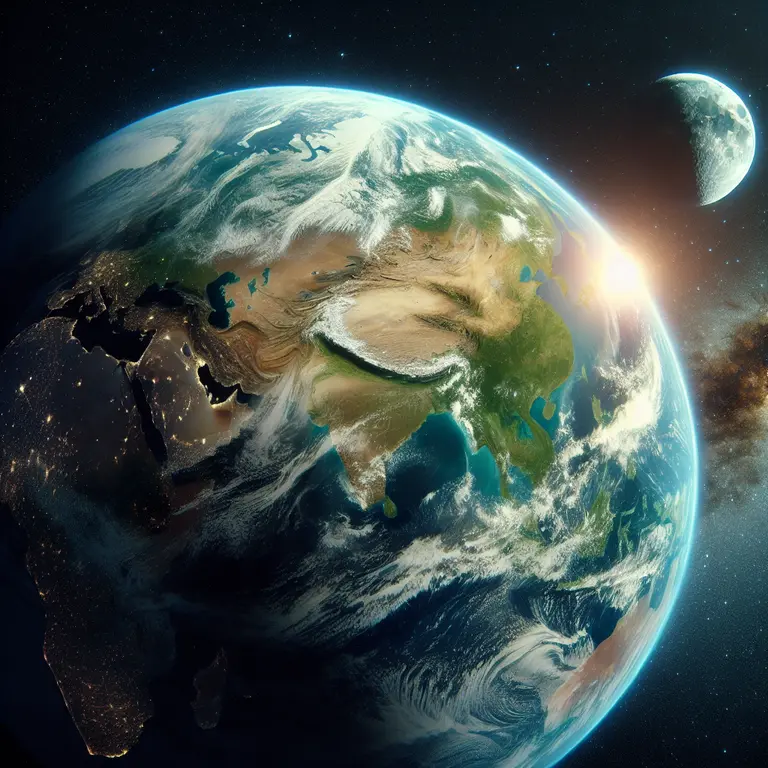
Earth’s rotation is gradually slowing down, and the culprit is our own Moon, which is essentially conducting a 4.5-billion-year energy heist that will continue for billions more years. This cosmic phenomenon represents one of the most enduring and consequential interactions in our solar system, affecting everything from the length of our days to the stability of Earth’s climate. The gravitational dance between Earth and its satellite demonstrates fundamental physical principles that shape not just our planet, but potentially all planetary systems with moons.
The Cosmic Slowdown
Every century, Earth’s day lengthens by approximately 2.3 milliseconds. This may seem negligible, but it adds up dramatically over geological time. When dinosaurs roamed the Earth 100 million years ago, a day was only about 23.5 hours long. Go back 1.4 billion years, and Earth completed a full rotation in just 18 hours.
This progressive deceleration is recorded in the geological record as “rhythmites” – layered sedimentary deposits that capture daily, monthly, and seasonal cycles. Ancient coral fossils also preserve growth patterns that reflect the number of days in a year during their lifetime. A Devonian rugose coral from 380 million years ago shows approximately 400 daily growth rings in each yearly band, confirming that years once contained more, shorter days.
The rate of slowdown isn’t perfectly constant. It fluctuates due to various factors, including changes in Earth’s core, major earthquakes that redistribute the planet’s mass, melting ice sheets, and even atmospheric circulation patterns. The 2004 Indian Ocean earthquake, for instance, shortened Earth’s day by about 2.68 microseconds by changing the planet’s moment of inertia.
The Mechanism: Tidal Friction
This slowdown occurs through a process called tidal friction. The Moon’s gravity pulls on Earth’s oceans, creating tidal bulges. As Earth rotates, these bulges are slightly ahead of the Moon’s position in the sky due to friction and inertia. This misalignment creates a gravitational torque that simultaneously:
- Slows Earth’s rotation (lengthening our day)
- Transfers angular momentum to the Moon, pushing it into a higher orbit
This transfer of Earth’s rotational energy to the Moon’s orbital energy follows the fundamental physical law of conservation of angular momentum.
While oceanic tides are the most visible manifestation of this process, the Moon also raises tides in Earth’s solid body—the crust actually bulges by several centimeters due to lunar gravity. These solid-body tides also contribute to the rotational slowdown, though to a lesser degree than oceanic tides.
Interestingly, the distribution of Earth’s continents affects this process. If Earth were entirely covered by ocean, the rotational slowdown would proceed more slowly. The continents interrupt the idealized flow of tidal bulges, creating additional friction that accelerates the transfer of rotational energy to the Moon.
The Moon’s Gradual Escape
The most surprising consequence: the Moon is moving away from Earth at approximately 3.8 centimeters per year—about the same rate human fingernails grow. This has been precisely measured using laser reflectors placed on the lunar surface during the Apollo missions.
This lunar recession wasn’t always occurring at the current rate. When the Moon formed about 4.5 billion years ago, it was much closer to Earth—perhaps only 22,500 kilometers away (compared to the current average distance of 384,400 kilometers). At this proximity, the Moon would have appeared about 20 times larger in the sky, and Earth’s rotation was likely just 5-6 hours long.
The recession rate has varied dramatically throughout history. During periods when the natural frequency of Earth’s oceans resonated more strongly with the Moon’s orbital period, the recession rate could have been much higher. Computer models suggest that around 620 million years ago, when the continents were configured differently, the Moon may have receded at nearly three times the current rate.
The energy transfer involved in this process is substantial. Earth loses about 3.321 terawatts of rotational kinetic energy through tidal friction—equivalent to about 25% of humanity’s current global energy consumption.
The Distant Future: Synchronized Rotation
This process will continue until Earth and the Moon are tidally locked. In about 50 billion years (if the Sun hadn’t already expanded to engulf Earth by then), one side of Earth would permanently face the Moon, and a day would last about 47 of our current days.
This mutual tidal locking represents an equilibrium state where no further angular momentum is transferred. The Moon is already tidally locked to Earth—which is why we always see the same face—but Earth’s greater mass means it takes much longer to become tidally locked to the Moon.
This phenomenon isn’t unique to the Earth-Moon system. Many moons in our solar system are tidally locked to their planets. Pluto and its largest moon, Charon, represent the only known case where both bodies are already mutually tidally locked—they perpetually show the same face to each other as they orbit their common center of mass.
Everyday Evidence You Can Observe
This cosmic slowdown actually affects our timekeeping. Atomic clocks, which measure time with extreme precision, occasionally need to be adjusted with “leap seconds” to account for Earth’s decreasing rotational speed. Since their introduction in 1972, 27 leap seconds have been added to Coordinated Universal Time (UTC).
You can actually witness the effects of Earth’s rotational energy loss by observing spring and neap tides. During spring tides, when the Sun and Moon align, their combined gravitational pull creates more extreme high and low tides—visible evidence of the forces that are gradually slowing our planet’s rotation.
Ancient astronomical records provide another line of evidence. Babylonian, Chinese, and Arab astronomers recorded eclipses whose timing and location can only be explained if Earth’s rotation was faster in the past. A famous example is the eclipse of October 22, 1137 BCE, recorded in ancient Chinese texts, which helps confirm the rate of Earth’s rotational deceleration.
Cross-Disciplinary Connection: Economic Impact
At the fascinating intersection of economics and technology, the insertion of leap seconds has become controversial in the computing world. In 2012, when a leap second was added, it caused widespread system crashes at companies like Reddit, LinkedIn, and Qantas Airlines. Google developed a technique called “leap smear” that gradually adds milliseconds throughout the day rather than inserting a full second at once—all because of the Moon’s gravitational effect on Earth’s rotation.
The financial impact of these time adjustments is significant. High-frequency trading systems, which execute millions of transactions per second, can experience substantial disruptions from leap second insertions. The potential economic losses have led some technology companies and financial institutions to advocate for abolishing leap seconds entirely, despite the growing divergence this would create between atomic time and astronomical time.
The next time you look up at the Moon, remember: you’re witnessing a celestial body that’s actively stealing Earth’s rotational energy, lengthening our days, and slowly drifting away into space—a process that has profound implications across multiple disciplines from geology to computing.