
The Invisible Ocean Living Inside Every Breath You Take
The atmosphere harbors a vast, largely unmapped ecosystem of airborne microorganisms that travel thousands of miles, influence weather patterns, seed clouds, and may be quietly shaping human health in ways science is only beginning to understand.
 Watch on YouTube
 Watch on Rumble
A Biosphere That Has No Floor
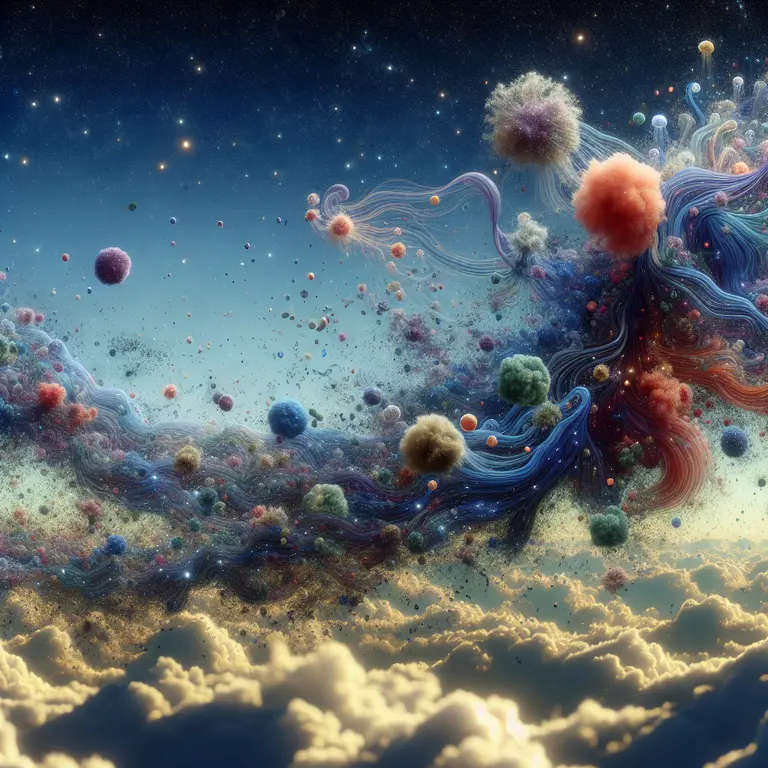
When scientists speak of Earth’s biosphere, most people picture forests, coral reefs, or the sunlit upper layers of the ocean. Almost nobody pictures the sky. Yet the atmosphere, from ground level up to roughly 10 kilometers, is home to a living community of bacteria, fungi, viruses, algae, and archaea collectively called the aerobiome. These organisms do not simply drift passively like dust. Many of them are metabolically active at altitude, consuming organic compounds, reproducing, and interacting with the chemistry of the clouds around them. A single cubic meter of air over a busy city can contain tens of thousands of bacterial cells. Over the open ocean, the count drops but never reaches zero. The aerobiome is, by any reasonable ecological definition, a global habitat, and it has been operating continuously for at least three billion years.
The existence of airborne microbes has been known since Louis Pasteur disproved spontaneous generation in the 1860s by demonstrating that sealed broth remained sterile, whereas open broth collected living organisms from the air. But for more than a century after Pasteur, the atmosphere was treated as a transit corridor rather than a habitat. Microbes were understood to enter the air from soil, water, and vegetation, survive briefly, and then settle back to the surface. The idea that they might be doing anything biologically meaningful while aloft was not seriously entertained. That assumption began to crack only in the early 2000s, when advances in DNA sequencing enabled researchers to identify organisms without culturing them in a laboratory. Culturing is a notoriously selective process; most microbes refuse to grow under artificial conditions, meaning that older methods systematically undercounted and mischaracterized what was actually present. Sequencing changed everything. What researchers found when they applied these tools to atmospheric samples was staggering in its complexity, its diversity, and its implications for how life on Earth actually functions.
The aerobiome is not uniform across altitude, geography, or season. Communities sampled above tropical forests differ markedly from those above polar ice sheets. Air masses moving over agricultural land carry different assemblages than those originating over ocean surfaces. There are daily rhythms to the aerobiome as well, with some organisms more abundant at night when humidity is higher and ultraviolet radiation is absent. The atmosphere, in other words, is not a featureless void populated by random biological debris. It has structure, and that structure responds to environmental conditions in ways that parallel what ecologists observe in soil or water communities.
Bacteria That Make It Rain
One of the most consequential and least publicized discoveries in atmospheric science over the past two decades is that certain airborne bacteria appear to be directly involved in precipitation formation. Clouds require nuclei around which water vapor can condense. Mineral dust and sea salt have long been recognized as nucleating agents, but researchers have now identified a bacterium called Pseudomonas syringae as one of the most efficient ice nucleators in nature. Its outer membrane proteins can trigger ice crystal formation at temperatures as warm as minus two degrees Celsius, far warmer than most inorganic particles require. This distinction matters enormously in the physics of cloud formation, because warmer nucleation temperatures mean that biological particles can initiate precipitation processes at altitudes and in atmospheric conditions where purely mineral nuclei would remain inactive.
P. syringae is found on plant surfaces worldwide, and when it becomes airborne, it rides updrafts into cloud-forming altitudes. Studies published in journals such as Atmospheric Chemistry and Physics have detected the organism in rain, snow, and hail samples collected across multiple continents. The implication is remarkable: bacteria may be participating in the global water cycle, effectively seeding their own dispersal by triggering the precipitation that carries them back to earth. This is not a marginal effect. Some researchers estimate that biological ice nucleators contribute meaningfully to precipitation in mid-latitude regions, though the precise quantification remains an active and contested area of research.
The story becomes more layered when additional organisms are considered. Certain marine algae release dimethyl sulfide, a compound that oxidizes in the atmosphere to form sulfate aerosols, which in turn serve as cloud condensation nuclei. The chain of causation runs from ocean biology through atmospheric chemistry to cloud formation and ultimately to rainfall patterns over land. The Gaia hypothesis, proposed by James Lovelock in the 1970s and widely dismissed by mainstream scientists as romantic speculation, posited that living organisms collectively regulate Earth’s climate to sustain conditions favorable to life. Lovelock was vague enough about the mechanism that critics found it easy to dismiss him. But as the specific chemical and biological pathways are mapped in increasing detail, the core observation that life does not merely inhabit the atmosphere but actively shapes its behavior looks considerably less eccentric than it once did. Life does not merely inhabit the atmosphere. In measurable ways, it helps construct the conditions that allow it to persist there.
Transcontinental Passengers and What They Carry
The aerobiome is not static. Organisms lifted from one continent routinely land on another, sometimes after journeys of thousands of kilometers that take days or weeks. Saharan dust events, which occur dozens of times per year and deposit millions of tons of particulate matter across the Atlantic, carry viable microorganisms from African soils into the Caribbean and the Amazon basin. A 2020 study tracking these events found African-origin bacterial and fungal species reproducing in Caribbean soils weeks after a dust plume passed overhead. The Amazon rainforest, which generates its own weather systems through moisture released by its vegetation, receives a significant portion of its phosphorus from Saharan dust that is biologically enriched. The fertilization of one of Earth’s most biodiverse ecosystems is, in part, a gift from the Sahara carried on the wind.
This intercontinental seeding raises questions that immunologists and epidemiologists are only beginning to frame properly. The human immune system in any given location has been calibrated over generations against a local microbial environment. The microbes in the soil, water, food, and air of a particular region shape immune development from infancy onward. When novel organisms arrive in quantity from distant ecosystems, the consequences are not straightforward to predict. Some researchers have proposed links between Saharan dust events and increased rates of asthma attacks in Caribbean populations, with the biological cargo of the dust, rather than the particulate matter alone, being the active agent. The evidence remains correlational rather than causal, but the hypothesis is now taken seriously enough to attract funding from the National Institutes of Health and equivalent bodies in Europe. Disentangling the effects of mineral particles, chemical compounds, and living organisms within a dust plume is technically demanding, and the field is still developing rigorous tools to do so.
The aerobiome also carries antibiotic resistance genes, and this may be among its most consequential features from a public health perspective. A 2018 study published in Science of the Total Environment identified genes conferring resistance to multiple antibiotic classes in air samples collected at remote mountain locations far from any agricultural or clinical sources. The genes were attached to viable bacteria, not merely to free-floating fragments of genetic material. Antibiotic resistance, in other words, does not stay where humans create it through agricultural overuse or inadequate clinical stewardship. It becomes airborne and travels. The mountain ranges of Central Asia and the forests of Scandinavia are not insulated from the resistance patterns generated by intensive livestock operations in other continents. The atmosphere ensures that the consequences of local practices become globally distributed.
The Stratospheric Frontier and What Survives There
Below the stratosphere, the aerobiome is relatively well characterized. Above the tropopause, at altitudes above 12 kilometers, conditions become extreme by almost any biological standard. Temperatures drop to minus 60 degrees Celsius or lower. Ultraviolet radiation is intense enough to destroy unshielded DNA within minutes of exposure. Pressure falls to levels that would rupture unprotected cells. Desiccation is essentially total. By any conventional assessment, this should be a sterile zone. And yet organisms have been found alive there, not dead cells or inert spores, but metabolically viable microbes capable of reproduction under more favorable conditions.
In 2009, scientists working with the Indian Space Research Organization collected samples at altitudes between 20 and 41 kilometers and reported finding three bacterial species that appeared to be novel, including one named Janibacter hoylei after the astronomer Fred Hoyle, who controversially argued that life arrived on Earth from space. The claim generated significant skepticism, primarily over the adequacy of contamination controls, and the debate surrounding those specific findings has never been fully resolved. More recently, Japanese researchers using balloon-borne sterile collection systems with more rigorous protocols confirmed the presence of viable bacteria at 12 kilometers, within the lower stratosphere, suggesting that the upper boundary of the biosphere is higher than textbooks have traditionally placed it. The precise altitude at which life becomes impossible, rather than merely improbable, remains an open question.
The relevance to astrobiology is direct and significant. If Earth’s own organisms can survive stratospheric conditions, then the argument that life cannot persist in the upper atmospheres of other planets becomes considerably harder to sustain. Venus, whose surface temperature exceeds 450 degrees Celsius and whose atmospheric pressure would crush any known organism, has cloud layers at altitudes between 48 and 60 kilometers where temperatures and pressures fall within ranges that some terrestrial microbes can tolerate. The detection in 2020 of what appeared to be phosphine in Venus’s atmosphere, since contested but not definitively refuted by subsequent analysis, attracted serious scientific attention partly because phosphine has no known abiotic production pathway at the concentrations initially reported. The aerobiome of Earth has quietly made the atmosphere of other planets a more legitimate place to search for life, not because the evidence for extraterrestrial biology is strong, but because the evidence that aerial habitats can sustain biology is now considerably stronger than it was a generation ago.
What This Means for the Future
The practical implications of taking the aerobiome seriously are beginning to move from academic literature into policy discussions and applied research programs. Climate modelers are beginning to incorporate biological ice nucleation into precipitation models, potentially improving the accuracy of regional rainfall forecasts and carrying enormous implications for agriculture, water resource management, and disaster preparedness. Current models that treat nucleation as a purely physical and chemical process may systematically misrepresent the conditions under which precipitation forms in certain regions, and correcting this error requires understanding both the biology and the physics.
Air quality monitoring systems, currently focused almost entirely on chemical and particulate pollutants, are being redesigned in some research contexts to include biological content. The European Union’s Horizon research program has funded several projects aimed at building the first comprehensive atlas of the European aerobiome across seasons and altitudes, a project that would have been technically impossible before the development of rapid environmental sequencing methods. Similar initiatives are underway in South Korea, Japan, and the United States, where the Department of Energy has begun incorporating aerobiome data into its atmospheric modeling programs.
There is also a more unsettling dimension to this emerging science. As climate change alters wind patterns, drought frequency, and vegetation cover, the communities of organisms lofted into the atmosphere will change with them. Species that were regionally confined within their local ecosystems may become globally distributed as those ecosystems are disrupted. Organisms adapted to arid conditions may become more prevalent in the aerobiome as desertification expands. The pathogens and allergens carried in dust events may shift in character and intensity. The aerobiome of 2050 may differ substantially from that of today, and the immune systems, agricultural ecosystems, and cloud formation patterns that depend on it will be affected in ways that are genuinely difficult to model with current tools.
The sky, it turns out, is not empty space waiting above us. It is an ecosystem as ancient and interconnected as any on the surface below, one that has been shaping rain patterns, seeding continents with microbial life, spreading genetic information across hemispheres, and possibly setting the conditions for life’s persistence on this planet for billions of years. Humanity has barely begun to read it, and the reading, when it advances far enough, may require revising some of the most fundamental assumptions scientists hold about where life lives, how ecosystems interact across vast distances, and what it means for an organism to have a habitat at all.