
The Miraculous and Radioactive Springs of Medieval Europe
For centuries, Europeans drank water from certain sacred springs believing in miraculous healing. Some of those springs were genuinely radioactive — and the 'cures' they caused may have had a real, if accidental, biological mechanism.
 Watch on YouTube
 Watch on Rumble
Introduction: The Setup Nobody Expects
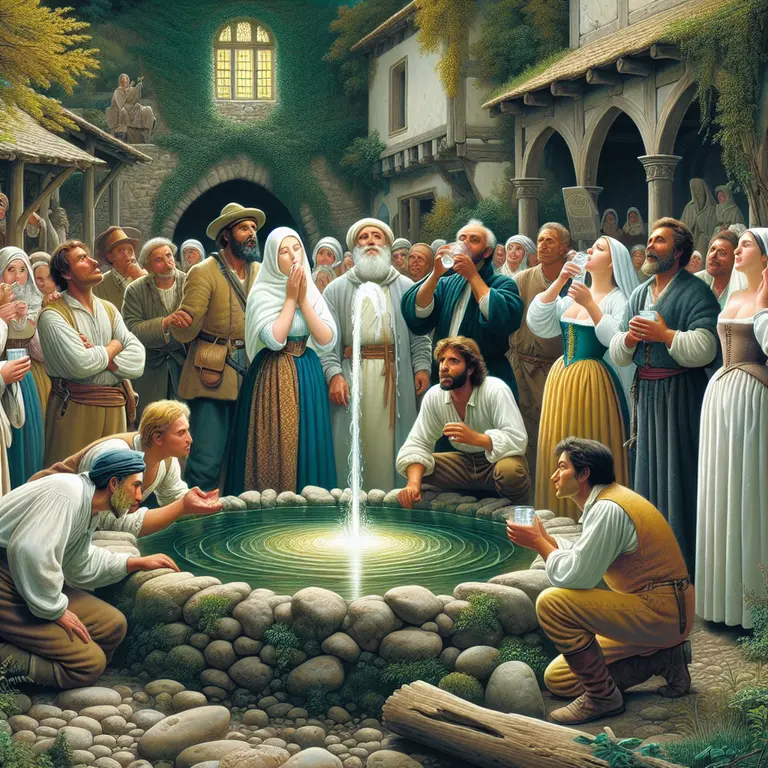
If you asked a medieval European pilgrim why they traveled hundreds of miles to drink from a particular spring, they would describe visions, divine intervention, and miraculous recoveries. They might tell you about the saint whose bones rested nearby, or the shepherd who first witnessed the waters glowing faintly in the dark, or the lame man who walked home unaided after three days of bathing. If you then asked a modern radiochemist to analyze the water in some of those same springs, they might hand you a Geiger counter reading and raise an eyebrow.
Some of the most celebrated healing springs in pre-modern Europe, including sites in the Bohemian spa region of what is now the Czech Republic, the Pyrenees, and parts of the British Isles, were naturally high in radon gas and dissolved radium, both radioactive decay products of uranium in the surrounding granite bedrock. The pilgrims were not wrong that something unusual was happening to their bodies. They were simply working with the explanatory vocabulary available to them, which happened to be entirely theological rather than nuclear.
This is not a story about medieval gullibility. It is a story about how the same physical phenomenon can be simultaneously a geological accident, a religious experience, a public health risk, a linguistic ancestor of global currency, and a genuinely unresolved question in modern radiobiology. Few single topics sit at so many disciplinary crossroads at once.
Radioactivity Before Anyone Knew What It Was
Radium was not isolated until 1898, when Marie and Pierre Curie extracted it from pitchblende ore after processing several tons of material in a leaking shed in Paris. Radon, the colorless, odorless gas produced by radium decay, was characterized shortly thereafter. But people had been bathing in and drinking from uranium-rich spring water for at least a thousand years before the Curies were born, and they had been crediting the results to saints, spirits, and divine favor for the entirety of that period.
The famous spa town of Jáchymov, known in German as Joachimsthal, in Bohemia, provides one of the most striking examples of this overlap. Its thermal springs drew visitors for centuries before anyone had a framework to explain why the water felt different, why the warmth seemed to penetrate deeper than ordinary heat, or why some visitors reported improvements in chronic conditions that had resisted every other remedy. The town sat atop one of the most significant uranium-bearing geological formations in Central Europe, and the springs that bubbled up from it carried measurable radioactivity.
Jáchymov later became the site of silver mining so economically significant that the coins minted from its ore were called Joachimsthaler, a name that was gradually shortened to thaler, and which traveled through Dutch as daler before arriving in English as dollar. The same mountain range that quietly irradiated medieval spa visitors for centuries gave the world its most universally recognized currency denomination. The geological formation responsible for the healing reputation of the waters was the same one that financed European trade economies and, eventually, lent its name to the monetary unit printed on every American banknote.
The connection does not stop there. By the early twentieth century, after radioactivity had been discovered and before its dangers were fully understood, radon therapy became a legitimate and fashionable medical industry across Central Europe. Sanatoriums in Jáchymov, Bad Gastein, Austria, and several other spa towns marketed radon-rich waters as treatments for arthritis, gout, neuralgia, and chronic pain. These were not fringe establishments operating at the margins of respectability. Radon baths and radon inhalation chambers were prescribed by licensed physicians, endorsed by medical associations, and sought out by wealthy patients who could afford the journey. The medieval pilgrim and the Edwardian aristocrat were, in a meaningful sense, doing the same thing for reasons they each believed were entirely rational.
The Strangest Part: It Might Have Worked
Here is where the story becomes genuinely counterintuitive, and where it stops being merely a curiosity of history and starts being a live question in contemporary science. Modern radiobiology includes a hypothesis called hormesis, which proposes that very low doses of ionizing radiation may trigger mild cellular stress responses that actually stimulate repair mechanisms rather than damage them, temporarily reducing inflammation and producing measurable physiological effects distinct from both the effects of no radiation and the effects of harmful doses.
The hormesis hypothesis is contested. It is not an accepted clinical treatment in mainstream medicine, and it should not be confused with any endorsement of unregulated radiation exposure. However, a body of peer-reviewed research, including controlled studies conducted in Austrian radon spa facilities as recently as the early 2000s, has found that patients with rheumatoid arthritis reported statistically significant short-term reductions in pain and inflammation following low-dose radon exposure. The proposed mechanisms involve upregulation of certain antioxidant enzymes and transient suppression of pro-inflammatory cytokines, though the precise biological pathway remains under investigation, and the evidence is not yet strong enough to have changed clinical guidelines.
What this means, taken carefully and with appropriate scientific humility, is that the medieval pilgrim who drank from a radioactive spring and attributed their reduced joint pain to a saint’s intercession may have been experiencing a real physiological effect. The mechanism was spectacularly misidentified. Theology was doing the explanatory work that biology had not yet been developed to perform. But the outcome, a measurable reduction in inflammatory symptoms following exposure to the water, may have been genuine rather than purely psychosomatic.
This does not rehabilitate the practice of drinking from unregulated radioactive springs, and it does not validate the theological framework that surrounded it. What it does is complicate the easy narrative in which pre-modern people were simply deceived by their own credulity. The springs had a real effect. The people who traveled to them were responding to something. The error was not in noticing the effect but in the story constructed to explain it.
A Cross-Disciplinary Intersection Unlike Almost Any Other
It is worth pausing to appreciate how unusual this particular convergence of topics actually is. The healing springs of medieval Europe sit at the intersection of religious geography, nuclear physics, economic history, etymology, and pharmacology in a way that almost no other single subject manages. Each of those disciplines has its own account of the same physical object, the same water flowing from the same bedrock, and none of those accounts is simply wrong.
The religious geographer sees a network of pilgrimage sites organized around reported miracles, shaping travel routes, funding ecclesiastical construction, and embedding specific locations into sacred cosmology. The nuclear physicist sees uranium decay chains producing radon gas that dissolves into groundwater at concentrations determined by local geology. The economic historian sees the same ore deposits that financed silver coinage, which became the etymological root of a word now spoken in every financial market on earth. The pharmacologist sees a contested but not dismissible body of evidence suggesting that the water may have produced real anti-inflammatory effects in some of the people who used it.
These accounts do not contradict each other. They describe the same phenomenon from different distances and with different instruments. The miracle and the mechanism were always the same water. Only the vocabulary changed, and the vocabulary changed because the instruments changed, and the instruments changed because the questions changed, and the questions changed because the old answers eventually stopped satisfying the people asking them.
Conclusion
The story of Europe’s radioactive healing springs is a reminder that the boundary between the miraculous and the explicable is not a boundary between the real and the imaginary. It is a boundary between what can be measured and what cannot yet be measured, between the frameworks available at a given moment and the phenomena those frameworks are being asked to contain.
Medieval pilgrims were not irrational for seeking relief at springs that offered it. Early twentieth-century physicians were not fraudulent for prescribing treatments that had some observational basis. Contemporary radiobiologists are not irresponsible for investigating whether low-dose radiation produces hormetic effects, even if the answer turns out to be more complicated than either proponents or critics currently believe. Each group was doing the best available science with the best available tools, which is more or less what science has always been.
The radioactive springs of Bohemia, the Pyrenees, and the British uplands will continue to flow whether or not anyone drinks from them. The radon will continue to rise through the granite, the water will continue to carry it to the surface, and the geology will remain entirely indifferent to the human arguments conducted above it. That indifference is, in its own way, the most clarifying fact in the entire story.