
Unexpected Cosmic Discovery: The Tale of a Persistent Hiss
How pigeon droppings and radio static led to crucial evidence for the Big Bang theory
 Watch on YouTube
 Watch on Rumble
The Accidental Discovery of Cosmic Microwave Background Noise
In the pantheon of scientific breakthroughs, few discoveries combine the profound with the mundane quite like the detection of cosmic microwave background radiation. What began as a frustrating technical problem for two radio astronomers in New Jersey would ultimately transform our understanding of the universe’s origins and provide the most compelling evidence for the Big Bang theory. This remarkable story weaves together cutting-edge technology, persistent pigeons, and the oldest light in existence—revealing how scientific advancement often follows unexpected paths.
The Mysterious Hum at Holmdel
In 1964, two Bell Labs radio astronomers, Arno Penzias and Robert Wilson, were deeply annoyed by a persistent background noise interfering with their sensitive radio antenna experiments. This wasn’t just any antenna—it was a massive, ultrasensitive horn reflector originally built to detect radio waves bounced off Echo balloon satellites. Standing 20 feet tall with a bell-shaped opening 20 feet in diameter, the Holmdel Horn Antenna represented the pinnacle of radio astronomy technology at the time.
The antenna had been designed with extraordinary precision to detect the faintest signals from space. Its aluminum surface was perfectly shaped to focus incoming radio waves, and its receiver was cooled with liquid helium to minimize thermal noise. Yet despite these precautions, Penzias and Wilson kept encountering a persistent low-level hiss that appeared uniform regardless of where they pointed their instrument.
The methodical scientists embarked on what would become a months-long detective story. They first suspected an equipment malfunction and recalibrated their instruments repeatedly. They considered interference from New York City’s radio stations, radar from nearby military installations, and even radiation from recent nuclear tests. Each potential culprit was systematically eliminated. They even climbed inside the horn to tape over seams that might be causing electrical resonances. The mysterious hum remained, measuring approximately 3.5 Kelvin above absolute zero (later refined to 2.7K) and coming uniformly from every direction in the sky.
The Avian Interference
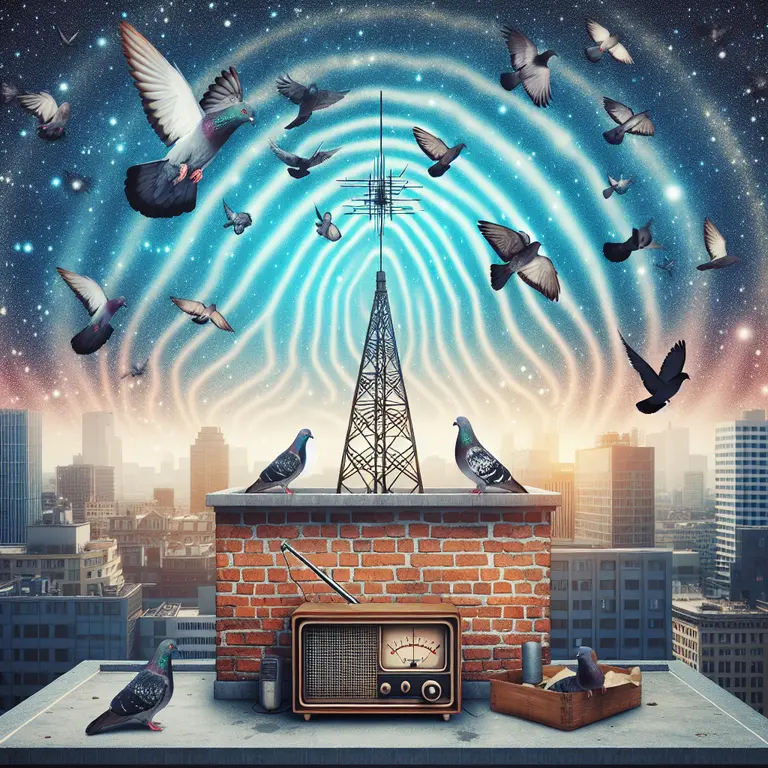
The investigation took an unexpected ornithological turn when Penzias and Wilson discovered something truly bizarre: a pair of pigeons had nested in the antenna and covered it with what they scientifically described in their notes as “white dielectric material” (yes, that’s pigeon droppings). The fastidious researchers believed they had finally found their culprit.
Surely, they thought, removing the birds and cleaning their mess would solve the problem. But the pigeons proved as persistent as the mysterious signal. After capturing the birds and releasing them miles away, the determined creatures promptly returned to their prime real estate. The scientists’ frustration grew to the point where they eventually resorted to shooting the pigeons—a detail notably absent from most physics textbooks and classroom discussions of this Nobel Prize-winning discovery.
With the antenna thoroughly cleaned of all avian contributions, Penzias and Wilson resumed their measurements with high hopes. To their astonishment, the mysterious noise persisted at exactly the same level. The pigeons, while problematic, were not responsible for the cosmic hiss. This realization forced the researchers to consider an extraordinary possibility: perhaps the signal wasn’t interference at all, but something far more significant.
The Cosmic Connection
What makes this discovery particularly astonishing is that, just 30 miles away at Princeton University, physicist Robert Dicke and his team were actively building an instrument specifically designed to detect the exact cosmic microwave background radiation predicted by Big Bang cosmology. Theoretical work by George Gamow, Ralph Alpher, and Robert Herman in the late 1940s had predicted that if the universe began in a hot, dense state (the Big Bang), the afterglow of this primordial fireball should still be detectable as a faint microwave radiation permeating all of space.
When a mutual colleague connected the two research groups, the significance of the Bell Labs “noise problem” became immediately apparent. Dicke, upon hearing about Penzias and Wilson’s persistent signal, reportedly told his research team: “Well, boys, we’ve been scooped.” The Princeton physicist immediately recognized what the Bell Labs researchers had stumbled upon: the fossil radiation from the early universe, cooled by cosmic expansion to just a few degrees above absolute zero.
The accidental discovery earned Penzias and Wilson the 1978 Nobel Prize in Physics, despite the fact that they initially had no idea what they had found. Their paper reporting the discovery was remarkably understated, focusing primarily on the technical aspects of eliminating possible sources of interference, with no mention of the Big Bang implications. The cosmological interpretation was published separately by Dicke’s team in a companion paper.
The Profound Implications
The discovery of cosmic microwave background (CMB) radiation fundamentally changed our understanding of the universe. Before this finding, the Big Bang theory competed with the Steady State theory, which proposed that the universe had always existed in roughly its current form. The uniform, omnidirectional nature of the CMB provided irrefutable evidence that the universe had indeed begun in an extremely hot, dense state approximately 13.8 billion years ago.
Subsequent missions like NASA’s Cosmic Background Explorer (COBE), the Wilkinson Microwave Anisotropy Probe (WMAP), and the European Space Agency’s Planck satellite have mapped the CMB with increasing precision, revealing tiny temperature fluctuations that correspond to the seeds of cosmic structure—the earliest ancestors of today’s galaxies and galaxy clusters.
Perhaps most surprising is that we can directly detect the afterglow of an event that happened 13.8 billion years ago using technology no more complex than what you’d find in a microwave oven or an old television. When you see static on an untuned analog TV, about 1% of that noise is actually cosmic microwave background radiation—you’re literally seeing the remnant heat from the birth of the universe.
The Serendipity of Science
This case of scientific serendipity connects astronomy with ornithology in the most unexpected way—proving that sometimes the most profound discoveries about the origin of the universe can be hindered by something as mundane as bird droppings. It also demonstrates how scientific breakthroughs often happen at the intersection of preparation, persistence, and pure luck.
The story of Penzias and Wilson reminds us that nature reveals its secrets in unexpected ways. Their discovery was possible because they refused to ignore an anomaly—the persistent noise that wouldn’t go away despite their best efforts. Rather than dismissing it as an unsolvable problem, they methodically eliminated every possible explanation until they were forced to consider that they had encountered something fundamental about the universe itself.
The discovery of the cosmic microwave background stands as one of science’s most eloquent examples of serendipity—where being in the right place, with the right equipment, the right problem, and the right mindset converged to unveil one of the universe’s most closely held secrets. It reminds us that sometimes the most significant discoveries don’t announce themselves with fanfare, but rather with a persistent hiss that refuses to be silenced.