
Unexpected Discovery: How Pigeons Helped Prove the Big Bang
How pigeon droppings and radio static led to evidence of the Big Bang
 Watch on YouTube
 Watch on Rumble
In 1964, two Bell Labs radio astronomers, Arno Penzias and Robert Wilson, were battling a persistent and inexplicable noise in their state-of-the-art horn antenna. This highly sensitive instrument, originally designed to detect radio waves bounced off Echo balloon satellites, kept picking up a mysterious background hiss that interfered with their observations.
The noise was maddening—it seemed to come no matter where they pointed the antenna in the sky. It was there day and night, across seasons. Penzias and Wilson meticulously eliminated every possible source of interference:
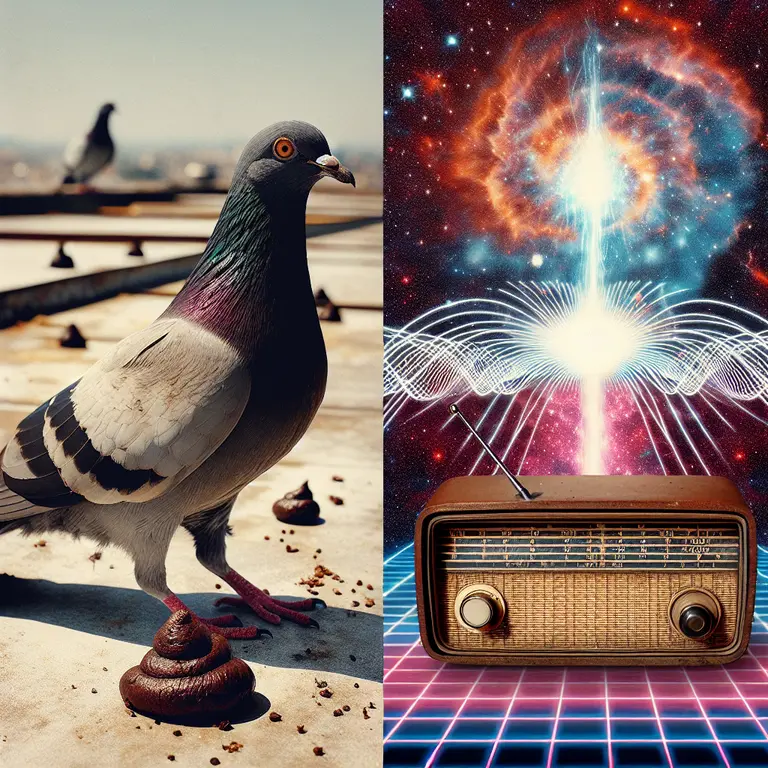
They cooled the receiver to eliminate thermal noise, rewired circuits to reduce equipment interference, and even dismantled parts of the antenna to clean out what they described in their notes as “white dielectric material”—which was, in fact, pigeon droppings from a family of pigeons nesting in the horn.
After capturing the pigeons and mailing them to a location miles away (they promptly returned), the scientists eventually resorted to shooting the persistent birds. Yet even after this drastic measure and thorough cleaning, the mysterious 3.5 Kelvin background hum remained.
The Holmdel Horn Antenna: From Cold War Tech to Cosmic Discovery
The 20-foot horn-reflector antenna at Bell Laboratories in Holmdel, New Jersey, wasn’t built for cosmology. Constructed in 1959, it represented cutting-edge telecommunications technology designed for the nascent field of satellite communications. The horn’s unusual shape—resembling a giant ear trumpet—was specifically engineered to minimize signal interference, making it ideal for the Echo and Telstar satellite projects that were part of America’s technological response to Sputnik.
The antenna’s design was revolutionary for its time. Unlike conventional dish antennas, the horn-reflector combination offered extremely low noise and high directional precision. Its aluminum surface was meticulously crafted to reflect microwave signals with minimal distortion, while its horn shape prevented ground radiation from entering the receiver. This design made it extraordinarily sensitive—so sensitive, in fact, that it could detect the faint thermal radiation from Earth’s atmosphere.
Bell Labs, the research division of the American Telephone and Telegraph Company (AT&T), had invested in this technology not to probe cosmic mysteries but to expand America’s communications infrastructure. The Cold War context is crucial to understanding this investment—reliable satellite communications were seen as vital to national security and technological prestige. Penzias and Wilson were tasked with calibrating and refining this instrument for telecommunications purposes, not for fundamental cosmological research.
From Annoyance to Nobel Prize
What Penzias and Wilson had stumbled upon—initially considering it nothing but an equipment failure or contamination—was actually the cosmic microwave background radiation (CMB), the afterglow of the Big Bang itself. This uniform radiation permeates the entire universe as a remnant from approximately 380,000 years after the universe’s birth, when the cosmos had cooled enough for electrons to combine with protons, allowing light to travel freely for the first time.
The most surprising aspect? At nearly the same time, just 30 miles away at Princeton University, physicist Robert Dicke and his team were specifically building equipment to search for precisely this radiation, which had been theoretically predicted. When Dicke heard about the Bell Labs “noise problem,” he famously remarked to his colleagues: “Boys, we’ve been scooped.”
The theoretical groundwork for this discovery had been laid decades earlier. In 1927, Georges Lemaître, a Belgian priest and physicist, had proposed what would later be called the Big Bang theory, suggesting the universe began as a “primeval atom.” In 1948, physicists Ralph Alpher, Hans Bethe, and George Gamow published the influential “Alpha-Beta-Gamma” paper predicting that if the Big Bang had occurred, residual radiation should still be detectable throughout the universe. By the early 1960s, Dicke’s team had independently reached similar conclusions and was actively searching for this radiation.
Penzias and Wilson published their finding as a simple observation of excess antenna temperature in the Astrophysical Journal, while Dicke’s team published the cosmological interpretation in companion papers. This accidental discovery—initially mistaken for bird droppings—earned Penzias and Wilson the 1978 Nobel Prize in Physics, fundamentally altering our understanding of cosmic origins.
The Pigeons’ Unwitting Contribution to Cosmology
The pigeons that nested in the Holmdel horn antenna have earned their peculiar place in scientific history. These birds—ordinary rock doves (Columba livia)—were attracted to the sheltered, concave interior of the horn, which provided an ideal nesting location protected from predators and weather. Their presence was more than a mere anecdotal curiosity; it represented a significant confounding variable in one of astronomy’s most important discoveries.
The “white dielectric material” (the scientists’ euphemism for pigeon excrement) was initially considered a potential source of the unexplained signal. Pigeon droppings contain uric acid crystals that can reflect radio waves, potentially creating signal interference. Penzias and Wilson documented their battle with the birds in their meticulous lab notes, including their increasingly desperate measures to remove them.
Their initial humane approach—capturing and relocating the birds—proved futile because pigeons’ remarkable homing abilities allow them to navigate back to nesting sites from distances of hundreds of miles. The scientists’ eventual decision to eliminate the birds (described in scientific papers as “discouraged from roosting”) highlights the frustration they experienced in their quest to eliminate all potential sources of interference.
Ironically, while the pigeons complicated the discovery process, they also ensured its thoroughness. By forcing Penzias and Wilson to systematically rule out every conceivable source of interference, the birds inadvertently pushed the scientists toward the remarkable conclusion that the signal they were detecting truly came from beyond Earth—from the very birth of the universe itself.
Serendipity in Science: The Pattern of Accidental Discoveries
The CMB discovery exemplifies a recurring pattern in scientific history: breakthroughs often occur by accident while researchers are pursuing entirely different goals. This phenomenon, sometimes called “serendipity,” has been responsible for numerous pivotal scientific advances, from Alexander Fleming’s discovery of penicillin to Wilhelm Röntgen’s discovery of X-rays.
What distinguishes productive serendipity from mere luck is the prepared mind that recognizes significance in unexpected observations. Penzias and Wilson possessed the technical expertise to eliminate conventional explanations for the noise in their antenna and the scientific curiosity to pursue the anomaly rather than ignore it. When they eventually connected with Robert Dicke’s team, the theoretical framework for interpreting their observation was already in place.
The Bell Labs culture of the 1960s also played a crucial role in this discovery. Despite being a corporate research facility primarily focused on telecommunications technology, Bell Labs fostered an environment where scientists could pursue unexplained phenomena, even when they seemed unrelated to immediate commercial applications. This institutional flexibility allowed Penzias and Wilson to devote significant time to investigating the mysterious noise from their antenna.
Conclusion: From Static to Cosmic Significance
The discovery of cosmic microwave background radiation transformed our understanding of the universe’s origins, providing compelling evidence for the Big Bang theory over competing models like the Steady State theory. What began as an annoying technical problem—complicated by nesting pigeons—ended as one of the most significant astronomical discoveries of the 20th century.
This story reminds us that scientific progress rarely follows a linear, predictable path. The universe’s origin story was hiding in what engineers considered annoying static, detected by an instrument designed for entirely different purposes. The intersection of telecommunications engineering and cosmology—two seemingly unrelated fields—produced a breakthrough that neither discipline might have achieved independently.
Perhaps most importantly, this discovery demonstrates how scientific advancement often depends on recognizing significance in the unexpected. In the static that most would ignore, Penzias and Wilson found the echo of creation itself—proving that sometimes, cleaning up after pigeons can indeed lead to understanding the very origins of our universe.