
Quantum Internet: Revolutionizing Communication and Security
Explore the potential of the quantum internet, a groundbreaking technology that promises to revolutionize secure communication and data transmission across the globe.
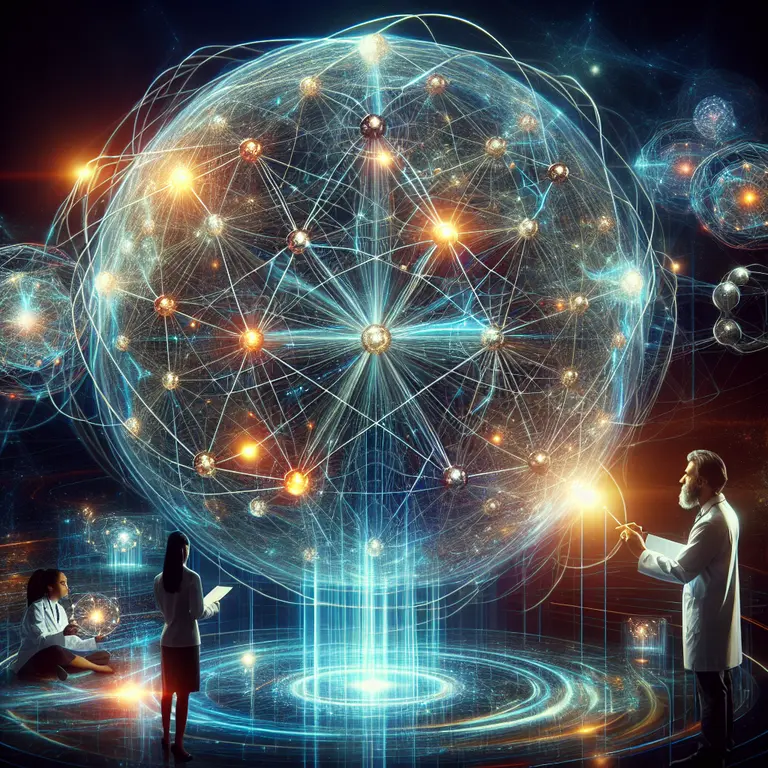
 Watch on YouTube
 Watch on Rumble
The Quantum Internet: A New Era in Secure Digital Communication
We live in an age where digital communication underpins nearly every aspect of modern life, from financial transactions and healthcare records to national security and scientific research. Yet the very infrastructure that makes this connectivity possible is increasingly vulnerable to sophisticated cyber threats. Classical encryption methods, once considered impenetrable, are now facing an existential challenge from the rapid advancement of quantum computing. Into this landscape enters one of the most ambitious technological undertakings in human history: the quantum internet. Far more than an incremental upgrade to existing networks, the quantum internet represents a fundamental reimagining of how information can be transmitted, secured, and processed. By harnessing the counterintuitive laws of quantum mechanics, it promises capabilities that would have seemed like pure science fiction just a generation ago.
Understanding Quantum Communication
To appreciate what the quantum internet offers, it is necessary to first understand the principles of quantum mechanics that enable it. At the core of quantum communication lies a phenomenon called entanglement, a process by which two or more particles become interconnected in such a way that the state of one instantly influences the state of the other, regardless of the physical distance separating them. This is not a matter of sending a signal between the particles. The correlation is immediate, a fact that famously unsettled Albert Einstein, who dismissed it as “spooky action at a distance.” Yet decades of experimental physics have confirmed that entanglement is not only real but reproducible and measurable.
Classical communication systems encode information in binary form, using bits that represent either a 0 or a 1. Quantum systems, by contrast, use quantum bits, or qubits, which can exist in a state of superposition. This means a qubit can represent 0, 1, or any combination of both states simultaneously, until the moment it is measured. This property exponentially increases the informational capacity of quantum systems compared to their classical counterparts. When combined with entanglement, superposition allows for forms of data transmission that are not only faster in certain respects but also fundamentally more secure. The rules governing quantum states ensure that any attempt to observe or copy quantum information without authorization will inevitably disturb the system, leaving a detectable trace.
The Role of Quantum Entanglement and Key Distribution
Quantum entanglement is not merely a theoretical curiosity. It is the practical engine powering one of the most important applications of the quantum internet: quantum key distribution (QKD). In classical encryption, two parties wishing to communicate securely must first agree on an encryption key. The security of this exchange depends on the assumed difficulty of certain mathematical problems, such as factoring large numbers. QKD replaces this assumption-based security with a guarantee rooted in the laws of physics themselves.
In a QKD system, entangled particles are distributed between two communicating parties. Because any eavesdropper attempting to intercept the transmission would necessarily disturb the quantum states involved, both the sender and receiver are immediately alerted to the intrusion. This is not a matter of detecting a sufficiently clever hacker. It is a consequence of quantum mechanics that cannot be circumvented, no matter how powerful the adversary’s computational resources. The first successful demonstration of QKD was conducted in 1989 by Charles Bennett and Gilles Brassard, and since then, researchers have extended its range to hundreds of kilometers via fiber-optic cables and even to over a thousand kilometers via satellite, as demonstrated by China’s Micius satellite experiment in 2017. These milestones confirm that entanglement-based communication is not merely theoretical but is actively being realized.
Overcoming the Technical Challenges of Building a Quantum Network
Despite these impressive advances, constructing a fully functional global quantum internet remains an enormously complex engineering challenge. Quantum states are extraordinarily fragile. Even minor environmental disturbances, such as temperature fluctuations, vibrations, or electromagnetic interference, can cause decoherence, in which qubits lose their quantum properties and become useless for computation or communication. Maintaining entanglement over long distances significantly amplifies this problem.
One of the most promising solutions to this challenge is the development of quantum repeaters. Unlike classical signal repeaters, which simply amplify a signal, quantum repeaters must extend the range of entanglement without ever directly measuring the quantum state, since such a measurement would collapse it. This is achieved through a process called entanglement swapping, in which intermediate nodes create and link entangled pairs in a chain, effectively extending the reach of quantum communication in steps. Researchers at institutions including Delft University of Technology in the Netherlands have already demonstrated rudimentary quantum networks using this principle, connecting multiple nodes across a small city-scale distance.
Another significant challenge is integrating quantum networks with the existing classical internet infrastructure. A sudden wholesale replacement of global communications systems is neither practical nor economically feasible. Instead, a hybrid model is expected to evolve over time, in which quantum channels are used selectively for the most sensitive communications while classical networks continue to handle the bulk of everyday traffic. This transitional architecture will require new protocols, specialized hardware, and international standards that do not yet fully exist. The development of quantum memory, devices capable of storing quantum states long enough to synchronize entanglement across a network, is another active area of research that will be critical to making this vision a reality.
Future-Proofing Security in the Age of Quantum Computing
One of the most pressing reasons to accelerate quantum internet development is the looming threat posed by quantum computers to current encryption standards. The most widely used encryption protocols today, including RSA and elliptic curve cryptography, derive their security from the computational difficulty of factoring large numbers or solving discrete logarithm problems. For classical computers, these tasks require prohibitively long processing times. For a sufficiently powerful quantum computer running Shor’s algorithm, they become manageable.
Shor’s algorithm, developed by mathematician Peter Shor in 1994, demonstrated theoretically that a quantum computer could factor large numbers exponentially faster than any known classical algorithm. While today’s quantum computers remain too small and error-prone to execute Shor’s algorithm at the scale needed to break real-world encryption, the trajectory of the technology is clear. Security experts refer to the future moment when this becomes possible as “Q-Day,” and governments and corporations around the world are already preparing for it. The United States National Institute of Standards and Technology finalized its first set of post-quantum cryptographic standards in 2024, acknowledging that the threat is no longer hypothetical.
The quantum internet offers a direct response to this threat. Rather than replacing one mathematical problem with a harder one, as post-quantum classical cryptography attempts to do, QKD eliminates the mathematical assumption entirely. Security becomes a product of physical law rather than computational complexity, making it resilient not just against today’s threats but against any future advances in computing power.
Potential Applications Across Industries
The implications of a functional quantum internet extend well beyond cryptography. In the financial sector, quantum-secured networks could eliminate entire categories of fraud and data breaches that currently cost the global economy hundreds of billions of dollars annually. Healthcare systems could transmit genomic data, medical imaging, and patient records with absolute confidentiality, enabling new forms of international medical research collaboration without compromising privacy. Pharmaceutical companies could use distributed quantum computing networks to model molecular interactions at a level of precision that would dramatically accelerate drug discovery.
In the realm of scientific research, the quantum internet could serve as the backbone for a new generation of distributed quantum supercomputers, linking quantum processors across continents to tackle problems in climate modeling, materials science, and fundamental physics that are currently beyond the reach of any single machine. Astronomical observatories could use quantum networks to synchronize their instruments with unprecedented precision, effectively creating Earth-sized telescopes for studying distant phenomena. The potential for cross-disciplinary breakthroughs is difficult to overstate.
Conclusion
The quantum internet stands at the intersection of theoretical physics, advanced engineering, and global policy, a technology that demands collaboration across disciplines and borders. Its development will not happen overnight, and the road ahead is filled with genuine technical obstacles that have yet to be solved. Yet the progress made in just the past decade, from satellite-based entanglement distribution to multi-node urban quantum networks, demonstrates that this is a matter of engineering persistence rather than fundamental impossibility. As the vulnerabilities of classical encryption become increasingly urgent and the capabilities of quantum hardware continue to grow, the quantum internet is transitioning from a visionary concept to a practical necessity. The networks we build in the coming decades will determine how securely and how freely humanity communicates in a world of increasingly powerful machines, and the principles of quantum mechanics may well be our most reliable guide.