
The Remarkable Tale of a Lost Medieval Green Future
Discover a forgotten medieval community that excelled in sustainable living techniques that are awe-inspiring even in modern times.
 Watch on YouTube
 Watch on Rumble
The Sylvan Collective: A Medieval Blueprint for Sustainable Living
In the annals of history, some communities stand out as extraordinary pioneers of innovation, sustainability, and harmony with nature. One such community, often overlooked despite its remarkable achievements, is the Sylvan Collective — a medieval society that flourished in what is now southern France during the 11th century. This unique group, bridging the divide between historical fact and folklore, created a self-sufficient, sustainable way of life long before such concepts entered modern discourse. Their practices, rooted in both ingenuity and deep respect for their natural environment, offer a treasure trove of insights for a world now grappling with accelerating environmental crises. To study the Sylvan Collective is to encounter a civilization that, centuries before the vocabulary existed to describe it, understood that human prosperity and ecological health are not competing interests but deeply intertwined.
Historical Context
The Sylvan Collective thrived in a time when feudal systems and agrarian economies dominated Europe. Rigid hierarchies, territorial disputes, and subsistence-level farming practices defined the era. Lords controlled vast tracts of land, serfs labored under conditions of near-total dependency, and the natural world was treated largely as a resource to be extracted rather than a system to be respected. Amid this landscape, the Sylvan Collective emerged as a striking anomaly. Nestled in a remote, forested region of southern France, they built a society that valued collaboration, innovation, and environmental stewardship above the accumulation of power or material wealth.
While much of their story has been preserved through oral traditions and fragments of historical records, it is evident that the community’s practices set them apart as a beacon of sustainable living during an otherwise tumultuous period. Scholars who have examined the surviving accounts note that the Collective appeared to operate with an almost systems-level awareness of how human activity affected the land, water, and wildlife around them. This was not a mere accident or a primitive instinct. It reflected a carefully cultivated philosophy passed down through generations and embedded into the daily rhythms of communal life.
Unlike the typical feudal estates that prioritized exploitation over conservation, the Sylvan Collective sought to live in harmony with its environment. Their commitment to sustainability extended across all facets of their society, from agriculture and architecture to energy use and governance. Over time, their methods have fascinated historians, environmentalists, and anthropologists seeking to understand how a medieval society could achieve such a degree of ecological and social equilibrium. The Collective challenges a common assumption that sustainability is a modern invention, suggesting instead that it is a rediscovery of wisdom that certain communities practiced long ago.
Agricultural Practices
The cornerstone of the Sylvan Collective’s sustainability was its innovative agricultural approach. In an age when most farming practices depleted soil fertility and relied on brutally labor-intensive methods, the Sylvan Collective implemented advanced techniques that prioritized long-term ecological balance over short-term yield.
Companion planting was one of their key innovations, a method now recognized and celebrated in modern permaculture. By planting legumes such as beans and peas alongside grains like wheat and barley, the community allowed these crops to naturally enrich the soil with nitrogen, eliminating the need for synthetic fertilizers. This symbiotic relationship between plants improved overall yields while preserving the health of their farmland across generations. The practice demonstrated a nuanced understanding of plant biology that most of their contemporaries lacked.
Additionally, the community practiced systematic crop rotation, alternating crops in a deliberate sequence to prevent soil exhaustion and reduce the risk of pest infestations. By giving sections of land periodic rest and varying the demands placed upon the soil, they maintained fertility without the need for constant clearing of new land — a practice that was devastating forests and watersheds across much of medieval Europe at the time.
The Sylvan Collective also placed great emphasis on maintaining natural ecosystems around their agricultural fields. They preserved hedgerows and forested buffers that supported biodiversity, encouraged pollination by native insects, and protected against soil erosion during heavy rains. These were not passive oversights but deliberate choices that reflected a deep understanding of the interconnectedness of ecological systems. Their fields were not islands of cultivation carved out of a hostile wilderness but integrated components of a larger living landscape they actively tended and protected.
Eco-Friendly Architecture
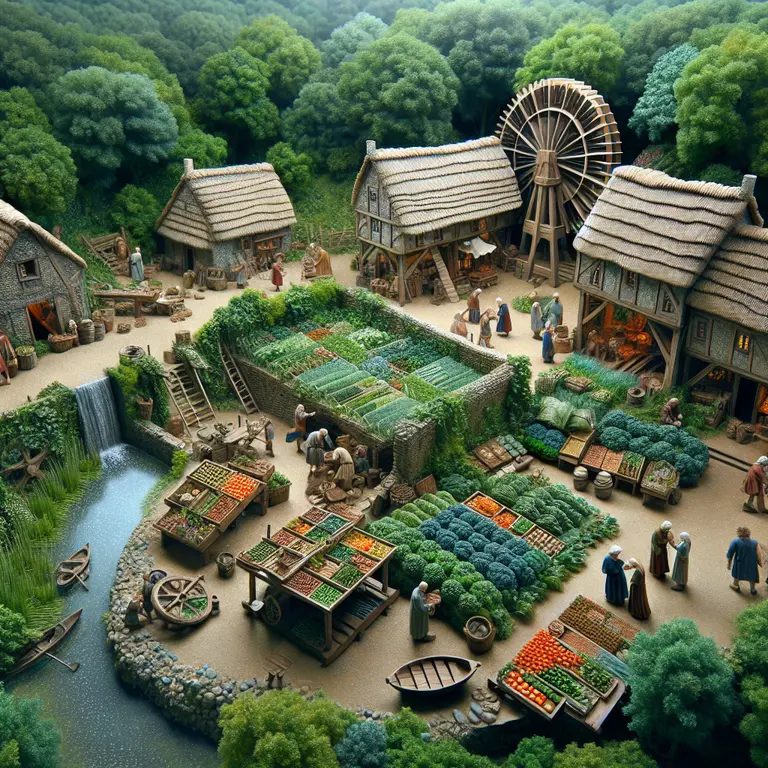
The ingenuity of the Sylvan Collective extended powerfully into its architecture, which was designed to integrate seamlessly with the natural environment rather than impose upon it. The community’s homes were built using locally sourced materials, minimizing the ecological footprint associated with transportation and processing. Stone, timber, clay, and plant fiber were gathered from within or immediately adjacent to their territory, and construction methods were developed to make the most efficient use of each material.
A hallmark of their architectural style was the use of living roofs — structures made from sod and native grasses layered over wooden beams. These roofs provided excellent natural insulation, keeping homes cool during summer months and retaining warmth through harsh winters, without any reliance on fuel-burning hearths beyond what was minimally necessary. The living roofs also absorbed rainwater, slowing runoff and reducing the erosion of surrounding soil during storms. In effect, each rooftop functioned as a small ecosystem in its own right, supporting mosses, wildflowers, and the insects that depended on them.
The living roofs served another purpose that speaks to the Collective’s broader philosophy: they allowed the buildings to blend harmoniously into the lush, green landscape, making the village far less intrusive on the natural surroundings. A traveler passing through the forest might barely notice the settlement at all. This was not simply an aesthetic choice. It reflected a worldview in which human habitation was meant to coexist with nature rather than announce its dominance over it. The Sylvan Collective’s approach to construction demonstrated how human settlements could exist and even thrive without fundamentally disrupting the delicate balance of the ecosystems they inhabited.
Renewable Energy and Resource Management
Long before the Industrial Revolution introduced fossil fuels as the dominant energy source, the Sylvan Collective demonstrated the considerable potential of renewable energy systems. The community relied heavily on water mills powered by the steady currents of nearby rivers. These mills were ingeniously designed and carefully positioned to grind grain, saw timber, and perform other labor-intensive tasks with remarkable efficiency, without causing environmental degradation.
This early adoption of renewable energy reduced the community’s dependence on human and animal labor while minimizing the need to burn wood or other organic materials at a scale that would have damaged the surrounding forest. The water mills symbolized the Collective’s broader approach to resource use: harnessing what nature provided in abundance and in perpetuity, rather than drawing down reserves that could not be replenished. The rivers freely and continuously gave their energy, and the mills returned nothing harmful to the water that powered them.
Beyond energy, the Collective applied similar principles to the management of timber, wild game, and freshwater. Hunting was regulated through communal agreement, with certain areas designated as protected zones where wildlife could reproduce undisturbed. Timber harvesting followed a rotational logic similar to their agricultural practices, ensuring that no section of forest was stripped faster than it could recover. These were not formal conservation policies in the modern regulatory sense, but they functioned with comparable effectiveness because they were grounded in a shared understanding that the community’s long-term survival depended on the health of the land around them.
Social Structure, Governance, and the Foundation of Collective Resilience
Perhaps the most remarkable aspect of the Sylvan Collective was its social structure and governance system. At a time when feudal hierarchies concentrated power and wealth in the hands of a tiny elite, the Sylvan Collective operated on principles of inclusivity and shared responsibility. Decision-making was a communal process, with every member of society having a meaningful voice in resource management, land use, conflict resolution, and community planning. No single individual held authority over the collective will.
This egalitarian governance model bore a striking resemblance to what modern political theorists might describe as participatory democracy or democratic socialism. It emphasized collective welfare over individual gain, and it created a system of accountability in which decisions about the environment were made by the very people who depended on it most directly. When a proposal was made to expand farmland, clear timber, or redirect water, the entire community weighed in on the consequences. This process was slower than the decrees of a feudal lord, but it was far less likely to produce the kind of short-sighted exploitation that devastated so many other medieval landscapes.
The Collective also fostered a strong sense of shared identity and mutual obligation. Children were educated in sustainable farming, construction, and resource stewardship from an early age, ensuring that the community’s knowledge and values were transmitted intact across generations. This cultural continuity was itself a form of resilience, protecting the community not only against environmental hardship but against the internal fragmentation that destroyed many other experimental societies of the period.
Legacy and Lessons for the Modern World
The legacy of the Sylvan Collective offers a powerful testament to humanity’s capacity for harmonious coexistence with nature. Their practices — from organic agriculture and eco-friendly architecture to renewable energy use and inclusive governance — highlight timeless principles that resonate deeply with today’s sustainability movements. As the modern world faces escalating environmental challenges, including climate change, biodiversity loss, and resource depletion, revisiting historical models like the Sylvan Collective can provide insights that are both humbling and genuinely useful.
One of the most critical lessons their story offers is the importance of viewing sustainability not as a singular policy goal or technical challenge but as an integrated way of life. The Collective did not have a sustainability department or an environmental committee. Their ecological wisdom was woven into every aspect of their farming, building, governance, and childrearing. The result was a community that could sustain itself for generations without exhausting the natural systems on which it depended.
The Sylvan Collective may occupy only a modest place in the historical record, and their story carries the inevitable uncertainty of any account preserved partly through oral tradition. But the principles they embodied are neither obscure nor inaccessible. They remind us that innovative solutions to environmental problems are often rooted in ancient wisdom, and that the path forward may require us to look backward with greater seriousness and humility. Their achievements stand as a quiet but enduring proof that sustainable living is not a modern ideal imposed on an unwilling world — it is a timeless possibility that human communities have realized before, and can realize again.