
Unveiling Paris's Catacombs: The Hidden Secrets Below
Explore the haunting, yet fascinating world beneath Paris, known as the Catacombs. Delve into their history, purpose, and the eerie stories surrounding this subterranean ossuary.
 Watch on YouTube
 Watch on Rumble
Introduction
Beneath Paris’s romantic boulevards and bustling cafés lies a hidden world steeped in history and shrouded in mystery: the Paris Catacombs. This vast network of underground ossuaries is more than an architectural curiosity; it is a haunting reminder of the city’s complex past, an artistic monument to mortality, and the subject of chilling folklore. Housing the remains of over six million people, the catacombs reveal a macabre intersection of necessity, creativity, and human resilience. Few places on earth compress so much history, so many lives, and so much philosophical weight into a single subterranean space. To walk through the catacombs is to move through centuries of Parisian civilization in its most elemental form, stripped of grandeur and reduced to the quiet permanence of bone and stone.
Origins and Historical Context
The story of the Paris Catacombs begins in the late 18th century, when the city was grappling with serious public health challenges that had been building for generations. Centuries of burials had overwhelmed Paris’s cemeteries, particularly Les Innocents Cemetery, one of the city's oldest and most densely packed burial grounds. The cemetery had become a hazard to nearby residents as decomposing bodies contaminated the ground and air, leading to widespread health concerns and even disease outbreaks. Complaints from the local population mounted as the stench from the graves pervaded the air, and the soil itself began to destabilize under the weight of the dead. In some accounts, the walls of neighboring buildings were reported to crack and lean inward as the saturated earth shifted beneath them.
To address this crisis, authorities turned to an unconventional solution: relocating human remains to the city’s abandoned limestone quarries. These quarries, which lay approximately 65 feet beneath the streets, had provided the building materials for iconic Parisian landmarks, including Notre Dame Cathedral and the Louver. Their labyrinthine tunnels, now empty after centuries of excavation, presented an ideal space for the grim task at hand. In 1786, the remains from Les Innocents Cemetery began their descent into the underground chambers, marking the official birth of the Paris Catacombs as a municipal ossuary.
This endeavor was as much a logistical feat as it was a symbol of innovation in urban planning. The transfer of remains was not conducted hastily or carelessly. Priests accompanied the processions of bones through the streets, blessing them by torchlight before they were lowered into the earth. It was not merely an effort to solve a public health crisis but also a reflection of the Enlightenment era’s growing emphasis on rationality, order, and collective welfare. The catacombs represented a society attempting to reconcile the realities of mass death with the demands of a modern, organized city, and doing so with a degree of solemnity that honored the dead even as it repurposed their resting places.
Over the following decades, remains from dozens of other Parisian cemeteries were added to the ossuary. By the early 19th century, the catacombs had received the bones of individuals from virtually every corner of the city, including victims of the French Revolution, the Reign of Terror, and various epidemic outbreaks. This convergence of the dead from radically different social circumstances created a space where aristocrats and commoners, revolutionaries and royalists, rested side by side in anonymous equality, a democratic irony that was not lost on the Parisian imagination.
Construction and Design
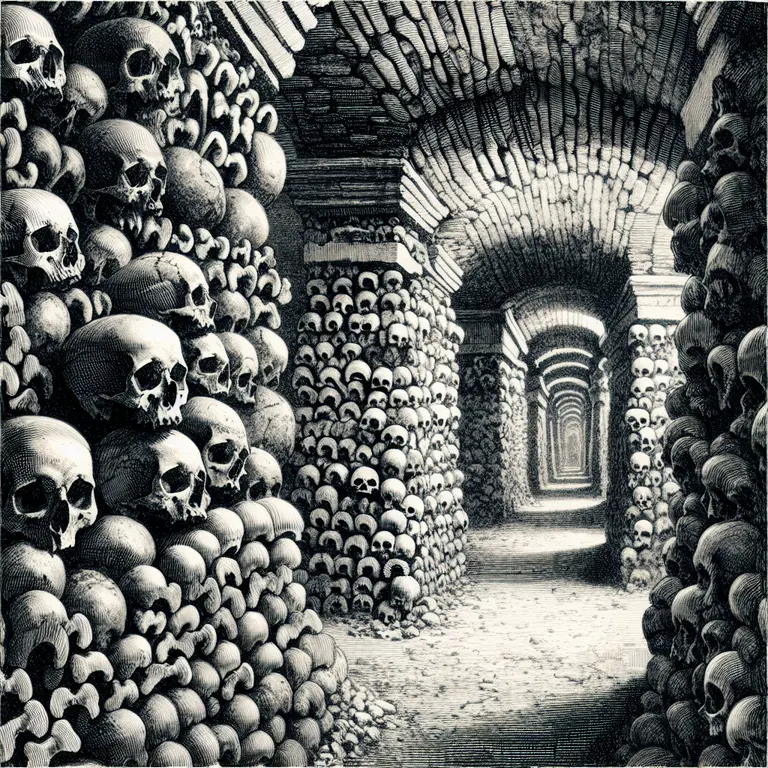
The construction and ongoing organization of the catacombs were immense undertakings, requiring meticulous planning and sustained execution over many years. Workers transported bones from various cemeteries across Paris, carefully stacking them along the tunnel walls in arrangements that were anything but random. Far from being haphazard, the remains were organized into hauntingly artistic displays, with skulls and femurs forming intricate geometric patterns that lined the passageways for hundreds of feet at a stretch.
These arrangements, often called “murals of mortality,” transformed the catacombs into a somber yet striking tribute to the dead. The deliberate design served both a practical and symbolic purpose. On one level, the neat organization maximized the available space within the tunnels, allowing millions of remains to be stored in a relatively compact underground environment. On another level, it reflected a profound philosophical statement about the universality of death and the fragility of human life. Inscriptions carved into the walls, such as the famous declaration “Stop! This is the Empire of Death,” further underscore the catacombs’ role as a place of reflection and reverence rather than mere storage.
The man most responsible for transforming the ossuary from a utilitarian depository into a space of artistic and spiritual meaning was Louis-Étienne Héricart de Thury, the Inspector General of Quarries in the early 19th century. Under his direction, the catacombs were reorganized and decorated to create a coherent aesthetic experience for visitors. He introduced the carved inscriptions, arranged the bones into more elaborate patterns, and opened sections of the tunnels to guided tours, effectively converting a public health solution into a cultural monument. His vision ensured that the catacombs would be remembered not as a dumping ground for the displaced dead but as a place of solemn beauty.
The engineering challenges involved in maintaining the catacombs were also considerable. The limestone tunnels, carved out over centuries of quarrying, were structurally fragile in places and required ongoing reinforcement to prevent collapse. The weight of the bones themselves, combined with the moisture that permeated the underground environment, created conditions that demanded constant attention. The fact that the catacombs have remained largely intact for over two centuries is a testament to the skill and dedication of the workers and inspectors who maintained them.
Cultural Significance and Folklore
Over the centuries, the Paris Catacombs have become deeply entwined with local folklore and eerie legend, adding layers of mystery to their already considerable historical weight. Stories of ghostly apparitions wandering the dark corridors are widespread, as are accounts of strange sounds and inexplicable sensations experienced by visitors who venture too far into the subterranean depths. The sheer scale of the tunnel network, most of which remains closed to the public, has made it fertile ground for the imagination.
One remarkably enduring legend concerns a man who entered the catacombs alone one evening in the 19th century, equipped only with a lantern. According to the tale, he became disoriented in the maze-like tunnels and was never seen again by those who knew him. His body was reportedly discovered years later, his lantern rusted and extinguished beside him. Some versions of the story claim that his restless spirit still roams the deeper passages, guiding or perhaps deliberately misleading those who dare to explore beyond the sanctioned boundaries.
The catacombs have also inspired a distinctly modern form of folklore centered on the subculture known as cataphiles, urban explorers who illegally enter the restricted portions of the tunnel network. These individuals, who have been active since at least the 1970s, have mapped extensive sections of the off-limits tunnels and have held underground gatherings, art installations, and even film screenings deep beneath the city. While French authorities periodically crack down on this activity, the cataphile community persists, adding a contemporary layer of mystery and counterculture mythology to the catacombs’ long history. Their existence speaks to the enduring human impulse to seek out hidden spaces and claim them, even temporarily, as sites of community and creativity.
The catacombs have also left a significant mark on literature, film, and visual art. Writers from Victor Hugo to contemporary thriller novelists have drawn on the imagery of tunnels, and several major films have used the catacombs as settings for horror and adventure narratives. This cultural presence has amplified the site’s mystique far beyond France's borders, ensuring that the catacombs occupy a prominent place in the global imagination of underground spaces.
Modern-Day Exploration
Today, the Paris Catacombs are one of the city’s most visited tourist destinations, offering a glimpse into a hauntingly beautiful world that exists in deliberate contrast to the brightness and energy of the streets above. However, only a small portion of the vast network, approximately 1.25 miles of its estimated 200 miles of tunnels, is open to the public. Visitors enter through a modest entrance in the 14th arrondissement and descend a narrow spiral staircase of nearly 130 steps into the depths of the ossuary.
The official tour is a humbling and thought-provoking experience. It guides visitors through dimly lit passageways where bones are stacked in orderly rows, the skulls gazing outward from the walls in silent testimony. The temperature underground remains a constant cool regardless of the season, and the atmosphere is one of hushed reverence that most visitors adopt instinctively, as though the weight of the place itself demands a certain quietude. The experience challenges perceptions of life and death in ways that are difficult to articulate but impossible to ignore.
For many visitors, the catacombs are more than a historical site. They are a space for genuine philosophical reflection, a rare place in the modern world where the fact of mortality is not softened or euphemized but presented plainly and on an overwhelming scale. Walking among the remains of six million Parisians, visitors are confronted with the fleeting nature of individual life and the enduring legacy of those who came before. It is an experience that bridges past and present, connecting modern explorers with the stories, struggles, and humanity of a bygone era in a way that no museum exhibit or textbook can fully replicate.
Conclusion
The Paris Catacombs are a testament to human ingenuity and resilience in the face of both practical and existential challenges. Born out of a public health crisis, they have evolved over more than two centuries into a cultural and historical landmark that continues to captivate, inspire, and unsettle in equal measure. Whether viewed as a marvel of urban planning, a work of macabre artistry, a repository of legend and folklore, or a philosophical meditation on mortality, the catacombs offer a uniquely powerful lens through which to examine the complexities of life, death, and collective memory.
Beneath the bustling streets of the City of Light lies a world that is as sobering as it is fascinating, a realm where history is written not in words but in bones. The Paris Catacombs remind us that even in death, humanity leaves behind a story worth telling, a legacy that endures long after the individual voices have fallen silent. In their dark and ordered passageways, six million lives persist as a single, unified monument to the fact that every civilization, no matter how luminous, is built upon the foundation of those who came before.