
The Mysterious Luminescent Waves of Vaadhoo Island
Explore the enchanting luminescent waves phenomenon on Vaadhoo Island in the Maldives, where nature meets otherworldly beauty.
 Watch on YouTube
 Watch on Rumble
Introduction
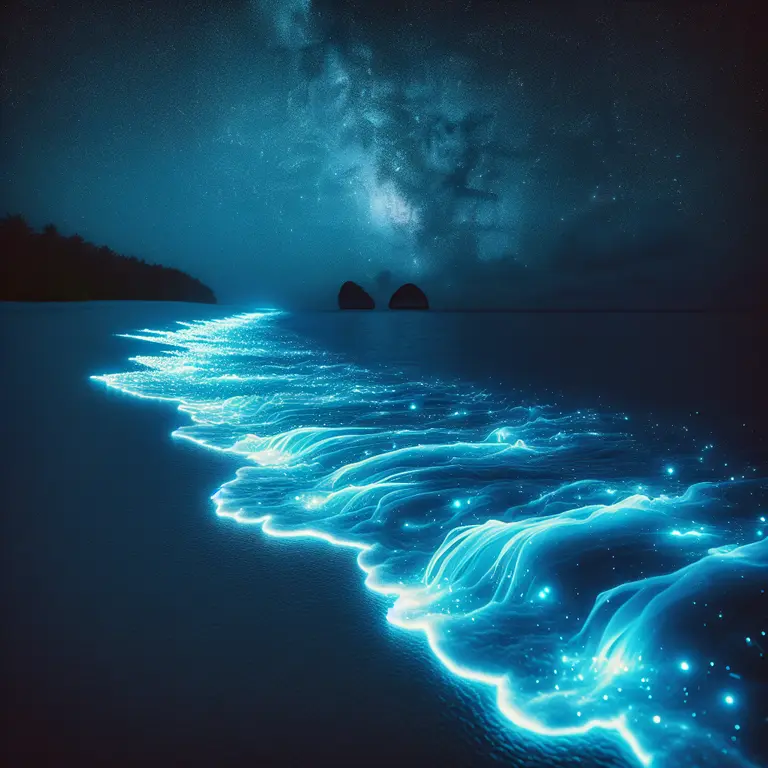
The world is brimming with natural wonders that evoke awe and admiration, but few phenomena captivate the imagination quite like the bioluminescent waves of Vaadhoo Island in the Maldives. Renowned for its pristine beaches, tranquil ambiance, and crystal-clear waters, this tiny island has earned international fame for a dazzling spectacle that transforms its shores into an otherworldly vision of glowing blue light. Dubbed “The Sea of Stars,” this natural wonder results from a remarkable interaction between microscopic organisms and the surrounding marine environment — a breathtaking example of nature’s artistry and ingenuity working in perfect, silent concert.
Vaadhoo Island itself is a modest place, home to fewer than 500 permanent residents and covering only a fraction of a square mile. Yet its global reputation far exceeds its physical size. Travelers from every corner of the world plan elaborate journeys to stand on its darkened shores and watch the ocean glow beneath their feet. What draws them is not luxury infrastructure or manufactured entertainment, but something far more ancient and far more extraordinary — a living light show produced by organisms so small they are invisible to the naked eye. Understanding what creates this phenomenon and why it matters beyond its visual beauty reveals a story as scientifically rich as it is visually stunning.
Understanding Bioluminescence
Bioluminescence is at the heart of this enchanting display — a biological process by which living organisms produce light through chemical reactions within their cells. This phenomenon occurs across a surprisingly wide range of marine species, including jellyfish, certain deep-sea fish, anglerfish, and various forms of plankton. On Vaadhoo Island, the primary architects of the glowing waves are dinoflagellates, a type of single-celled phytoplankton that emits a vivid neon-blue light when disturbed by movement or physical pressure.
The mechanism behind this glow involves two critical compounds found within dinoflagellate cells: luciferase, an enzyme, and luciferin, a light-emitting molecule. When these organisms are agitated — whether by crashing waves, the movement of swimming fish, or even the pressure of human footsteps along the wet shoreline — a chemical reaction is triggered that produces rapid bursts of cold, blue-green light. Unlike the heat-generating light produced by a flame or a light bulb, bioluminescent light releases almost no thermal energy, making it one of the most efficient forms of light production found anywhere in nature.
This bioluminescence is widely thought to serve as a defensive mechanism. When a predator disturbs a dense cloud of dinoflagellates, the sudden flash of light can startle the attacker, disrupt its hunting behavior, or attract a secondary predator that then targets the original threat — a phenomenon researchers sometimes call the “burglar alarm” effect. The result, when witnessed from a beach at night, is a breathtaking spectacle in which each wave that laps the shore ignites with shimmering blue light, as if the stars themselves have fallen into the sea. It is a defense strategy that, entirely by accident, produces one of the most beautiful sights on Earth.
Optimal Viewing Conditions
Visitors must carefully time their trips to Vaadhoo Island to witness the Sea of Stars in its full glory. The bioluminescent waves are most visible during dark, moonless nights when the absence of both artificial and natural light allows the ethereal glow to dominate the visual field. Even a half moon can diminish the spectacle considerably, washing out the subtle blue luminescence with ambient light. For this reason, experienced travelers often plan their visits around the lunar calendar, arriving during new moon phases to maximize the night sky's darkness.
The ideal viewing season falls between June and December, when nutrient-rich currents support the proliferation of dinoflagellates in the region’s warm, tropical waters. During these months, ocean temperatures and chemical conditions align to produce dense blooms of phytoplankton along the shoreline. These blooms are not always guaranteed — their intensity can vary significantly from night to night and year to year, depending on water temperature, salinity, and nutrient availability, such as nitrogen and phosphorus. This unpredictability is part of what makes a successful sighting feel so special.
Tourists strolling along the beach during peak conditions are often treated to a surreal and deeply personal experience. Their footsteps leave glowing trails in the wet sand, and the waves sparkle like liquid sapphire as they roll in from the darkness. Swimmers who enter the water describe being surrounded by swirling clouds of light that respond to every movement of their arms and legs. The experience engages multiple senses simultaneously, creating a feeling of immersion in something vast, ancient, and alive.
Scientific Insight into Bioluminescence
The bioluminescence on Vaadhoo Island is more than just a visual spectacle — it is a scientific marvel that continues to intrigue researchers across multiple disciplines. The phenomenon offers a glimpse into the synchronized behavior of billions of microscopic organisms that can emit light in unison within milliseconds of being disturbed. Despite significant advancements in marine biology and biochemistry, much remains unknown about the precise molecular mechanisms that govern this collective and near-instantaneous behavior across such large populations of independent cells.
Scientists studying bioluminescence have uncovered its profound importance within marine ecosystems. The light produced by dinoflagellates can deter predators, serve as chemical signaling between organisms, or even influence reproductive behavior. Beyond the organisms themselves, bioluminescence has become a critical tool for understanding broader environmental systems. Researchers use glowing plankton to track ocean current movements, study predator-prey dynamics in real time, and monitor environmental changes, such as shifts in water temperature, acidity, and nutrient levels. In this sense, the glow of the sea functions almost like a living instrument panel, reflecting the health of the ocean itself.
The scientific legacy of bioluminescence research extends well beyond the ocean. The discovery and isolation of green fluorescent protein from bioluminescent jellyfish, for example, earned three scientists the Nobel Prize in Chemistry in 2008. This protein has since become one of the most widely used tools in molecular biology, allowing researchers to tag and track individual cells, proteins, and genetic processes inside living organisms. Studies of luciferin and luciferase have similarly contributed to advances in medical imaging, cancer detection, and the development of biosensors capable of identifying environmental contaminants. Vaadhoo Island’s glowing waves are, in a very real sense, connected to breakthroughs happening in laboratories around the world.
A Tourist Attraction and Its Responsibilities
Unsurprisingly, Vaadhoo Island has become a sought-after destination for travelers from around the globe. Its idyllic beaches and serene atmosphere provide the perfect backdrop for the bioluminescent display, drawing thousands of visitors each year who arrive with cameras, journals, and a profound sense of anticipation. For many, witnessing the Sea of Stars is a once-in-a-lifetime experience that offers a rare and genuine connection to the natural world — something increasingly difficult to find in an age of screens and simulations.
Tourists often describe the phenomenon as magical, dreamlike, and profoundly moving. Walking along the glowing shoreline, they find themselves immersed in a surreal landscape where every step sparks a cascade of shimmering light. Yet this surge in tourism also brings responsibility. Increased foot traffic, water pollution from sunscreen and other chemicals, and the disruption caused by artificial lighting from resorts and photography equipment can all negatively affect the delicate conditions that support dinoflagellate blooms. Some marine biologists have raised concerns that poorly managed tourism could, over time, degrade the very phenomenon that draws visitors in the first place.
Cultural and Environmental Significance
Beyond its aesthetic and scientific appeal, Vaadhoo Island’s bioluminescence carries deep cultural and environmental significance. For the local communities of the Maldives, a nation composed entirely of low-lying coral atolls, the marine environment is not a backdrop but a foundation. The ocean provides food, income, cultural identity, and the land itself, since the islands are products of coral reef systems that have formed over thousands of years. The glowing waves serve as a powerful, visible reminder of the interconnectedness of all life in this fragile archipelago, highlighting the urgent need for sustainable practices to preserve these ecosystems for future generations.
The Maldives is also one of the nations most acutely threatened by climate change. Rising sea levels, coral bleaching driven by ocean warming, and increasing storm intensity all pose existential risks to the islands and the ecosystems that support them. In this context, the Sea of Stars takes on additional meaning. It is not only a wonder to be admired but a signal worth heeding. The health of the dinoflagellate blooms is tied to the health of the ocean as a whole, and any significant degradation of water quality or temperature stability could diminish or eliminate the phenomenon entirely.
Conclusion
The bioluminescent waves of Vaadhoo Island are a testament to the beauty, complexity, and resilience of the natural world. This awe-inspiring phenomenon captivates the senses while simultaneously deepening our understanding of marine life, ecological systems, and the biochemical processes that sustain them. Whether viewed as a scientific curiosity, a tourist destination, or a symbol of nature’s quiet ingenuity, the Sea of Stars reminds us that the most extraordinary things on this planet are often the result of the smallest and most overlooked forms of life.
As humanity grapples with the accelerating challenges of climate change, ocean acidification, and environmental degradation, the glowing shores of Vaadhoo Island carry a message that is both beautiful and urgent. They invite us to dream and to wonder, but also to act with greater care toward the systems that make such wonders possible. In the blue light of a billion microscopic organisms, there is both a celebration of what the natural world can offer and a quiet call to ensure that its brilliance continues to illuminate the darkness for generations to come.