
Exploring the Enigmatic Legacy of Japan's Feline Islands
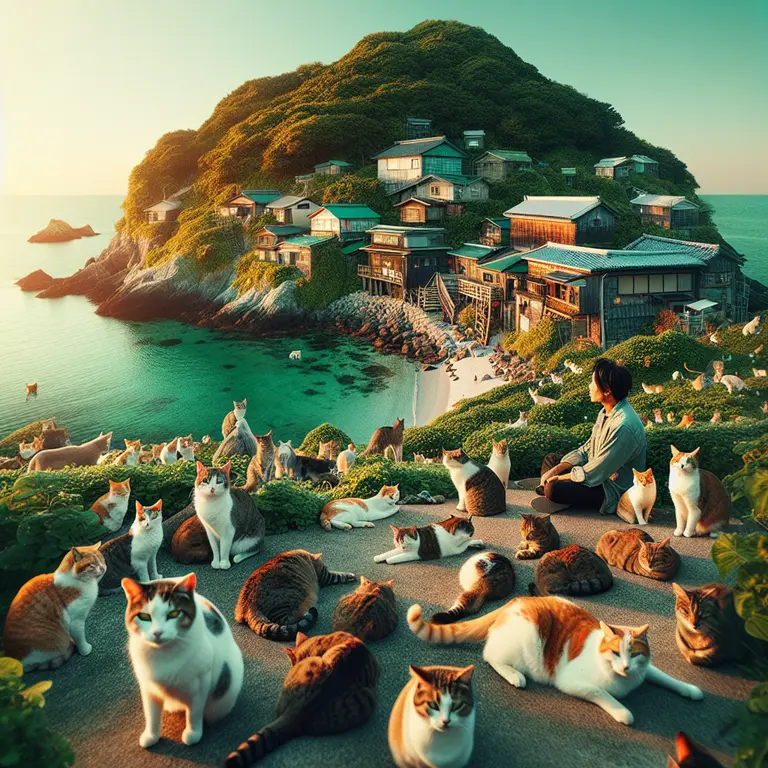
Japan is home to several islands, collectively known as 'Cat Islands,' where feline residents outnumber humans.
 Watch on YouTube
 Watch on Rumble
Japan’s Cat Islands: Where Felines Rule and Tradition Endures
Japan has long occupied a singular place in the global imagination, a nation where ancient ritual and ultramodern innovation coexist in a productive tension. Temples centuries old stand within sight of neon-lit city blocks. Farmers tend rice paddies within commuting distance of some of the world’s most densely populated urban centers. It is a country that seems to hold contradictions together with unusual grace. Nowhere is this more apparent, or more charmingly illustrated, than on Japan’s so-called Cat Islands, a scattered collection of small, often remote islands where domestic cats have come to outnumber human residents by extraordinary margins. These are not novelty destinations manufactured for tourists. They are genuine communities with deep histories, where the presence of cats is woven into the very fabric of daily life, economic survival, spiritual belief, and cultural identity. To visit one of these islands is to step into a world that quietly insists on its own logic, one shaped by centuries of coexistence between people and animals in circumstances that were rarely comfortable but always meaningful.
Tashirojima: The Crown Jewel of Cat Islands
The most celebrated of Japan’s Cat Islands is Tashirojima, a small landmass nestled off the coast of Ishinomaki in Miyagi Prefecture. It sits in the Pacific with a kind of unhurried stillness, its narrow lanes winding past weathered wooden houses, small shrines, and fishing equipment left to rest between uses. Once a bustling fishing village, Tashirojima has witnessed a significant and steady decline in its human population over the past several decades. Today, fewer than 100 residents remain, the majority of them elderly, living out their years in a place the wider world had largely forgotten until the cats made it famous again. Yet while the human numbers have dwindled, the island’s feline population has flourished with remarkable consistency, earning Tashirojima the moniker Cat Island and transforming it into a symbol of something rarer than tourism can usually manufacture, which is genuine, unscripted coexistence between humans and animals.
Tashirojima’s bond with its feline inhabitants stretches back over two centuries. Local fishermen, who relied entirely on the sea for their livelihoods, began to observe cats' behavior as an informal predictor of weather and fishing conditions. Cats, with their sensitivity to atmospheric pressure and environmental change, would behave differently before storms, and the fishermen learned to read these signals. Over time, what began as pragmatic observation evolved into something richer. Cats became indispensable companions, their instincts regarded as omens of good fortune, their presence on a boat or near the docks interpreted as a favorable sign before setting out on the water. This relationship, rooted in genuine utility, gradually accumulated layers of meaning that made it cultural as much as practical.
The islanders also embraced an ancient Japanese belief that feeding and nurturing animals brings good luck and prosperity to the giver. This philosophy further elevated the status of cats in Tashirojima, where they came to be seen not merely as useful creatures but as protectors and bringers of fortune. For families whose fathers and sons regularly departed on dangerous fishing voyages into uncertain seas, the idea that a well-fed and contented cat might tip the balance toward a safe return was not superstition so much as a form of emotional insurance, a way of asserting some agency over circumstances that were fundamentally beyond human control.
A Role Beyond Superstition: Cats and Economic Sustainability
Beyond their symbolic importance, cats played a thoroughly practical role in the economic sustainability of Tashirojima, a role often overlooked in favor of the more romantic aspects of the island’s feline history. During the island’s peak years, silkworm farming emerged as a vital industry alongside fishing, providing an additional source of income for local families. Silkworms, however, are extraordinarily vulnerable to rodent infestations. A single season of unchecked mice or rats could devastate entire silk crops, wiping out months of careful labor in a matter of days. The island’s cats became natural guardians of the silkworm farms, moving through storage areas and cultivation spaces and efficiently controlling rodent populations in a way that no human intervention could have matched at the same scale or cost.
This dual role, spiritual protector and economic asset, cemented the cats’ status as indispensable community members in a way that went far beyond sentiment. They were contributing to household survival in measurable terms. As Tashirojima eventually transitioned away from silkworm farming and as fishing itself became less central to the island’s economy, the bond between humans and cats persisted, sustained now by shared history and the kind of mutual dependence that outlasts its original practical justification. The cats remained because the people kept feeding them, and the people kept feeding them because the relationship had by then become part of who they were.
It is worth noting that Tashirojima maintains a longstanding prohibition on dogs and on keeping them on the island. This is not merely a quirk but a deliberate cultural statement, a declaration that the island’s identity is bound to its feline residents in a way that brooks no competition. The rule has been honored by residents for generations and continues to be respected today.
The Rise of Tourism: A Feline-Fueled Economy
In recent decades, Tashirojima has garnered global attention as a haven for cat lovers, attracting tourists eager to witness the island’s unique dynamic firsthand. Visitors from Japan and from countries as far as the United States, France, and South Korea arrive by ferry to stroll through the island’s picturesque lanes, where cats roam freely, lounging on porches, sunbathing on upturned fishing boats, or meandering alongside their human neighbors with an air of total indifference to the cameras pointed at them. The cats are not performers. They live their lives, and the tourists arrange themselves around that fact, which is part of what makes the experience feel genuine rather than staged.
The surge in tourism has sparked the development of cat-themed attractions that range from the charming to the genuinely inventive. Perhaps the most distinctive are the Manga Island lodges, a series of small accommodations shaped like cat faces, designed to offer visitors an immersive, whimsical overnight experience. Local businesses have expanded to offer cat-inspired souvenirs, handmade crafts, and food items, further integrating the island’s commercial identity with its feline residents in ways that feel organic rather than forced.
This influx of visitors has breathed new life into an economy that had previously struggled under the weight of demographic decline. Tourism has provided a much-needed source of revenue for the island’s aging community, enabling residents to preserve their unique culture and maintain the fabric of daily life. There is something quietly poignant about this arrangement. The cats that were once kept to protect fishing nets and silkworm farms are now, in a sense, protecting the island’s economic future through the sheer force of their appeal. The relationship has transformed in form while remaining constant in function.
Cultural and Spiritual Significance of Cats in Japan
The phenomenon of the Cat Islands cannot be fully understood without situating it within the broader context of Japan’s deep cultural reverence for cats. In Japanese folklore, cats occupy a complex and multifaceted symbolic space. They are simultaneously figures of good fortune, mystery, protection, and occasionally danger. The maneki-neko, or beckoning cat, is perhaps the most universally recognized expression of this reverence, a ceramic or lacquered figurine with one paw raised in a gesture of invitation, found in shop windows, restaurant entrances, and household altars across the country. The belief that a beckoning cat draws wealth and good fortune to its owner is centuries old and shows no sign of fading.
Cats also appear throughout Japanese literature and art as creatures of particular spiritual resonance. They are depicted as beings that move between worlds, comfortable in both the visible and invisible dimensions of existence. The bakeneko and nekomata of Japanese folklore are shapeshifting cat spirits capable of supernatural acts, figures that inspire both awe and wariness. This ambivalence is itself telling. In Japanese culture, the most powerful things are rarely simple, and the cat, with its nocturnal habits, its inscrutable gaze, and its capacity for both affection and indifference, fits naturally into a worldview that finds meaning in ambiguity.
On Tashirojima, this spiritual dimension is palpable in small but consistent ways. A small shrine near the center of the island is dedicated to a cat deity, built according to local legend at the site where a cat was accidentally killed by a falling stone during a construction project. The islanders buried the cat and erected a shrine in its honor, a gesture that speaks to the seriousness with which they have always regarded their feline neighbors. Visitors leave offerings at the shrine, and the practice continues today, connecting the present moment to a tradition of care and respect that predates living memory.
Environmental Stewardship and the Challenges of Fame
While the popularity of Tashirojima and other Cat Islands has brought undeniable economic benefits, it has also raised legitimate concerns about environmental sustainability and animal welfare. The growing volume of tourist traffic risks disturbing the delicate balance between the human, feline, and natural ecosystems that have developed over generations. Visitors who arrive with the best intentions can inadvertently cause harm by feeding the cats inappropriate food, disrupting their social dynamics, or simply overwhelming a small community with more attention than it can comfortably absorb.
To address these challenges, local authorities and residents have implemented a range of measures to protect the island’s environment while ensuring that tourism remains sustainable in the long term. Educational materials distributed to visitors emphasize responsible behavior, including guidelines about what not to feed the cats, how to interact with them without causing stress, and how to move through the island’s natural spaces without damaging fragile habitats. These initiatives reflect an understanding that the island’s charm is not inexhaustible and that preserving it requires active, ongoing effort.
Beyond Tashirojima, other Cat Islands across Japan face similar pressures. Aoshima in Ehime Prefecture, with a human-to-cat ratio of nearly 1:10, has struggled to provide adequate veterinary care for its large feline population. Crowdfunding campaigns organized by concerned visitors have helped fund spay-and-neuter programs, illustrating how the global community of cat enthusiasts can contribute meaningfully to the welfare of the animals they travel so far to see. Enoshima, near Tokyo, blends its feline character with historical landmarks and scenic coastal beauty, offering a somewhat different experience that draws on Japan’s capacity to layer meaning upon meaning in a single place.
Conclusion
Japan’s Cat Islands are more than tourist attractions, and they are more than curiosities produced by unusual demographic circumstances. They are living records of the ways in which human communities and animal populations have shaped each other over time, through necessity, through belief, and through the slow accumulation of shared experience that eventually becomes tradition. Tashirojima and its counterparts represent a form of coexistence that is neither sentimental nor accidental but the product of centuries of practical and spiritual negotiation between people who needed the land and sea to sustain them and the animals who moved through that same world on their own terms.
As travelers continue to arrive on these islands, drawn by photographs of cats sleeping in fishing nets or gazing out to sea from sun-warmed stone walls, they become part of that ongoing story. Their presence, when managed thoughtfully, contributes to the preservation of communities that might otherwise fade entirely from the map. The Cat Islands remind us that the bonds between humans and animals are rarely simple and rarely static. They evolve, they shift in meaning, they find new forms of expression across changing circumstances. And in that evolution, they reveal something essential about what it means to share a world with other creatures, not as masters or stewards in any triumphant sense, but as neighbors, as companions, and as fellow inhabitants of a place that belongs, in the end, to all of us.