
The Malay Folktale of the Invisible Creature 'Hantu Pelesit'
A traditional Malaysian folklore myth telling tales of 'Hantu Pelesit,' an invisible creature believed to cause mischief.
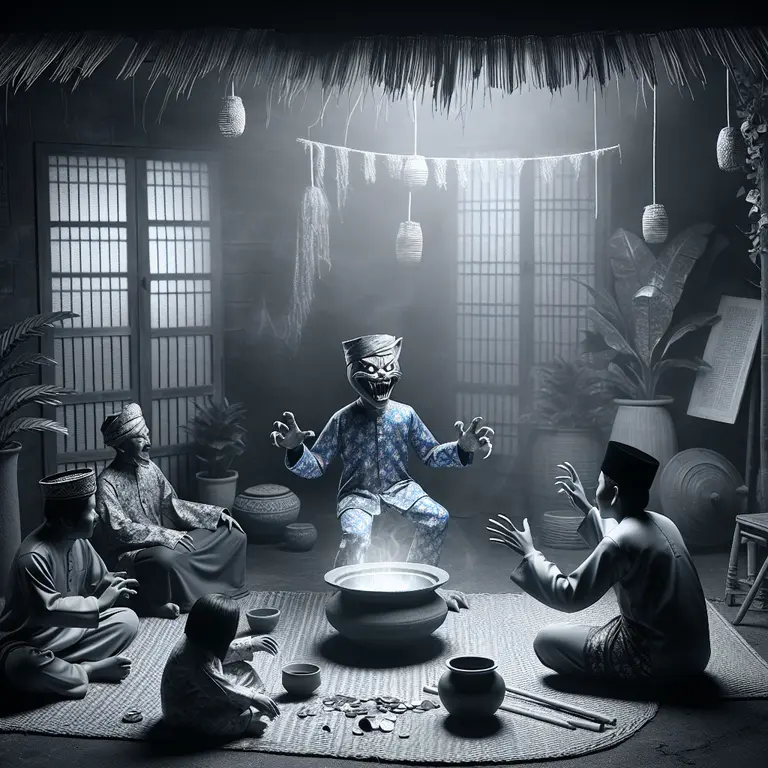
 Watch on YouTube
 Watch on Rumble
Introduction
Malaysia is a nation of extraordinary cultural depth, shaped by centuries of migration, trade, colonization, and indigenous tradition. Its population is a mosaic of Malays, Chinese, Indians, and numerous indigenous communities, each contributing its own belief systems, rituals, and stories to a shared national identity. Within this rich cultural landscape, folklore occupies a central and deeply meaningful place. Malaysian myths and legends are not merely entertainment — they are living documents of history, morality, and communal understanding. Among the most compelling figures in this tradition is the Hantu Pelesit, an invisible spirit said to bring chaos, illness, and misfortune to those it targets. Though largely unfamiliar to the outside world, this supernatural entity has shaped the way entire communities in Malaysia understand illness, conflict, and the unseen forces that govern human fate.
The story of the Hantu Pelesit is not simply a ghost story. It is a window into the complex relationship between human beings and the unknown, between community trust and fear, and between ancient tradition and the relentless march of modernity. To understand this spirit is to grasp an essential aspect of how people throughout history have made sense of a world that frequently defied easy explanation.
Etymology and Cultural Significance
The name Hantu Pelesit is drawn from two Malay words that together paint a vivid picture of what this entity represents. The word hantu broadly translates as ghost or spirit, a term that appears in the names of many supernatural beings in Malay folklore. The word pelesit refers specifically to a type of demonic or supernatural familiar, a being that serves as an agent of harm under the control of a human master. Together, the name evokes something more unsettling than a wandering ghost — a spirit deliberately weaponized.
This distinction is crucial to understanding why the Hantu Pelesit occupies such a particular place in Malaysian cultural consciousness. Unlike spirits that act of their own volition, the Hantu Pelesit is said to be cultivated and controlled by a witch, most commonly depicted as an elderly woman with knowledge of the dark arts. This human element transforms the spirit from a force of nature into an instrument of human malice, making it simultaneously more terrifying and more socially charged. The belief that a neighbor, a rival, or a jealous acquaintance could direct such a force against you introduces an element of paranoia into everyday social life.
The folklore of the Hantu Pelesit is most deeply rooted among Malaysia’s indigenous communities, though its influence extends across ethnic lines. Malay communities throughout the peninsula are familiar with the concept, and variations of the spirit familiar appear in the traditions of neighboring cultures across Southeast Asia, suggesting a shared mythological heritage that predates modern national borders. This cross-cultural resonance speaks to the universality of the fears the Hantu Pelesit embodies — fear of invisible harm, betrayal, and forces beyond human control.
Characteristics and Behavior
Descriptions of the Hantu Pelesit’s form and behavior have varied across generations and regions, but certain characteristics appear consistently in the oral tradition. The spirit is said to be invisible to ordinary perception, capable of entering a person’s body without any outward sign of intrusion. Once inside a host, it can cause a wide range of afflictions, from sudden and unexplained physical illness to dramatic shifts in personality and behavior. Victims may become erratic, withdrawn, or inexplicably aggressive, and those around them may struggle to account for the change.
One of the most socially disruptive aspects attributed to the Hantu Pelesit is its alleged ability to sow discord within families and communities. According to local lore, the spirit can plant seeds of doubt and suspicion between people who were previously close, turning trusted relationships into sources of conflict. In tightly knit rural communities where social cohesion was essential for survival, this dimension of the spirit’s power would have been particularly frightening. An invisible force capable of eroding trust from within a household represented a threat not just to individuals but to the entire social fabric.
Beyond human affliction, the Hantu Pelesit has also been blamed for agricultural misfortune. Crop failures, livestock deaths, and persistent bad luck in farming have all been attributed to the spirit’s influence at various points in Malaysian history. This agricultural dimension of the legend reflects the practical anxieties of communities whose livelihoods depended entirely on the land, and whose survival could be threatened by a single failed harvest.
Origins and Historical Context
The origins of the Hantu Pelesit stretch back to a time when oral tradition was the primary means of transmitting knowledge, history, and values across generations. Long before literacy was widespread, communities relied on storytelling to explain the world around them, to warn against dangerous behaviors, and to maintain social order. The Hantu Pelesit emerged from this context as both an explanation and a warning.
In pre-modern agricultural societies, illness was one of the most frightening and least understood aspects of life. Without access to medical knowledge, a sudden fever, a prolonged mental disturbance, or an unexplained death demanded some kind of explanation. Attributing these events to supernatural forces like the Hantu Pelesit served an important psychological function — it transformed random and terrifying events into something that could be understood within a coherent framework. If a spirit was responsible, then perhaps a specialist, a bomoh or traditional healer, could intervene. The existence of the legend created a system of response, however imperfect, for dealing with the unpredictable.
The social dimensions of the legend were equally important. By locating the source of harm in a human agent — the witch who controls the spirit — the folklore created a mechanism for processing interpersonal conflict and community tension. Accusations of spirit-sending, while sometimes destructive, also reflected real social anxieties about jealousy, rivalry, and the unequal distribution of fortune. In this sense, the Hantu Pelesit functioned as a kind of cultural mirror, reflecting the fears and tensions of the communities that told its story.
Modern Perspectives and Cultural Preservation
In contemporary Malaysia, the relationship between urban and rural populations, as reflected in legends like the Hantu Pelesit, has grown increasingly complex. In cities, where education, technology, and exposure to global culture have shifted the dominant framework for understanding illness and misfortune, explicit belief in spirit possession is less common. Many younger Malaysians encounter these stories primarily through literature, film, and digital media, where they have found new life as elements of horror entertainment.
Yet in rural communities, particularly among older generations and indigenous groups, the Hantu Pelesit and related beliefs remain a living part of daily life. Traditional healers continue to practice, and families confronted with unexplained illness or behavioral changes may still seek spiritual remedies alongside or instead of conventional medicine. This is not simply a matter of ignorance or backwardness, as it is sometimes dismissively characterized. It reflects a different but internally consistent understanding of health, community, and the relationship between the visible and invisible worlds.
Scholars of anthropology and folklore have increasingly recognized the importance of preserving these traditions, not because the spirits are real in a literal sense, but because the stories carry irreplaceable cultural information. They encode historical knowledge about social relationships, ecological conditions, and the psychological strategies communities developed to cope with uncertainty. To lose them entirely would be to lose a significant dimension of human experience.
Conclusion
The Hantu Pelesit is far more than a ghost story told to frighten children. It is a sophisticated cultural artifact that encodes centuries of human experience, fear, social tension, and communal wisdom. Its persistence in Malaysian folklore speaks to the enduring human need to make sense of suffering, to assign meaning to misfortune, and to locate the invisible forces that shape our lives. As Malaysia continues to modernize and its urban population grows increasingly distant from the rural traditions that gave rise to these legends, the challenge will be to preserve the stories without reducing them to mere curiosity. The Hantu Pelesit reminds us that the past is never simply behind us — it lives in the stories we tell, the fears we carry, and the ways we understand the world around us.