
The Eruption of Laki in 1783: an Environmental Catastrophe
The 1783 eruption of the Icelandic volcano Laki had profound and far-reaching effects, both environmentally and socially, which are not widely known.
 Watch on YouTube
 Watch on Rumble
Introduction
On June 8, 1783, one of the most significant volcanic events in recorded history began quietly beneath the vast, windswept landscapes of southern Iceland. The eruption of Laki, a fissure volcano largely unknown outside of geological and historical circles, would go on to reshape weather patterns across the Northern Hemisphere, devastate agricultural systems from Iceland to Egypt, and may have even contributed to the political unrest that culminated in the French Revolution. Unlike the famously well-documented eruptions of Mount Vesuvius in 79 AD or Krakatoa in 1883, the Laki event remains relatively obscure in mainstream discourse. This obscurity is remarkable given the sheer scale of its consequences. Understanding what happened during those eight months of continuous eruption offers a rare window into how natural events can silently redirect the course of human history.
Background and the Eruption Itself
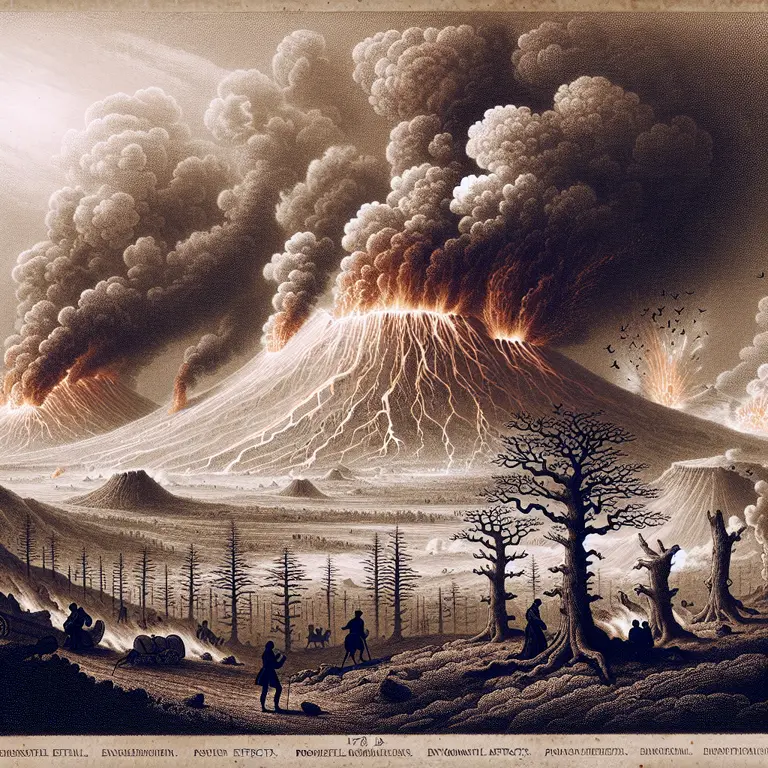
Laki, known in Icelandic as Lakagígar or the Laki Craters, is not a single volcanic peak but rather a fissure system stretching approximately 27 kilometers across the southern highlands of Iceland. It sits within the larger Grímsvötn volcanic system, which remains one of the most active volcanic zones on Earth. The eruption that began in June 1783 was not a sudden, explosive event like those of Vesuvius or Mount St. Helens. Instead, it was a prolonged and relentless outpouring of lava and toxic gases that lasted until February 1784, making it one of the longest sustained volcanic eruptions in recorded history.
The scale of the eruption is almost impossible to comprehend in human terms. Approximately 14 cubic kilometers of basaltic lava were expelled over the course of those eight months, covering more than 500 square kilometers of Icelandic terrain in flows that in some places reached depths of several meters. To put this in perspective, the total lava output of Laki dwarfed that of many more famous eruptions. But it was not the lava that made Laki so catastrophically consequential. It was the gases.
Accompanying the lava flows were enormous volumes of volcanic gases released directly into the lower and middle atmosphere. Estimates suggest that Laki emitted approximately 120 million tonnes of sulfur dioxide, along with significant quantities of carbon dioxide, hydrogen fluoride, and hydrogen chloride. These were not brief bursts of emission. They were sustained releases that continued day after day for months, allowing the gases to accumulate and spread across the globe in ways a shorter eruption could not.
Environmental Consequences Across the Northern Hemisphere
The sulfur dioxide released by Laki reacted with atmospheric water vapor, forming dense clouds of sulfate aerosols. These aerosols acted as a reflective veil across much of the Northern Hemisphere, scattering incoming solar radiation and preventing it from warming the Earth’s surface. The result was a phenomenon now commonly referred to as volcanic winter, though in this case it manifested not as a single catastrophic cold snap but as a prolonged and insidious disruption of normal seasonal patterns.
In the summer of 1783, a strange dry fog settled over much of Europe. Contemporary observers described a persistent haze that dimmed the sun and gave it an eerie reddish hue. Benjamin Franklin, who was serving as American ambassador to France at the time, wrote one of the earliest scientific observations of this phenomenon, noting the unusual fog and speculating that it might be connected to volcanic activity in Iceland. He was correct, though it would take more than a century for the scientific community to fully understand the mechanisms involved.
The climatic effects that followed were severe and widespread. The summer of 1783 was abnormally hot in some regions due to the direct heating effects of the gas cloud near the source, but this was followed by one of the coldest winters in European memory. The winter of 1783 to 1784 brought extreme cold to much of Europe and North America. Rivers that rarely froze, including portions of the Thames in England, remained icebound for weeks longer than usual. In North America, the winter was so severe that ice was recorded in the Gulf of Mexico. Across the Middle East and North Africa, the disruption of the African and Asian monsoon systems led to severe drought and the lowest recorded Nile River flood levels in centuries, contributing to famine in Egypt that killed an estimated one-sixth of the population.
The fluorine compounds released by Laki had their own devastating ecological effects closer to the source. Fluorine settled on vegetation across Iceland, contaminating the grass and water supplies that livestock depended upon. Animals that consumed this fluorine-laden vegetation developed a condition now known as fluorosis, which caused their bones and teeth to become brittle and deformed. The livestock losses triggered by this were catastrophic and set the stage for the human tragedy that followed.
Social and Human Consequences
Iceland bore the most immediate and devastating human cost of the Laki eruption. The combination of toxic gas clouds, fluorine poisoning of the food supply, and the destruction of grazing land created conditions of almost unimaginable hardship for the island’s population. The event became known in Icelandic history as the Móðuharðindin, which translates roughly as the Mist Hardships, a name that captures the haunting quality of the sulfurous haze that hung over the island for months.
The livestock losses were staggering. It is estimated that approximately 50 percent of Iceland’s cattle and 80 percent of its sheep perished as a direct or indirect result of the eruption. With the pastoral economy essentially destroyed, famine spread rapidly. By the time the worst had passed, Iceland had lost somewhere between 20 and 25 percent of its entire population to starvation, disease, and the cascading effects of malnutrition. The Danish government, which administered Iceland at the time, actually considered evacuating the entire remaining population to the Danish mainland, a plan that was ultimately abandoned but which illustrates just how close Iceland came to losing its human presence entirely.
Across Europe, the consequences were less acute but still deeply significant. Crop failures resulting from the cold summer and harsh winter of 1783 to 1784 drove up food prices and created conditions of widespread hunger among the rural poor. France was particularly hard hit. Historians have increasingly noted that the years following the Laki eruption were marked by a series of poor harvests that placed extraordinary strain on the French peasantry, already burdened by an inequitable taxation system and an increasingly dysfunctional monarchy. While it would be an oversimplification to argue that a volcanic eruption caused the French Revolution, the food shortages and economic instability that followed Laki almost certainly deepened the social tensions that erupted into revolution in 1789. The connection between environmental stress and political upheaval is a recurring theme in history, and Laki provides one of the most compelling examples of this relationship.
Why Laki Remains Underappreciated
Given the scale of its consequences, the relative obscurity of the Laki eruption in popular historical consciousness is itself worth examining. Part of the explanation lies in the nature of the event. Laki did not produce a dramatic, instantaneous catastrophe of the kind that tends to capture historical imagination. There was no single day of destruction, no buried city, no towering ash cloud visible for hundreds of miles. Instead, Laki worked through slow, diffuse, and indirect mechanisms. Its effects unfolded over months and years, spread across an entire hemisphere, and were mediated through weather systems, crop failures, and economic pressures that could easily be attributed to other causes by those living through them.
Modern volcanology and climate science have given researchers the tools to trace these connections with much greater confidence than was possible even a few decades ago. Ice core records from Greenland and Antarctica preserve chemical signatures of the Laki eruption, enabling scientists to measure its atmospheric impact with precision. Tree-ring data from across the Northern Hemisphere document the climatic anomalies of 1783 to 1784 in extraordinary detail. These scientific records have enabled historians and scientists to work together and reconstruct the full scope of what Laki set in motion.
Conclusion
The eruption of Laki stands as one of the most consequential natural events of the past five centuries, a catastrophe whose influence reached from the highlands of Iceland to the floodplains of the Nile and the streets of Paris. Its story is a powerful reminder that the natural world and human civilization are not separate systems operating in isolation but are deeply and sometimes violently interconnected. In an era when volcanic monitoring, climate modeling, and emergency preparedness have become increasingly sophisticated, the lessons of Laki remain urgently relevant. The Grímsvötn system that produced Laki remains active today. Understanding what happened in 1783 is not merely an exercise in historical curiosity. It is a necessary preparation for a future in which such events remain entirely possible.