
Cerro Rico: a Mountain That Transformed Spanish Fortunes
Cerro Rico, a mountainous region in Bolivia, produced so much silver that it financed the Spanish Empire and had a global economic impact.
 Watch on YouTube
 Watch on Rumble
Cerro Rico: The Mountain That Ate Men and Built Empires
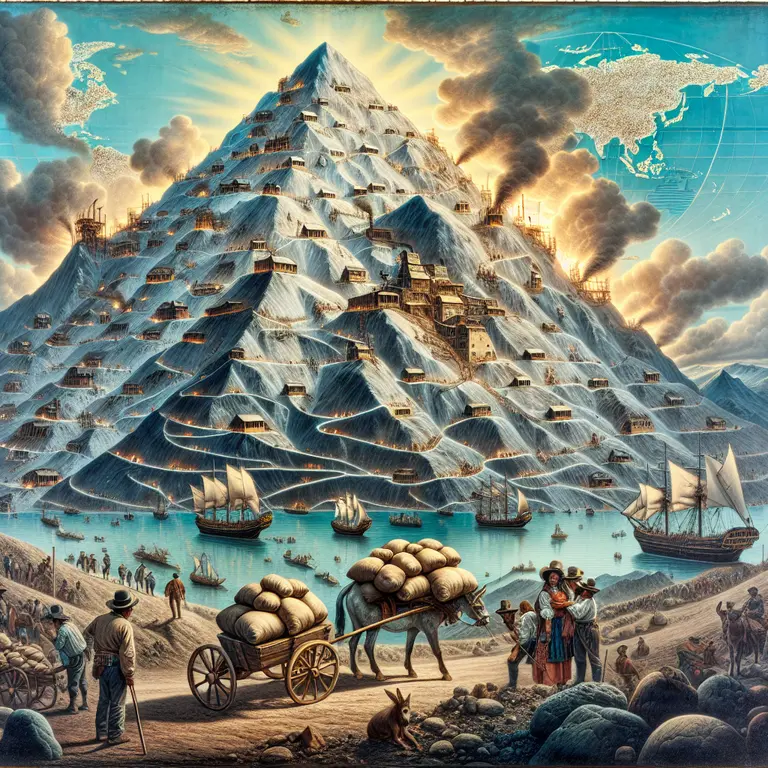
Cerro Rico, or “Rich Hill,” rises dramatically above the city of Potosí in the Bolivian Andes at an elevation of nearly 4,800 meters. Its distinctive conical silhouette has become one of the most recognizable and symbolically loaded landscapes in the entire Western Hemisphere. When silver veins were discovered within its rust-colored flanks in 1545, the mountain became the engine of Spain’s colonial ambitions and, by extension, a pivot point for the global economy. Yet behind the staggering wealth it produced lies a story of forced labor, ecological ruin, and a human toll so severe that historians have estimated the mountain claimed the lives of up to eight million people over the course of its colonial exploitation. Cerro Rico is not merely a geological curiosity or a footnote in economic history. It is a monument to the contradictions at the heart of empire — boundless material wealth extracted at an almost incomprehensible human and environmental cost.
Discovery and Early Exploitation
The story of Potosí’s founding is inseparable from the story of a single man. An Indigenous Quechua worker named Diego Gualpa is credited with stumbling upon silver ore in 1545 while searching for an Incan shrine on the slopes of Cerro Rico. According to historical accounts, Gualpa noticed unusually bright, heavy stones near a small fire he had built to stay warm during the night, and, upon closer inspection, recognized the telltale glint of silver. Word traveled quickly through the colonial administration and eventually reached Spain, igniting what could reasonably be described as one of the earliest and most consequential mining booms in recorded history.
Potosí grew with astonishing speed. Within decades of that initial discovery, it had transformed from a barren highland settlement into one of the largest and most cosmopolitan cities in the world. By the late 16th century, its population had swelled to between 160,000 and 200,000, making it comparable in size to London, Paris, and Seville. The city attracted merchants, priests, administrators, fortune-seekers, and enslaved laborers from across the Spanish Empire and beyond. Streets were lined with churches, theaters, and gambling houses. The phrase “vale un Potosí,” meaning “worth a Potosí,” entered the Spanish language as an expression for something of immeasurable value — a phrase that Miguel de Cervantes even placed in the mouth of Don Quixote. The mountain had become synonymous with wealth itself.
Economic Impact
The silver extracted from Cerro Rico was minted into coins known as “Pieces of Eight,” the reales de a ocho that became the first truly global currency. These coins circulated across Europe, Asia, the Middle East, and the Americas, lubricating trade networks that spanned the entire known world. Spanish galleons carried the silver westward across the Pacific to the Philippines, where it was exchanged for Chinese silk, porcelain, and spices. The coins also flowed eastward across the Atlantic to fund Spain’s military campaigns, construct its grand cathedrals and palaces, and service the debts of an empire perpetually at war. At the height of Potosí’s productivity in the late 16th and early 17th centuries, an estimated two-thirds of all silver coins in global circulation originated from this single mountain in the Bolivian highlands.
The economic consequences of this silver flood were paradoxical and far-reaching. Historians and economists have long debated the role that Potosí’s silver played in the “Price Revolution” that swept through 16th-century Europe, a period of sustained inflation driven in part by the sudden and dramatic increase in the money supply. Spain, despite being the primary beneficiary of this wealth, ultimately suffered some of its worst effects. The influx of silver encouraged consumption over production, weakened domestic industries, and contributed to cycles of debt and bankruptcy that plagued the Spanish crown throughout the 17th century. Meanwhile, the silver that flowed into China helped stabilize the Ming dynasty’s monetary system for a time, demonstrating how deeply the fate of a mountain in the Andes had become entangled with the political economies of civilizations on the other side of the world.
Human Cost
The prosperity generated by Cerro Rico was built almost entirely on the suffering of Indigenous and, later, enslaved African workers. The colonial authorities institutionalized this exploitation through a system known as the Mita, adapted from an earlier Incan labor draft and dramatically expanded to meet the insatiable demand for mining labor. Under the Mita, Indigenous communities throughout the Andean region were required to send a portion of their male population to work in the mines of Potosí, often for periods lasting six months or longer. Workers descended into the mountain through narrow, poorly ventilated tunnels, carrying heavy loads of ore on their backs up crude wooden ladders in near-total darkness.
The conditions underground were lethal. Cave-ins were frequent and unpredictable. The air was thick with silica dust, which caused silicosis, a progressive and fatal lung disease that killed miners slowly over the years. Mercury, used extensively in the amalgamation process for silver refining, poisoned workers through prolonged skin contact and inhalation of mercury vapors. The neurological and physical effects of mercury poisoning were devastating and irreversible. Many workers died before completing their assigned labor terms, and entire communities were demographically hollowed out by the constant drain of the Mita. Contemporary observers, including the Spanish priest Bartolomé Arzáns de Orsúa y Vela, documented the horror with a mixture of moral outrage and resigned acceptance. The phrase “the mountain that eats men” — la montaña que come hombres — was not metaphorical. It was a straightforward description of observable reality.
Environmental Impact
The environmental destruction wrought by centuries of silver extraction at Cerro Rico was equally profound and considerably longer-lasting. The smelting of silver ore required enormous quantities of fuel, and the forests of the surrounding Andean highlands were systematically stripped to provide timber for mine shafts and charcoal for smelting furnaces. This deforestation destabilized soils across wide areas, contributing to erosion that altered local hydrology for generations. The landscape around Potosí, once home to diverse high-altitude ecosystems, was reduced to a largely barren and degraded terrain.
Mercury contamination presents perhaps the most persistent environmental legacy of the colonial mining era. Millions of kilograms of mercury were used in Potosí’s silver refineries over the course of several centuries, and a significant portion of that mercury entered the local waterways and soils. Studies conducted in recent decades have found elevated mercury concentrations in the sediments of rivers and lakes throughout the region, a toxic inheritance that continues to affect aquatic life and poses ongoing health risks to communities that depend on local water sources. The environmental damage is not merely historical. It is an active, ongoing condition that modern communities must navigate alongside the economic pressures of continued mining activity.
A Present-Day Paradox
Today, Cerro Rico presents one of the starkest paradoxes in the world of cultural heritage and resource economics. The mountain continues to be actively mined by thousands of independent miners organized into cooperatives, many of whom work under conditions that bear a disturbing resemblance to those endured by their colonial-era predecessors. There are no large corporations managing safety protocols or investing in modern equipment. Workers still descend into the mountain’s labyrinthine tunnels with little more than handheld drills, dynamite, and a stubborn faith in the mountain’s remaining generosity. Silicosis remains endemic. Accidents are common. Life expectancy for active miners is grim.
UNESCO declared Potosí a World Heritage Site in 1987, recognizing the city’s extraordinary historical and architectural significance. However, the designation has created a complex tension between preservation and survival. The mountain itself is structurally compromised after centuries of tunneling, and a significant collapse near its summit in 2011 alarmed engineers and conservationists alike. Proposals to stabilize the mountain or restrict mining activity have met with fierce resistance from local communities for whom the mines remain the primary source of income. The heritage designation has done little to resolve the fundamental contradiction: the very activity that gives the site its historical significance is also the activity that threatens to destroy it.
Conclusion
Cerro Rico stands as one of the most consequential and cautionary landmarks in human history. Its silver built empires, reshaped global trade, and helped finance the early modern world as we know it. It also consumed millions of lives, poisoned ecosystems, and left communities in a state of economic dependency that persists to this day. The mountain’s story is not simply a tale of colonial excess, though it is certainly that. It is also a story about the structural relationships between resource extraction, human labor, and environmental sustainability — relationships that remain as urgent and unresolved in the 21st century as they were in the 16th. In the ongoing global conversation about ethical supply chains, climate responsibility, and the rights of mining communities, Cerro Rico offers a history both rich and sobering, a reminder that the true cost of wealth is rarely reflected in the price of the things it produces.