
The Hidden Backbone: Undersea Cables of the Global Internet
Beneath the ocean floor lies a fragile web of fiber-optic cables carrying 99% of international data — and the geopolitical battles now forming around them.
 Watch on YouTube
 Watch on Rumble
The Deep-Sea Cables Quietly Running the Internet
The idea of transmitting information across oceans via undersea cable is not a product of the digital age. The first transatlantic telegraph cable was successfully laid in 1858, connecting Valentia Island, Ireland, to Heart’s Content, Newfoundland. Queen Victoria and U.S. President James Buchanan exchanged congratulatory messages across it, though the cable failed within weeks due to electrical damage caused by overpowering the signal. Engineers had pushed too much voltage through the line in an attempt to accelerate transmissions, and the insulation degraded rapidly under the strain. A working, durable transatlantic cable was not achieved until 1866, when Isambard Kingdom Brunel’s steamship, the SS Great Eastern, successfully laid a line that held. What followed was one of the most consequential infrastructure buildouts in human history — one that has never really stopped.
The commercial and strategic implications of that first durable cable were immediately understood. Within years of the 1866 success, British telegraph companies had extended submarine cable networks to India, Australia, and the Caribbean, creating what historians sometimes call the Victorian internet. These cables allowed commodity prices, military orders, and diplomatic communications to travel in hours rather than weeks, fundamentally reshaping the pace of empire and trade. The companies that controlled cable landing stations held enormous geopolitical leverage, a dynamic that has not disappeared so much as migrated to new actors and technologies.
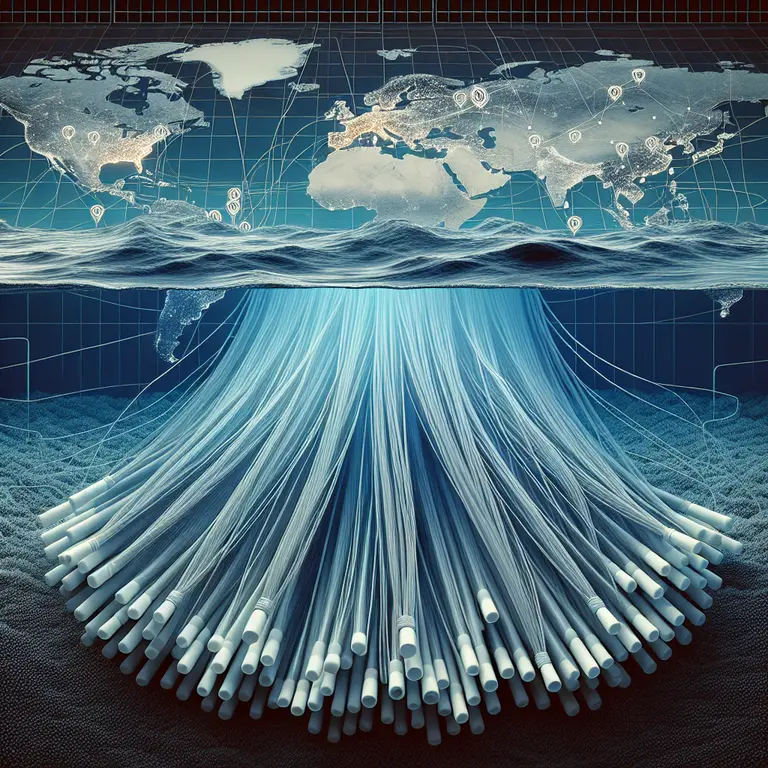
Today, more than 550 active undersea cable systems stretch across roughly 1.4 million kilometers of ocean floor. These fiber-optic lines, many no thicker than a garden hose, carry an estimated 99% of all international internet traffic and financial transactions. Satellites, often imagined as the backbone of global communications, account for a fraction of 1% of the actual data volume. Even the much-discussed rise of low-earth orbit satellite constellations like SpaceX’s Starlink, while genuinely expanding connectivity in remote areas, cannot match the raw throughput capacity of a modern fiber-optic cable. When you send an email from New York to London, stream a video from a South Korean server, or execute a stock trade between Tokyo and Frankfurt, the data almost certainly travels through a cable lying on the seabed, unseen and largely unacknowledged.
How the Cables Actually Work
Modern undersea cables are engineering marvels that bear little resemblance to their 19th-century predecessors. A contemporary cable consists of multiple pairs of optical fibers — sometimes dozens — bundled within layers of steel wire, copper tubing, waterproof polyethylene sheathing, and in shallow coastal zones, additional armoring to protect against anchors and fishing trawls. The optical fibers themselves are thinner than a human hair, yet each pair can carry terabits of data per second using wavelength-division multiplexing, which sends dozens of different light frequencies simultaneously through the same fiber. Each frequency, or channel, carries its own independent stream of data, and the combined effect is more like a highway with hundreds of lanes than a single road.
The physics of light transmission in glass fiber is itself a remarkable story. Data travels as pulses of laser light that bounce along the fiber’s core through a principle called total internal reflection, contained by the difference in refractive index between the core and the surrounding cladding material. The purity of the glass used in these fibers is extraordinary — if the ocean were made of fiber-optic glass rather than water, you could theoretically see to the bottom of the Mariana Trench with the naked eye. Even so, light signals attenuate over distance, and cables require repeaters — cylindrical amplifier units spaced roughly every 60 to 100 kilometers along the cable’s length. These repeaters are powered by a continuous electrical current running through the copper conductor at voltages of up to 15,000 volts. The entire system must function without maintenance for 25 years in one of the most hostile environments on Earth: crushing pressures, corrosive saltwater, unpredictable seismic activity, and occasional encounters with deep-sea creatures.
The process of laying a cable is itself a logistical undertaking of extraordinary complexity. Specialized cable-laying ships, of which only a small global fleet exists, must survey the route in advance, plan for the placement of repeaters, navigate around underwater volcanoes and fault lines, and manage the tension of thousands of kilometers of cable spooling off their decks. Near coastlines, cables are buried under the seabed using remotely operated vehicles and hydraulic jets to reduce the risk of damage from anchors and trawling. In at least one documented case, a 2012 incident off the coast of West Africa, sharks were found to have bitten into a cable — their electroreceptors apparently sensitive to the electromagnetic fields emitted by the copper conductor. Cable manufacturers responded by adding additional shielding layers to cables deployed in affected regions, a small but telling example of how the natural world continues to complicate even the most advanced human infrastructure.
The Geopolitics Beneath the Surface
For decades, undersea cables were largely the domain of telecommunications consortia — cooperative ventures between national phone companies. That landscape changed dramatically when hyperscale technology companies began building their own private cables. Google, Meta, Microsoft, and Amazon now collectively own or co-own a significant and growing share of global undersea cable capacity. Google’s Dunant cable, connecting the U.S. to France, and its Equiano cable running from Portugal to South Africa, represent a new era of corporate-controlled transoceanic infrastructure. These companies are motivated not only by the need for raw bandwidth but also by the desire to control latency, routing decisions, and the security of their own data as it moves between continents.
This privatization has drawn the attention of governments and military strategists for reasons that go beyond simple economics. When a private corporation controls the physical pathway through which a nation’s financial system communicates with the rest of the world, questions of accountability, access, and vulnerability become acutely political. The cables are extraordinarily exposed: a single anchor drag or submarine earthquake can sever a major link, as happened in 2006 when a seismic event near Taiwan cut multiple cables simultaneously and disrupted internet access across much of Southeast Asia for weeks. Internet traffic had to be rerouted through satellite links and the remaining functional cables, causing significant slowdowns and service outages across the region. The incident served as a stark demonstration that the internet’s apparent resilience has hard physical limits.
More alarmingly, intelligence agencies in several countries have documented increased activity by Russian naval vessels and submarines near known cable routes in the North Atlantic. The concern is not merely that cables could be severed in a conflict — a crude but effective act of sabotage — but that they could be tapped, allowing surveillance of the enormous volume of data passing through them. NATO established a new maritime coordination center in 2020 specifically to monitor threats to undersea infrastructure. The United States Federal Communications Commission and the European Union have both moved to restrict Chinese companies, particularly Huawei Marine Networks, from participating in cable projects connecting to their shores, citing espionage concerns. The result is an emerging bifurcation of global cable infrastructure along geopolitical lines, with Western-aligned and China-aligned networks increasingly diverging in their routing and ownership.
The Future of the Ocean Floor Network
The next generation of undersea cables is already being planned and laid, and the scale of ambition has grown considerably. New systems are pushing toward petabit-per-second capacity — one quadrillion bits per second — through advances in spatial division multiplexing, which uses multiple cores within a single fiber strand, and more efficient optical amplification techniques. The 2Africa cable, backed by Meta and a consortium of telecom companies, is currently being deployed around the entire African continent and into the Middle East, representing the longest submarine cable system ever attempted at over 45,000 kilometers. Its significance extends beyond raw length: much of sub-Saharan Africa has historically been served by a small number of cables, creating bottlenecks and resilience problems that have limited the continent’s digital development. The 2Africa system, along with several competing projects, promises to change that equation substantially over the coming decade.
There is also renewed interest in Arctic cable routes. As polar ice retreats due to climate change, a trans-Arctic cable connecting Europe, Asia, and North America via the Arctic Ocean becomes increasingly feasible, potentially cutting latency on Asia-Europe routes by 30 milliseconds — an eternity in high-frequency financial trading, where fortunes are made and lost on microsecond advantages. A Finnish company called Cinia has been developing such a route, though geopolitical tensions following Russia’s 2022 invasion of Ukraine have complicated planning that would require passing near Russian territorial waters. The Arctic route illustrates a recurring theme in undersea cable history: the most efficient engineering solutions are rarely separable from the most difficult diplomatic problems.
A Hidden Foundation
Beneath the indifferent surface of the world’s oceans, a contest is underway — part engineering race, part diplomatic struggle, part intelligence operation — over the physical substrate of global civilization. The infrastructure that supports this contest is aging in places, threatened in others, and expanding in directions that would have seemed implausible even twenty years ago. Repair ships respond to cable breaks dozens of times each year, grappling lines across the ocean floor to retrieve severed ends and splice in new segments, often working in conditions of significant weather and depth. The engineers and sailors who perform this work are among the least recognized essential workers in the global economy.
The internet feels weightless, instantaneous, and everywhere. It is described in the language of clouds, streams, and wireless signals, a vocabulary that suggests something atmospheric and intangible. In reality, it rests on glass threads in the dark, under miles of water, subject to shark bites and anchor drags and the territorial ambitions of nation-states. Every photograph shared, every financial transaction cleared, every video call across continents depends on this buried, invisible network. Understanding that the modern world is held together by physical objects lying on the ocean floor does not diminish the achievement of the internet — it makes that achievement considerably more extraordinary.