
Pulsars: a Spilled Tea Leads to a Groundbreaking Discovery
How a graduate student's tea break led to one of astronomy's most important discoveries
 Watch on YouTube
 Watch on Rumble
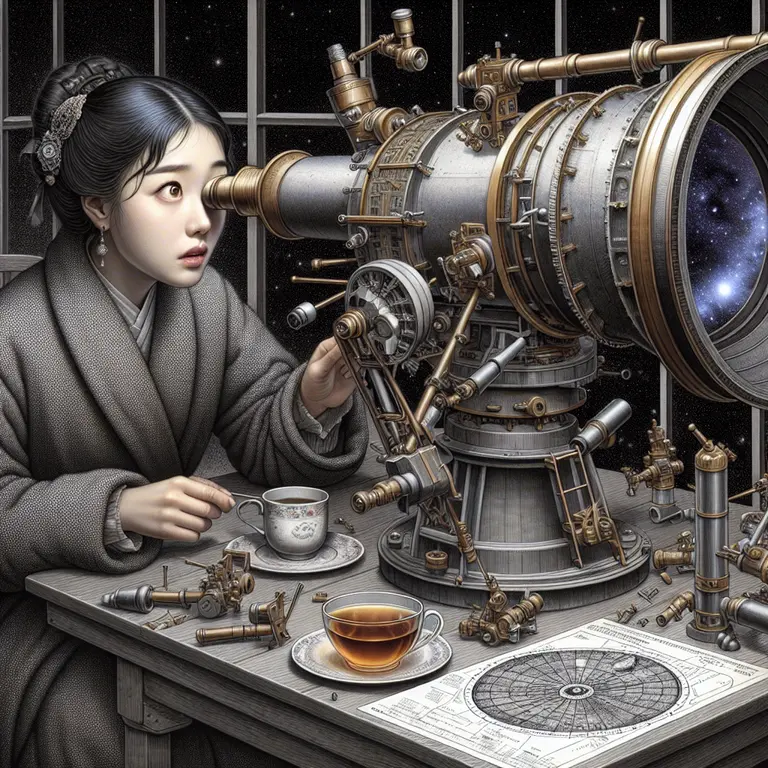
In the autumn of 1967, amid the rolling fields outside Cambridge, a seemingly insignificant incident involving a graduate student and a cup of tea led to one of the most profound astronomical discoveries of the 20th century. This serendipitous moment would not only revolutionize our understanding of stellar evolution but also demonstrate how scientific breakthroughs often emerge from the most unexpected circumstances.
The Reluctant Astronomer and Her Unusual Project
Jocelyn Bell (later Bell Burnell) had not initially planned to become an astronomer. Born in Northern Ireland in 1943, she faced discouragement early in her academic journey. At school, when the boys were directed to science lessons, Bell and other girls were steered toward domestic science. “I was sent to cookery class to learn how to make the perfect meringue rather than to learn about physics,” she would later recall. Despite this, Bell persisted in her scientific pursuits, eventually earning a physics degree from the University of Glasgow before continuing her doctoral studies at Cambridge.
At Cambridge’s Mullard Radio Astronomy Observatory, Bell joined Anthony Hewish’s team, constructing a revolutionary radio telescope designed to study quasars—distant, highly energetic galactic nuclei. Unlike conventional telescopes, this installation sprawled across 4.5 acres of field and consisted of over 1,000 wooden posts and 2,000 dipole antennas connected by 120 miles of wire and cable. Bell played a crucial role in its construction, even hammering posts into frozen ground during the bitter winter of 1966.
The telescope generated enormous amounts of data—approximately 96 feet of chart paper every day—which Bell was tasked with analyzing by hand. This painstaking process required exceptional attention to detail and remarkable patience. For months, she meticulously examined these charts, searching for the characteristic scintillation patterns of quasars among the cosmic noise.
The Curious “Bit of Scruff” and a Fortuitous Accident
By July 1967, Bell had developed an intimate familiarity with the patterns appearing on her charts. While reviewing the data, she noticed something peculiar—a slight, irregular marking she described as a “bit of scruff.” Unlike the random cosmic static or the identifiable patterns of known phenomena, this signal pulsed with remarkable regularity, recurring precisely every 1.3373 seconds.
The observatory regularly had to contend with terrestrial interference. Earlier that year, Bell had identified another pulsating signal that proved to be nothing more extraterrestrial than a car with a faulty spark plug passing near the facility. To maintain focus during the long hours of analyzing data, Bell often kept a cup of tea nearby—a simple comfort during tedious work.
What many historical accounts omit is that on one pivotal day, Bell accidentally knocked over her tea, spilling it across her charts. While hurriedly cleaning up the mess, her attention was drawn to the unusual signal pattern now partially stained with tea. The interruption had broken her routine analysis, allowing her to see the pattern with fresh eyes. This “scruff” defied categorization among known astronomical phenomena or terrestrial interference.
Bell approached Hewish with her findings, but he initially suggested it might be human-made interference. Undeterred, she continued monitoring the signal for several weeks, confirming its persistence and precise periodicity. The signal’s remarkable regularity—maintaining timing accuracy to one part in 10 million—led to a half-serious, half-joking designation: “LGM-1” (Little Green Men 1), acknowledging the remote possibility of an artificial, perhaps extraterrestrial origin.
The Revelation and Revolution in Astrophysics
By December 1967, Bell had discovered a second pulsating source in a different part of the sky, effectively eliminating the extraterrestrial civilization hypothesis. Soon after, she identified two more such objects. These discoveries pointed to a natural astronomical phenomenon—one that would fundamentally alter our understanding of stellar evolution.
What Bell had discovered were pulsars—rapidly rotating neutron stars that emit beams of electromagnetic radiation from their magnetic poles. As these stars rotate, the beams sweep across space like cosmic lighthouses, appearing to pulse when observed from Earth. These neutron stars represent the collapsed cores of massive stars that have undergone supernova explosions, containing roughly 1.4 times the mass of our sun compressed into a sphere approximately 20 kilometers in diameter—a density so extreme that a teaspoon of neutron star material would weigh about a billion tons on Earth.
The discovery provided the first observational evidence for neutron stars, which had been theoretically predicted by Walter Baade and Fritz Zwicky in 1934 but had never been observed before. It also offered a natural laboratory for testing extreme physics, including Einstein’s theory of general relativity. Later discoveries of binary pulsar systems would provide the first indirect evidence for gravitational waves, decades before their direct detection in 2015.
Recognition, Controversy, and Legacy
The announcement of the discovery in February 1968 created a sensation in the scientific community. However, when the 1974 Nobel Prize in Physics was awarded for the discovery, it went to Antony Hewish and radio astronomy pioneer Martin Ryle—conspicuously excluding Bell Burnell despite her instrumental role.
This omission sparked controversy about gender bias in science and the recognition of graduate students’ contributions. Bell Burnell herself responded with characteristic grace: “I believe it would demean Nobel Prizes if they were awarded to research students, except in very exceptional cases, and I do not believe this is one of them.” She maintained that the prize appropriately went to Hewish as the project supervisor.
Throughout her subsequent distinguished career, Bell Burnell served as president of the Royal Astronomical Society, the first female president of the Institute of Physics, and was appointed Dame Commander of the Order of the British Empire in 2007. In 2018, she received the $3 million Special Breakthrough Prize in Fundamental Physics—a sum she promptly donated to establish a scholarship fund supporting women, underrepresented ethnic minorities, and refugee students pursuing physics studies.
The Enduring Significance of Serendipity
The pulsar discovery exemplifies how scientific breakthroughs often emerge from a combination of meticulous preparation, keen observation, and fortuitous circumstance. Bell Burnell herself has emphasized the role of serendipity: “I sometimes wonder if I would have noticed the first pulsar signal had I not spilled that tea. That moment of disruption made me see the data differently.”
Today, over 3,000 pulsars have been identified, serving as cosmic tools for understanding gravity, testing general relativity, and even developing potential interstellar navigation systems. Some pulsars rotate hundreds of times per second with such precision that they rival atomic clocks, while others exist in binary systems that provide natural laboratories for studying gravitational physics.
The humble cup of tea that contributed to one of astronomy’s most significant discoveries reminds us that scientific progress often follows unexpected paths, as Bell Burnell noted in her 2018 Breakthrough Prize acceptance speech: “The diversity in science and the ability to look at problems from different perspectives matter. Who knows what might be discovered by someone who approaches problems differently than everyone else?”