
The Mysterious Migration of Plastic Ducks Across the Arctic
How 28,800 bath toys lost at sea became valuable scientific tools for understanding ocean currents
 Watch on YouTube
 Watch on Rumble
The Great Duck Oceanography Experiment That Nobody Planned
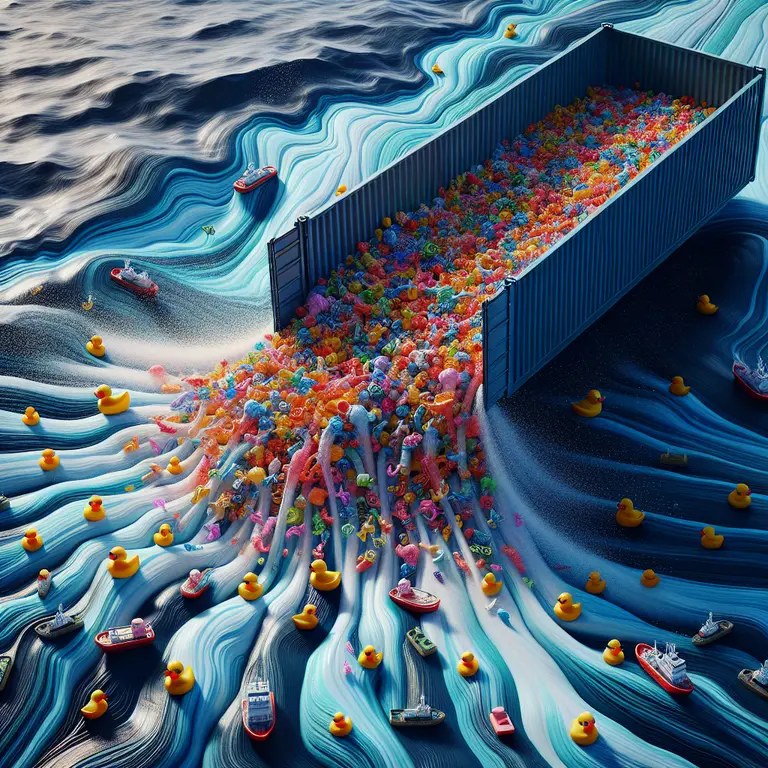
In January 1992, a cargo ship traveling from Hong Kong to Tacoma, Washington, encountered a severe storm in the middle of the Pacific Ocean. During the tumultuous weather, 12 shipping containers were swept overboard—one of which contained something rather unusual: 28,800 plastic bath toys manufactured by The First Years. These weren’t just any bath toys, but colorful ducks, turtles, frogs, and beavers that were designed to float.
What happened next transformed an ordinary shipping accident into one of oceanography’s most serendipitous experiments. The unplanned journey of these bath toys would ultimately revolutionize our understanding of ocean currents, provide invaluable data for climate scientists, and create an unexpected chapter in the history of oceanographic research—all because a shipment of children’s playthings went astray in international waters.
An Accidental Scientific Breakthrough
Oceanographers have long struggled to directly track ocean currents. Computer models can predict patterns, but actually confirming how water moves across vast distances is remarkably difficult. Traditional scientific instruments, such as drift bottles, often sink or become damaged, and electronic trackers are expensive and limited in number.
Enter the plastic ducks.
The first arrivals began washing ashore near Sitka, Alaska, about ten months after the spill. What made this remarkable wasn’t just that the toys had traveled approximately 2,000 miles, but that oceanographer Curtis Ebbesmeyer recognized their scientific value. He began meticulously documenting where and when the toys appeared, using their journey to validate and improve ocean circulation models.
Ebbesmeyer, who had previously studied Nike sneakers that had spilled into the Pacific in 1990, immediately understood the potential of these floating toys. Unlike purpose-built scientific equipment, the bath toys had several advantages: they were numerous, identical, designed to float indefinitely, and easily recognizable by beachcombers who could report findings.
The oceanographer and his colleague, James Ingraham from the National Oceanic and Atmospheric Administration (NOAA), developed a computer model called OSCURS (Ocean Surface Current Simulator) to predict where the toys might travel. The actual discoveries of the toys helped refine this model, making it significantly more accurate at predicting the movement of objects in ocean currents—a capability with applications ranging from search-and-rescue operations to pollution control.
The Arctic Duck Expedition
Here’s where it gets astounding: some of the toys didn’t just float along predictable coastal currents. Instead, they embarked on an epic journey that few scientists would have predicted.
A significant number of the bath toys became trapped in the North Pacific Gyre before being carried north through the Bering Strait and into the Arctic Ocean. There, they became frozen in ice packs, slowly traveling with the ice across the Arctic at about 7 miles per day.
By 2000, oceanographers predicted that the toys—now bleached white from sun exposure—would eventually emerge in the North Atlantic as the ice melted. Remarkably, in 2003, some bath toys began appearing on the shores of Maine and Massachusetts, while others crossed the Atlantic to Scotland and England—more than 11 years and 17,000 miles after the original spill.
This extraordinary journey revealed the existence of a “trans-Arctic express”—a current that moves from the Pacific to the Atlantic through the Arctic Ocean. While scientists had theorized about this connection, the bath toys provided tangible evidence of its existence and timeframe. The toys demonstrated that objects entering the Pacific could emerge in the Atlantic after approximately a decade, traveling at predictable rates through seemingly impenetrable Arctic ice.
What made this discovery particularly valuable was that it occurred during a period when Arctic ice was beginning to show significant changes due to global warming. The toys inadvertently became markers for these changes, with their accelerating journey times providing evidence of thinning ice and altered current patterns that corresponded with climate models.
The Scientific Legacy and Environmental Paradox
The accidental duck migration revealed a critical fact that challenges common assumptions: the Arctic ice pack isn’t a static barrier but a dynamic conveyor belt connecting the Pacific and Atlantic Oceans. This has profound implications for climate science, international policy, and maritime archaeology.
For climate scientists, the journey of these plastic objects demonstrated how pollutants, including microplastics, can travel between ocean basins. This has forced a reconsideration of how we model marine pollution, suggesting that even the most remote oceanic regions are connected to industrial activities thousands of miles away. The data gathered from their journey has helped validate satellite measurements and sophisticated computer models that track everything from oil spills to debris fields.
In terms of international policy, the bath toys demonstrated how marine debris from one country inevitably affects others. This has strengthened arguments for international cooperation on ocean protection, showing that pollution cannot be considered a purely local problem. The toys’ journey across international boundaries highlighted the interconnectedness of marine ecosystems and the need for coordinated global responses to marine pollution.
For maritime archaeologists, the bath toy experiment provided insights into how historical shipwrecks might have distributed artifacts across oceans. The predictable patterns of the toys’ movements have helped researchers understand how artifacts from ancient shipwrecks might have traveled, potentially explaining why certain items appear on shores far from known wreck sites.
Perhaps most counterintuitively, these plastic toys—symbols of environmental pollution—became invaluable tools for understanding the very environments they were contaminating. This represents a profound paradox: objects that would typically be considered pollutants became essential scientific instruments, providing data that could not have been gathered any other way.
The Collectible Aftermath and Cultural Impact
In a strange twist of consumer culture, the surviving bath toys became highly sought-after collectors’ items. The specific toys from this spill (identifiable by specific manufacturing details) have sold for hundreds of dollars each. Some beachcombers still search for them today, more than 30 years after the spill.
Beyond their value as collectibles, the “Friendly Floatees” (as they came to be known) entered popular culture in unexpected ways. They inspired children’s books, were featured in oceanography museum exhibits, and even appeared in episodes of popular television shows. The story of the traveling bath toys captured public imagination in a way that traditional oceanographic research rarely does, making complex concepts like ocean gyres and current systems accessible to the general public.
Conclusion: Small Objects, Big Science
The journey of these humble bath toys represents one of science’s great serendipitous moments—when an accident leads to discovery. What began as a shipping mishap ultimately provided oceanographers with data that would have cost millions to gather through conventional research methods.
Today, scientists continue to use the lessons learned from the great duck migration to refine models of ocean currents and Arctic ice movement. The methodologies developed to track these toys have been applied to studying other floating debris, helping researchers understand the growing problem of ocean plastic pollution.
The next time you see a rubber duck in a bathtub, remember its distant cousins that accidentally became pioneers in oceanographic research, silently drifting through Arctic ice to reveal the hidden connections between our world’s oceans. Their unlikely journey reminds us that scientific breakthroughs can come from the most unexpected sources—even a shipment of children’s bath toys lost at sea.