
Unveiling the Dark History Behind Christmas Caroling
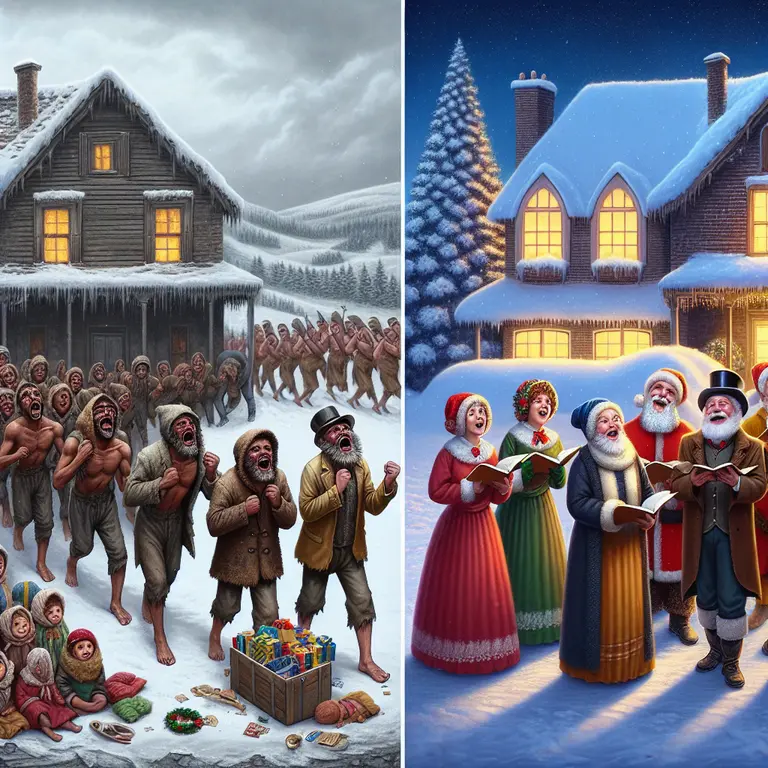
How Christmas caroling evolved from a form of aggressive begging that sometimes included threats against wealthy households.
 Watch on YouTube
 Watch on Rumble
In the crisp winter air of today’s holiday season, the image of carolers in Victorian attire singing harmonious melodies door-to-door evokes warmth and nostalgia. Yet beneath this sanitized tradition lies a far more complex and socially charged practice that once dominated England’s winter landscape. Wassailing—a medieval custom that combined elements of community ritual, agricultural magic, and thinly veiled extortion—reveals how profoundly our contemporary holiday traditions have been transformed over centuries. This seasonal practice functioned as a temporary inversion of power structures, allowing the peasantry a rare moment of leverage against their social betters during the darkest days of winter.
The Menacing Roots of Christmas Caroling
The cheerful door-to-door Christmas caroling tradition familiar to many today bears little resemblance to its medieval predecessor: wassailing. In 12th- to 16th-century England, wassailing often functioned as a form of seasonal class warfare, where peasants would approach the homes of wealthy landowners, demanding food, drink, and money in exchange for good fortune in the coming year. The term derives from the Old English “wæs hæil,” meaning “be healthy” or “be whole,” but the practice itself wasn’t always so benevolent.
Wassailers would arrive at manor houses in large, sometimes intimidating groups, carrying bowls of spiced ale or cider (the “wassail bowl”). They would sing traditional songs not as entertainment but as a ritualized form of negotiation. The implicit—and sometimes explicit—threat was that refusing hospitality could result in bad luck, damaged property, or even physical harm to the residents. This “trick or treat” dynamic predated Halloween customs by centuries.
Historical records from Somerset in the 1480s document wassailers breaking down doors when denied entry, while parish records from the 1530s mention compensatory payments to homeowners whose property was damaged during “Christmastide misrule.” The wassail songs themselves contained verses that shifted from blessing to threat, such as the traditional lyric: “We’ve come here to claim our right… And if you don’t open up your door, we’ll lay you flat upon the floor.”
The Wassail Protection Racket
In rural communities, particularly in apple-growing regions like Somerset, Devon, and Herefordshire, wassailing took on an agricultural dimension. Peasants would surround apple trees, sing to the trees, pour cider on their roots, and place cider-soaked bread in the branches—all while making tremendous noise with pots and pans. This ritual was ostensibly to awaken the tree spirits and ensure a good harvest, but it coincided with demands made upon the orchard owners.
Historical records from the 1600s document instances where wassailers who were turned away returned later to damage property. In 1637, a landowner in Lincolnshire complained to local authorities about wassailers who, after being refused entry, broke windows and released livestock from their enclosures. The Puritan parliament of 1647 even attempted to ban wassailing alongside other Christmas customs, viewing it as both pagan and socially disruptive.
The economic underpinnings of this practice were significant. Winter was a precarious time for agricultural laborers, as food stores dwindled and work opportunities became scarce. Wassailing provided a culturally sanctioned mechanism for wealth redistribution when it was most needed. Manor accounts from the late medieval period show that large estates would budget specifically for wassailing visitors, suggesting that this “extortion” had become institutionalized to some degree. A 1589 household ledger from a Gloucestershire estate lists expenditures for “wassailers’ ale and bread” alongside other expected seasonal expenses.
Class Inversion and Temporary Power
Wassailing represented a rare inversion of the social order, creating a temporary period where the lower classes could make demands of their social superiors with relative impunity. This concept of “misrule” was common in medieval and early modern winter festivals, including the Feast of Fools and the tradition of the Lord of Misrule, where social hierarchies were briefly upended.
Anthropologists note that wassailing served as a pressure release valve in highly stratified societies. For a brief period during the darkest days of winter, the poor could approach the wealthy as near-equals, receiving goods and hospitality that would typically be inaccessible. The rich, meanwhile, could demonstrate their generosity and fulfill social obligations of noblesse oblige, while also practically ensuring that their property remained safe from vandalism.
This seasonal power inversion had deep pre-Christian roots in Roman Saturnalia and Germanic Yule celebrations, where social norms were temporarily suspended. The church, unable to eliminate such deeply entrenched customs, instead incorporated and gradually modified them. By the late medieval period, wassailing had become entwined with the Christian calendar, typically occurring on Twelfth Night (January 5th) or Old Twelfth Night (January 17th after the calendar reform of 1752).
Court records from the Tudor period reveal the tensions this practice created. A 1542 case from the Star Chamber mentions a group of “disorderly wassailers” who were prosecuted for “excessive demands and threatening behavior,” yet received relatively light punishment due to the “customary nature of their seasonal liberties.”
The Wassail Bowl and Ritual Elements
Central to the wassailing tradition was the communal drinking vessel—the wassail bowl itself. These were often elaborate objects, crafted from wood, pottery, or occasionally silver for wealthy households. The drink inside, also known as wassail, was typically a hot, mulled cider or ale, spiced with nutmeg, cinnamon, and ginger, and sweetened with honey. Floating pieces of toast (the origin of the term “toast” in drinking culture) or roasted apples would be added, creating a potent alcoholic punch that facilitated the social lubrication necessary for such boundary-crossing encounters.
The ritualistic aspects of wassailing extended beyond mere drinking and included other activities. Participants often dressed in costume—sometimes as animals or mythological figures—and incorporated elements of mummery (folk plays). In some regions, a “wassail queen” would be selected to lead the procession, and she would be lifted into apple trees to place offerings among the branches. The blending of performance, alcohol consumption, and ritual demand created a powerful social technology that served multiple community functions beyond simple extortion.
Evolution Into Modern Caroling
By the Victorian era, the more threatening aspects of wassailing had largely been sanitized. The practice evolved into the more familiar Christmas caroling, where songs were offered freely as gifts rather than as part of an exchange. The transformation was partly due to changing class dynamics and partly to deliberate efforts by Victorian cultural arbiters, such as Charles Dickens, who helped reshape Christmas into a family-centered holiday focused on generosity and goodwill.
Some regional wassailing traditions persist in parts of England, particularly in cider-producing regions, where the apple tree wassailing ritual remains a cultural heritage event. However, most participants are unaware of the practice’s origins as a form of seasonal extortion—a reminder that many beloved holiday traditions have complex, sometimes unsettling histories that have been smoothed over by time and cultural evolution.
The transformation from wassailing to caroling represents a broader pattern in holiday customs, where economically necessary customs become culturally preserved traditions, gradually losing their original function while maintaining aesthetic elements. What once served as a crucial mechanism for winter survival among the poor has become a quaint cultural performance, with its economic and power dimensions forgotten mainly in contemporary celebrations.