
Unraveling the Origin of the Christmas Pickle Tradition
Exploring the contested history of the Christmas pickle ornament tradition and its surprising connections across cultures.
 Watch on YouTube
 Watch on Rumble
The Curious Custom
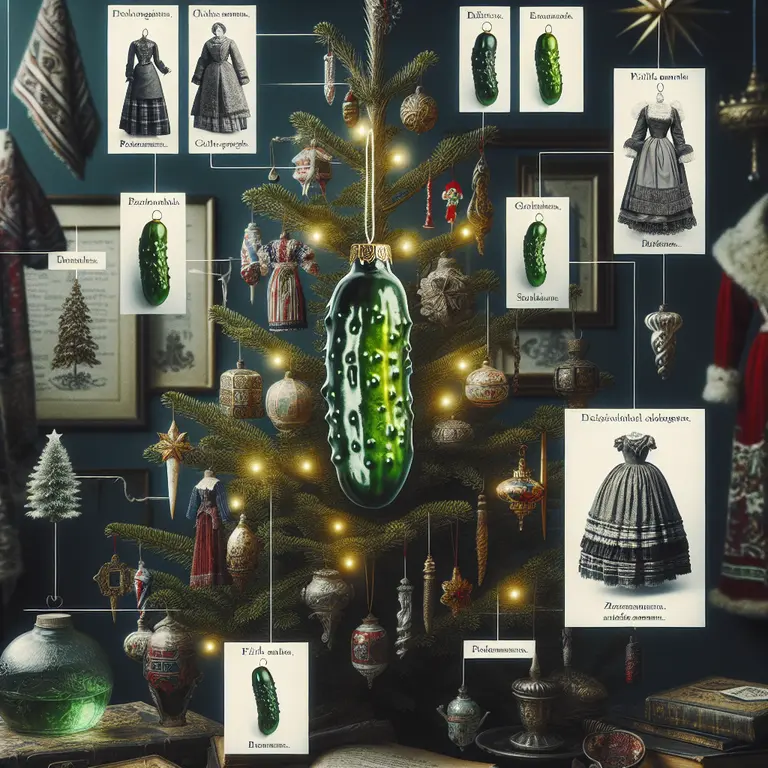
Among the colorful baubles and twinkling lights adorning Christmas trees across America, one peculiar ornament stands out for its oddity: a glass pickle. According to tradition, the pickle is hidden deep within the tree’s branches on Christmas Eve. The first child to find it on Christmas morning receives an extra gift or enjoys a year of good fortune. Despite its popularity in the United States, where an estimated 25% of households with German-American heritage participate in this tradition, the origins of the custom remain surprisingly disputed and shrouded in conflicting narratives.
Retailers and ornament companies have long marketed these glass pickles as an “old German tradition” called Weihnachtsgurke (Christmas pickle). However, when German nationals are questioned about this supposed homeland tradition, the vast majority express complete bewilderment. A 2016 survey conducted by the YouGov market research group found that 91% of Germans had never heard of the Christmas pickle tradition. This disconnect has led folklorists and cultural historians to investigate how this curious custom actually emerged.
Competing Origin Stories
Several competing narratives attempt to explain the origins of the Christmas pickle, each more dubious than the last. One tale centers on a German-American Civil War soldier named John Lower (or Lauer), who was captured and imprisoned at Andersonville, a Confederate prison. Near death from starvation, he begged a guard for just one pickle before he died. The guard took pity and provided the pickle, which Lower credited with giving him the mental and physical strength to survive. After returning home, he began the tradition of hiding a pickle in the family Christmas tree.
Another legend places the origin of the pickle in medieval times, involving two Spanish boys traveling home from boarding school for the holidays. When they stopped at an inn for the night, the evil innkeeper killed the boys and stuffed their bodies into a pickle barrel. That evening, St. Nicholas stopped at the same inn and discovered the crime. He miraculously restored the boys to life, leading to the pickle’s association with Christmas salvation.
A third, more plausible but still unverified theory suggests the tradition originated with Victorian-era Christmas tree decorations. Germans were indeed early leaders in glass ornament production, particularly in the Thuringian town of Lauscha, which began mass-producing glass ornaments in the 1840s. Vegetable-shaped ornaments, including pickles, were among their offerings. F.W. Woolworth first imported these German glass ornaments to the United States in the 1880s, which may have sparked the American tradition.
Historical records indicate that Lauscha’s glassblowers were renowned for crafting ornaments in the shapes of fruits, nuts, and vegetables using hand-blown glass techniques that had been refined over generations. These craftsmen used molds made of clay or wood to shape molten glass, then silvered the inside with a mixture of silver nitrate and sugar water, creating a reflective surface similar to mirrors. The pickle designs may have been particularly challenging to develop due to their irregular shape and texture, making them somewhat special among the glass ornament repertoire.
Berrien Springs: The Pickle Capital
Perhaps the most fascinating aspect of the Christmas pickle phenomenon is how a small Michigan town embraced and commercialized the disputed tradition. Berrien Springs, with a population of just over 1,800 residents, has proclaimed itself the “Christmas Pickle Capital of the World.” Since 1992, the town has held an annual Christmas Pickle Festival each December, complete with a “Grand Dillmaster” who leads the festive pickle parade.
The festival originated when local merchants were seeking a unique holiday promotion. Upon discovering the pickle tradition, they seized upon it as a marketing opportunity, despite (or perhaps because of) its mysterious origins. The celebration includes pickle-themed games, ornament sales, and the crowning of a pickle queen. Local restaurants even feature pickle-flavored ice cream and pickle-themed dishes during the festival weekend.
What makes this particularly interesting is that Berrien Springs has no special historical connection to pickles, Christmas traditions, or German heritage. The town essentially adopted an already dubious tradition and further commercialized it, adding another layer to the pickle’s peculiar cultural journey.
The Berrien Springs festival has evolved over the years, becoming more elaborate with each iteration. The parade now features floats decorated with giant pickles, children dressed as pickles, and local high school bands playing musical arrangements themed around pickles. Local artisans create pickle-inspired crafts, ranging from pickle ornaments crafted from various materials to pickle-scented candles and soaps. The festival has become a significant economic driver for the small town, attracting thousands of visitors during what would otherwise be a slower tourism season.
The Victorian Ornament Industry Connection
The most compelling explanation for the pickle tradition lies in the economics and marketing practices of the Victorian ornament industry. The late 19th century saw an explosion in Christmas commercialization, with new traditions being created or formalized at a rapid pace. This period coincided with the advent of mass production techniques, which made decorative items more affordable for middle-class families.
Glass ornament production in Lauscha, Germany, was particularly significant during this era. By the 1880s, the town’s glassblowers were producing over 4,700 different ornament designs. American entrepreneur F.W. Woolworth recognized the commercial potential of these ornaments and began importing them to his stores. By 1890, he was reportedly selling $25 million worth of German glass ornaments annually—an astronomical sum for the time.
The ornament industry operated on the principles of novelty and differentiation. Manufacturers and retailers constantly need new designs and stories to maintain consumer interest. Archival records from ornament companies show they frequently created marketing narratives around specific designs to boost sales. These stories often drew on Old World traditions or sentimental tales to foster emotional connections with consumers.
The pickle ornament presented a particular marketing challenge. Unlike angels, stars, or Santas, pickles had no obvious Christmas connection. Creating a mysterious “tradition” around them solved this problem while adding an element of intrigue and game-playing that appealed to Victorian sensibilities. Period advertisements and catalogs from the 1890s occasionally mention the pickle tradition, suggesting its commercial origins.
Cultural Appropriation and Invention
The Christmas pickle tradition represents a fascinating case study in cultural appropriation and invention. Unlike many appropriated traditions that borrow from marginalized cultures, the pickle tradition involves attributing a newly invented American custom to a respected European culture. This “reverse appropriation” gave the tradition immediate credibility and a sense of historical depth it didn’t actually possess.
Folklorists refer to this phenomenon as “invented tradition,” a term coined by historians Eric Hobsbawm and Terence Ranger. Invented traditions are practices that appear to be ancient but are actually of recent origin. They typically establish themselves with remarkable rapidity and develop their own complex backstories. The Christmas pickle fits this pattern perfectly, having emerged in the late 19th century but quickly acquiring multiple origin myths that place it centuries earlier.
What makes the pickle tradition remarkably resilient is its playful nature. As a game that involves children searching for a hidden ornament, it creates positive family memories that encourage its continuation, regardless of its historical authenticity. Each family that adopts the tradition adds their own variations and stories, allowing it to evolve and feel increasingly legitimate over time.
Marketing Myth or Cultural Evolution?
Cultural historians increasingly believe that the Christmas pickle represents a prime example of what folklorists call “fakelore” – invented traditions presented as longstanding cultural practices. The most likely explanation is that the tradition began as a marketing strategy by German glass ornament importers or American retailers in the late 19th century.
Ornament sellers, noticing that vegetable-shaped decorations weren’t selling as well as other designs, may have created an intriguing backstory to boost sales. The supposed German connection lent the tradition an air of Old World authenticity that appealed to American consumers. This theory is supported by the fact that Woolworth’s was indeed selling German-made glass pickle ornaments by the 1890s, coinciding with the earliest mentions of the tradition.
What makes the Christmas pickle particularly fascinating to cultural anthropologists is its representation of the malleable nature of holiday traditions. Despite its dubious origins, the pickle ornament has become a genuine tradition for many American families, illustrating how holiday customs evolve, adapt, and take on meaning, regardless of their historical accuracy.
The Christmas pickle’s journey from possible marketing ploy to beloved tradition illustrates how cultural practices aren’t simply inherited intact but are constantly being negotiated, reinvented, and imbued with new significance – a reminder that today’s invented tradition may well become tomorrow’s cherished heritage.