
Illuminating Christmas: The Physics and Evolution of Lights
The scientific evolution, surprising dangers, and environmental impact of Christmas light technology from dangerous Victorian candles to modern LED systems.
 Watch on YouTube
 Watch on Rumble
Dangerous Beginnings: Candle-Lit Trees and Early Electrification
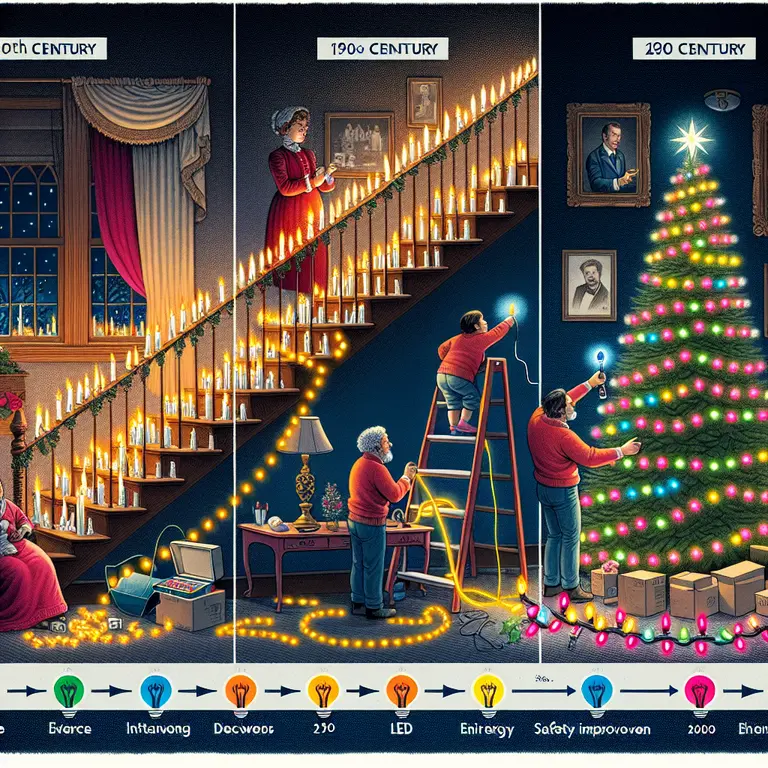
The tradition of illuminating Christmas trees began in the 17th-century Germany with real candles affixed to tree branches—a practice that unsurprisingly led to numerous devastating house fires. Insurance records from urban America in the 1880s document a 15% spike in residential fire claims during December, with Christmas Eve being particularly catastrophic. The New York City Fire Department responded to an average of 67 Christmas tree fires in the week surrounding Christmas in 1880 alone.
Thomas Edison’s assistant, Edward H. Johnson, created the first electric Christmas lights in 1882—just three years after Edison’s light bulb demonstration. Johnson hand-wired 80 small red, white, and blue electric light bulbs and wrapped them around a rotating Christmas tree in his Manhattan home. While celebrated in scientific circles, these lights remained prohibitively expensive for most households. The first strand of electric Christmas lights cost approximately \(300 in 1890 (about \)9,000 in today’s currency), requiring a dedicated generator and electrician to install them.
The transition from dangerous candles to electric lights was surprisingly slow. President Grover Cleveland commissioned the first electrically lit White House Christmas tree in 1895, which helped popularize the concept, but by 1900, fewer than 3% of American homes had electricity. Department stores were early adopters, recognizing the commercial potential of dazzling window displays. Macy’s famous holiday windows began featuring electric Christmas lights in 1897, drawing crowds so large that New York City police had to establish special pedestrian traffic patterns during the holiday season.
The democratization of Christmas lights was facilitated by an unexpected innovation: the rental model. The “Electric Christmas Tree Company” was formed in 1900 and offered to install and remove temporary Christmas light systems for wealthy homes in New York City. For (50 (about )1,500 today), customers could enjoy the spectacle without purchasing the equipment. By 1905, several urban areas had similar services, creating a seasonal gig economy for electricians.
The Curious Physics of Christmas Light Failure
The notorious tendency of Christmas light strands to fail when a single bulb burns out stems from an interesting electrical principle. Traditional incandescent Christmas lights operate in what engineers call a “series circuit,” where electricity must flow through each bulb to complete the circuit. When one filament breaks, the entire electrical pathway is interrupted.
This problem was partially addressed in 1927 by NOMA Electric Company with the invention of the “shunt” device—a lesser-known component within Christmas light bulbs. This tiny wire bypass activates when a filament burns out, allowing current to continue flowing through the rest of the strand. However, these shunts fail approximately 30% of the time, which explains why some strands still go entirely dark due to a single bulb failure.
Perhaps more surprising is the quantum physics at work in modern LED Christmas lights. These lights utilize semiconductor materials where electrons jump between energy states, releasing photons of specific wavelengths. The color of LED Christmas lights is determined by the precise energy gap in the semiconductor material—typically gallium compounds doped with particular elements. Red LEDs use aluminum gallium arsenide, while blue lights (the most recent innovation) require gallium nitride, which was only perfected in the 1990s by Japanese researcher Shuji Nakamura, who received the 2014 Nobel Prize in Physics for this breakthrough.
The physics of Christmas light failure extends beyond simple burnouts. Temperature fluctuations cause microscopic expansions and contractions in the metal components, gradually weakening connection points. This thermal cycling explains why lights often fail when first turned on after storage—the initial surge of current overwhelms connections weakened during the off-season. Engineers refer to this phenomenon as “thermal shock failure,” and it accounts for approximately 40% of all Christmas light malfunctions.
Another curious phenomenon is the “half-wave rectification” that occurs in partially failed LED strands. When specific components fail, the lights may still illuminate but at reduced brightness and with a barely perceptible flicker at 60Hz—half the standard alternating current frequency. This subliminal flicker can trigger headaches in sensitive individuals, a phenomenon documented in a 2018 study published in the Journal of Environmental Psychology.
The Hidden Environmental Footprint
The environmental impact of Christmas lights is surprisingly significant. According to NASA satellite imagery analysis, the increase in nighttime illumination during December increases the light output of some suburban areas by 30-50%. The U.S. Department of Energy estimates that holiday lighting consumes approximately 6.63 billion kilowatt-hours of electricity annually—equivalent to the total electricity consumption of El Salvador.
Less known is the specific environmental cost of manufacturing Christmas lights. A 2019 analysis of supply chains revealed that producing one strand of traditional incandescent Christmas lights generates approximately 2.3 kg of carbon dioxide and requires 3.9 gallons of water. LED lights have a lower manufacturing footprint but introduce concerns related to rare-earth element mining. The mining of neodymium, yttrium, and cerium for LED phosphors has created environmental hotspots, particularly in Baotou, Inner Mongolia, where rare earth processing has resulted in the formation of a 10-square-kilometer toxic lake.
The disposal of Christmas lights presents additional environmental challenges. The copper wire in Christmas light strands is valuable enough that specialized recycling operations have emerged. One facility in Jackson, Mississippi, processes over 20 million pounds of discarded Christmas lights annually, recovering approximately 4 million pounds of copper. However, the insulation materials, typically PVC with lead stabilizers in older lights, often end up in landfills where they can leach toxins.
Light pollution from Christmas displays has been shown to affect wildlife in documented ways. Migratory birds use celestial navigation cues that can be obscured by intense ground illumination. A 2020 study in the Journal of Experimental Biology found that artificial light from seasonal displays disrupts the hibernation patterns of particular bat species, causing them to wake prematurely and deplete their critical fat reserves.
Cultural Adaptation and Innovation
Christmas lights have evolved differently across cultures. In the Philippines, the tradition of paról (star-shaped Christmas lanterns) predates electric lighting but has incorporated modern technology. These lanterns, originally used candles, now feature complex programmable LED systems that synchronize across entire neighborhoods in competitions called “Ligligan Paról.”
In Iceland, the tradition deliberately minimizes the use of electric lighting. Their jólasveinar (Christmas lads) tradition involves thirteen days of celebration, where homes are primarily lit by candles, with electric lights used sparingly to honor the natural darkness of the Icelandic winter and preserve visibility of the Northern Lights. Some municipalities have enacted “aurora preservation ordinances” that restrict Christmas light usage during peak aurora viewing periods.
Perhaps the most unusual development is the recent emergence of “quantum dot” Christmas lights, first commercially available in 2022. These lights utilize colloidal semiconductor nanocrystals that produce extraordinarily pure colors with minimal energy input. A standard string consumes 80% less electricity than even LED predecessors while producing colors that more precisely match the wavelengths to which human cone cells are most responsive, creating a subjectively brighter experience despite lower energy usage.
The technological frontier now includes “smart” Christmas lighting systems that incorporate machine learning to optimize energy usage. These systems analyze historical weather patterns, home occupancy data, and even social media activity to predict optimal display times. Some advanced systems in development use electrochromic technology—the same used in “smart windows”—allowing lights to change color and intensity without requiring different LEDs, potentially reducing manufacturing resource requirements by up to 60%.
Conclusion: Illuminating More Than Trees
The evolution of Christmas lights reflects broader patterns of technological adoption, environmental awareness, and cultural adaptation. What began as a dangerous practice of attaching open flames to dried pine branches has transformed into a sophisticated intersection of electrical engineering, quantum physics, and cultural expression.
As we continue to innovate with more efficient, sustainable lighting technologies, the fundamental human desire to push back against winter’s darkness remains unchanged. Christmas lights represent one of humanity’s most widespread seasonal modifications to our environment—visible even from space—yet they are deeply connected to personal traditions and memories.
The physics, engineering, and environmental considerations behind these festive illuminations tell a story of human ingenuity and our complex relationship with technology. From dangerous candles to quantum dots, the humble Christmas light continues to evolve, illuminating not just our homes but our understanding of the physical world and our place within it.