
Exploring the Dark and Fascinating Origins of Krampusnacht
The forgotten pre-Christian Alpine traditions of Krampus, the demonic counterpart to St. Nicholas, whose violent punishments for misbehavior reveal darker historical aspects of Christmas celebrations.
 Watch on YouTube
 Watch on Rumble
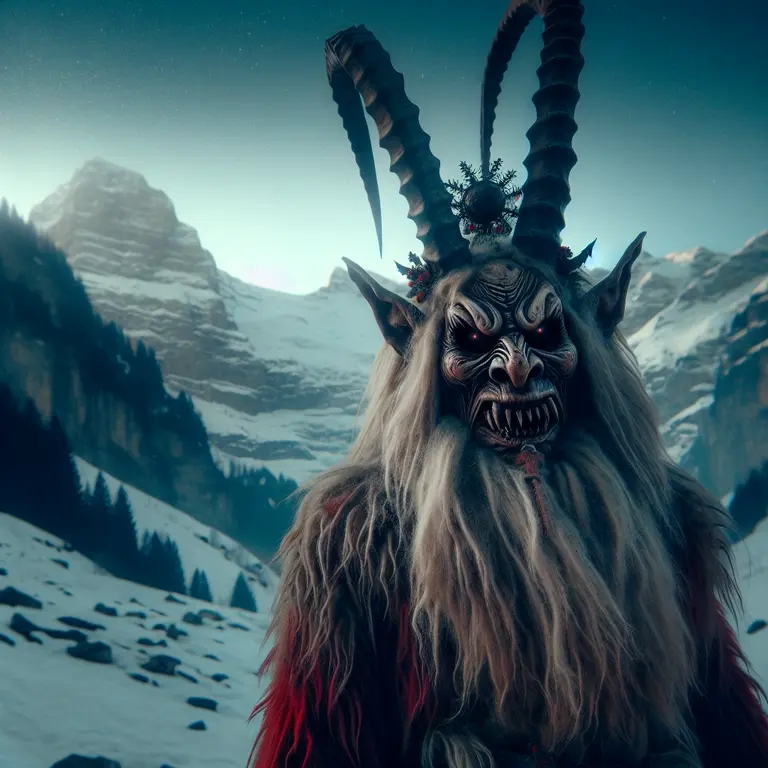
While modern Christmas celebrations often center on the jolly figure of Santa Claus bringing gifts to well-behaved children, a much darker tradition persists in Alpine European regions—the horned, demonic figure of Krampus, also known as St. Nicholas’s malevolent companion, represents one of the most fascinating and disturbing Christmas traditions that predates Christianity itself. This ancient figure reveals how winter solstice celebrations once balanced light with darkness, reward with punishment, and how pagan traditions were never entirely erased from European Christmas customs.
The Pre-Christian Origins of the Christmas Demon
Krampus’s origins trace back to pre-Christian Germanic paganism, specifically to the son of Hel, the Norse goddess of the underworld. Anthropologists have identified connections between Krampus and ancient winter solstice rituals where communities would dramatize the struggle between darkness and light during the year’s longest night. The figure’s name derives from the German word ‘krampen,’ meaning claw, and his appearance—with goat horns, a long pointed tongue, and chains—bears striking resemblance to chthonic underworld entities found in multiple pre-Christian European mythologies.
Particularly fascinating is how Krampus survived Christianization efforts. When missionaries spread throughout Alpine regions between the 8th and 11th centuries, rather than eliminating pagan winter rituals, they incorporated and adapted them. Krampus became paired with St. Nicholas, creating a good cop/bad cop dynamic that served the Church’s moral instruction purposes while allowing local populations to maintain cultural continuity with their ancestral practices.
The syncretic nature of Krampus reflects a broader pattern in European religious history. Archaeological evidence from Alpine burial sites dating back to the 7th century reveals the coexistence of Christian symbols alongside pagan amulets, indicating a gradual blending rather than an abrupt replacement of belief systems. The figure of Krampus embodies this cultural compromise, carrying forward ancient animistic traditions within a nominally Christian framework. Folk tales collected by 19th-century ethnographers reveal that in some isolated Alpine communities, Krampus was believed to be a nature spirit who punished those who overharvested from forests or hunted certain animals during their breeding seasons, suggesting ecological dimensions to his original purpose.
Krampusnacht: The Night of Terror Before St. Nicholas Day
December 5th marks Krampusnacht (Krampus Night), the evening before St. Nicholas Day in Austria, Bavaria, Hungary, Slovenia, and parts of Northern Italy. During this night, particularly in remote Alpine villages, young men don elaborately carved wooden masks, fur suits, and horns to become Krampus. What many don’t realize is that these costumes often cost between €1,000 €2,000 and are handcrafted using traditional techniques passed down through generations. Some masks date back over 100 years and are considered family heirlooms.
The Krampuslauf (Krampus Run) involves dozens of costumed Krampuses parading through towns, wielding bundles of birch branches called ‘ruten’ to swat onlookers. Historically, these processions served a social regulatory function. According to records from the 17th century, Krampus would target individuals who had violated community norms throughout the year, administering ritualized punishment that could be pretty severe. Court documents from 1601 in Salzburg describe a Krampus performer who beat a young woman so severely she later died from her injuries, highlighting the sometimes deadly serious nature of these traditions.
The creation of Krampus masks follows strict traditional protocols that vary by region. In the Gastein Valley of Austria, mask carvers traditionally begin their work on the night of the first full moon after Michaelmas (September 29th), using wood from trees struck by lightning—believed to contain extraordinary power to ward off evil. The carving process must be completed before the first snow falls, and throughout the creation period, carvers observe various taboos, including abstaining from alcohol and maintaining ritual silence while working. These practices, documented in the diaries of mask carvers from the 1800s, suggest that the creation of Krampus masks was itself a form of sacred craftsmanship.
Regional variations of Krampus celebrations reveal fascinating local adaptations. In the South Tyrolean village of Taufers, the “Tuifl” (dialect for “devil”) performs a ritualized dance with a young woman representing purity, enacting an ancient fertility narrative that predates Christian influence. Meanwhile, in parts of Slovenia, Krampus is accompanied by “Parkeljni,” more miniature demonic figures that represent specific vices, such as greed, sloth, and dishonesty, creating a more nuanced moral lesson than the simple good/evil dichotomy found elsewhere.
Krampus Under Political Suppression and Revival
What many Christmas enthusiasts may not realize is that Krampus traditions were actively suppressed during several periods of European history. The Catholic Church attempted to ban Krampus celebrations in the 12th century, viewing them as diabolical. More recently, during the 1930s, Austria’s Fascist government prohibited Krampus celebrations, seeing them as both pagan (and thus anti-Christian) and emblematic of Social Democratic values.
Particularly noteworthy is the documentation from the Dollinger Archives indicating that between 1934 and 1938, over 120 Krampus participants were arrested during Austria’s Austrofascist period. The government viewed the masked processions as potential covers for political dissent. Krampus costumes and masks were confiscated and burned, representing a significant loss of folk art.
The suppression of Krampus traditions extended beyond Austria. During the Third Reich, Nazi cultural authorities attempted to replace traditional Krampus figures with “Hans Trapp,” a less demonic but still frightening figure from Alsatian folklore who better aligned with their constructed Germanic mythology. This effort failed mainly in rural areas, where families continued to observe Krampusnacht in secret. Oral histories collected from elderly villagers in the Bad Goisern region reveal that some families would post lookouts during clandestine Krampus gatherings to avoid detection by authorities, demonstrating the deep value placed on these traditions.
After World War II, Krampus traditions experienced a gradual revival, though they remained primarily in rural areas. However, since the early 2000s, Krampus has undergone a remarkable international renaissance. The tradition has spread to urban centers across Europe and even to North America, where Krampus-themed Christmas events now take place in cities such as Los Angeles, Philadelphia, and Toronto.
This revival has not been without controversy. Anthropologists note that the modern Krampus has been somewhat sanitized and commercialized, losing some of the genuine terror and moral weight that traditional observances carried. Meanwhile, some conservative religious groups in Alpine regions have opposed the revival, arguing that it represents a neo-pagan intrusion into Christian holiday traditions—ironically echoing the same concerns voiced by medieval clergy nearly a millennium ago.
The Forgotten Punishments: Krampus’s Traditional Methods
While contemporary Krampus figures might playfully swat at parade-goers, historical accounts reveal far more disturbing disciplinary methods. According to 18th and 19th-century Alpine records, Krampus was said to deal with misbehaving children in truly nightmarish ways that go far beyond the modern narrative of merely giving coal to naughty children.
The most common punishment involved Krampus stuffing children into his sack or basket (called a ‘korb’) to carry them away. But where was he taking them? Various regional traditions suggested different fates: drowning children in mountain streams, eating them, or transporting them to the underworld. In parts of Bavaria, parents would tell children that Krampus would take them to his lair in the Black Forest, where they would be forced to work in the coal mines until the following Christmas.
Perhaps most disturbing was the ‘chain rattling’ tradition. Krampus performers would carry heavy chains, sometimes heated in fires before processions. These chains symbolized the binding of the Devil by the Christian church, but also served as a frightening warning to children. Historical accounts from the Bavarian State Library include letters from the 1850s describing children becoming physically ill with fear as Krampusnacht approached, and village doctors reporting cases of what we would now recognize as anxiety disorders associated explicitly with December’s arrival.
Ethnographic studies from the early 20th century document regional variations in Krampus’s punitive methods. In parts of the Eastern Alps, particularly around Lake Millstatt, Krampus was said to carry a large book listing children’s transgressions, with specific punishments tailored to each offense. Children who had stolen might have their hands symbolically burned with hot coal, while those who had lied might have their tongues “marked” with ash. These ritualized punishments served as physical manifestations of guilt and penance, concepts central to medieval Catholic practice but expressed through pre-Christian forms.
This darker side of Christmas traditions reveals how fear once played a central role in winter celebrations—a psychological aspect of seasonal festivities that has been sanitized mainly from contemporary Christmas observances.
The Modern Transformation and Cultural Significance
Today’s Krampus celebrations represent a fascinating case study in how ancient traditions adapt to contemporary sensibilities while retaining their essential character. Modern Krampuslaufs typically emphasize spectacle over genuine terror, with participants understanding the theatrical nature of the experience. Nevertheless, the enduring appeal of Krampus speaks to something primal in human psychology—the recognition that darkness and light, punishment and reward, fear and joy exist in necessary balance.
Cultural historians suggest that Krampus serves as a counterweight to the increasingly commercialized and sanitized nature of Christmas. In a holiday season dominated by forced cheer and consumption, Krampus represents an acknowledgment of winter’s historical harshness and the complex moral landscape of human existence. As climate-controlled environments and global supply chains have distanced many from the realities of winter that our ancestors faced, Krampus reminds us of a time when darkness was not merely metaphorical but a daily reality during the coldest months.
The revival of Krampus traditions also reflects broader cultural trends toward reclaiming regional identities in an increasingly homogenized global culture. For many in Alpine communities, Krampusnacht represents not just a quaint custom but an assertion of cultural distinctiveness and historical continuity. In this light, the horned devil of Christmas serves not just as a frightening counterpart to St. Nicholas but as a living link to ancestral wisdom about the necessity of balance, the inevitability of darkness, and the promise of returning light.