
Radiolarians: Nature’s Masterful Architects of the Sea
An exploration of radiolarians, microscopic marine organisms that create intricate glass-like skeletons and have influenced art, geology, and evolutionary understanding.
 Watch on YouTube
 Watch on Rumble
Nature’s Forgotten Glass Artists
In the vast depths of our oceans, invisible to the naked eye, exist some of nature’s most accomplished architects: radiolarians. These single-celled protozoans, belonging to the supergroup Rhizaria, have been crafting intricate mineral skeletons for over 550 million years. What makes radiolarians particularly fascinating is their ability to extract silica from seawater and fashion it into breathtakingly complex geometric structures that resemble delicate glass sculptures.
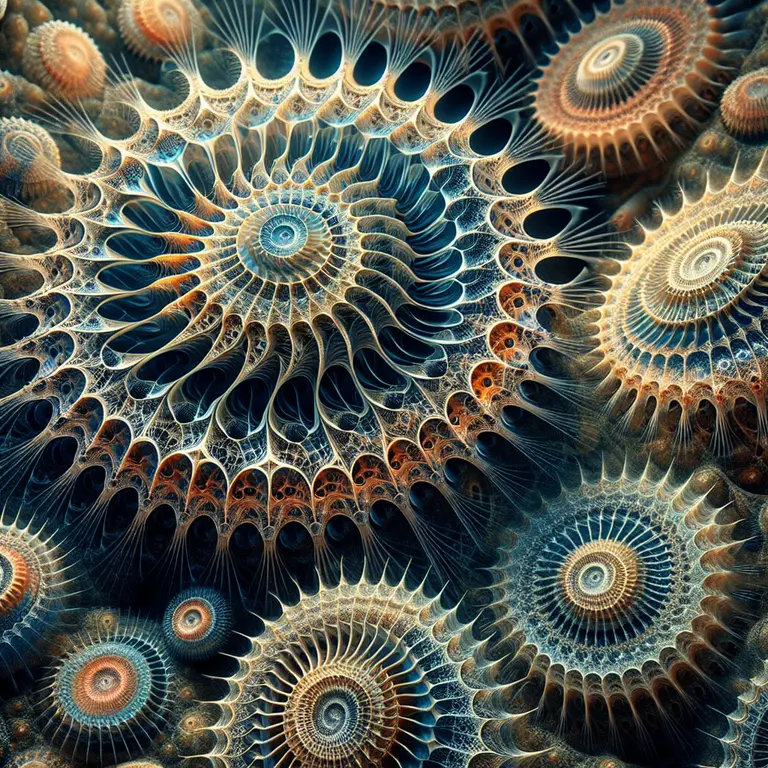
Each radiolarian species produces a uniquely patterned skeleton (called a test) with a symmetry and precision that seems impossible for a single-celled organism lacking a brain or nervous system. These microscopic marvels typically range from 0.1 to 0.2 millimeters, though some giant species can reach up to 2 millimeters. Their skeletons feature an astonishing array of spikes, lattices, spheres within spheres, and honeycomb patterns that follow mathematical principles, such as the Fibonacci sequence and fractal geometry.
The diversity of radiolarian forms is staggering, with taxonomists documenting over 10,000 species across three main classes: Polycystina (characterized by silica skeletons), Acantharia (with strontium sulfate skeletons), and Phaeodaria (comprising both silica and organic material). This remarkable diversity emerged through adaptive radiation, allowing radiolarians to colonize virtually every marine environment from tropical surface waters to the darkest trenches. Their evolutionary success stems partly from this architectural versatility—different skeletal structures provide specific advantages in various ocean depths and conditions, affecting buoyancy, protection from predators, and feeding efficiency.
Perhaps most remarkable is that radiolarians achieve their architectural feats without the benefit of multicellularity. Unlike the collaborative cell communities that build coral reefs or mollusk shells, each radiolarian operates as an independent entity, orchestrating complex biomineralization through molecular mechanisms that remain partially mysterious to science. This capacity for a single cell to execute such precise three-dimensional construction has led some biologists to reconsider the cognitive capabilities of organisms that are often considered “simple.”
Haeckel’s Obsession and Artistic Legacy
Perhaps no one was more captivated by radiolarians than German biologist Ernst Haeckel (1834-1919). After examining samples collected during the groundbreaking HMS Challenger expedition (1872-1876), Haeckel became obsessed with these microscopic creatures. He eventually described over 4,000 radiolarian species and created hundreds of meticulous illustrations, which were published in his work, “Art Forms in Nature” (1899-1904).
Haeckel’s radiolarian illustrations transcended scientific documentation to become influential in art and design. Their geometric patterns and organic symmetry directly inspired Art Nouveau architecture, particularly evident in René Binet’s entrance gate to the 1900 Paris World Fair. The radiolarian aesthetic continues to influence modern architects and designers, as seen in contemporary 3D-printed sculptures and parametric architecture. The Gherkin skyscraper in London, designed by Norman Foster, employs a diagrid structural system reminiscent of radiolarian frameworks—optimizing strength while minimizing material usage.
What’s often overlooked in discussions of Haeckel’s radiolarian work is how it fundamentally challenged Victorian-era perceptions about the division between art and science. At a time when industrial production was increasingly separating these domains, Haeckel’s illustrations suggested that nature itself was the ultimate artist, producing forms that human designers could only aspire to emulate. His work sparked philosophical debates about whether aesthetic beauty could arise spontaneously from natural processes or required conscious intention—questions that continue to resonate in contemporary discussions of evolutionary aesthetics and biomimicry.
Haeckel’s obsession with radiolarians extended beyond their forms to their philosophical implications. He viewed these organisms as evidence for his controversial monist philosophy, which rejected dualistic distinctions between mind and matter. For Haeckel, the ability of “primitive” single-celled organisms to create such mathematically sophisticated structures suggested that consciousness or purpose might exist on a continuum throughout all living matter—a perspective that anticipated aspects of both modern systems biology and certain strains of environmental philosophy.
The Geological Whispers of Radiolarians
When radiolarians die, their silica skeletons sink to the ocean floor, accumulating over millennia to form radiolarian ooze. In certain geological conditions, this ooze transforms into radiolarian chert—a complex, fine-grained sedimentary rock. These chert deposits have become crucial tools for geologists and paleontologists.
Radiolarian cherts serve as time capsules, revealing ancient oceanic conditions and helping scientists map prehistoric sea levels and climate patterns. The Franciscan Complex along California’s coast contains radiolarian chert layers dating back 200 million years, which helped confirm the theory of plate tectonics by demonstrating that these marine sediments had traveled thousands of kilometers from their Pacific origin before being uplifted onto the North American continent.
Perhaps most remarkably, radiolarian fossils from the Permian-Triassic boundary (approximately 252 million years ago) provide evidence of the most severe mass extinction in Earth’s history. Analysis of radiolarian assemblages reveals a dramatic 95% species reduction, coinciding with ocean acidification and anoxic conditions, offering sobering parallels to current climate change concerns.
The study of ancient radiolarians has yielded unexpected insights into Earth’s deep history. In the Barbados Ridge Complex of the Caribbean, radiolarian-rich sediments helped geologists reconstruct the tectonic collision between the Caribbean and Atlantic plates. Similarly, in Japan’s Inuyama area, alternating layers of radiolarian chert and shale revealed that Earth’s orbital cycles (Milankovitch cycles) affected oceanic productivity patterns as far back as the Jurassic period.
These microscopic fossils have proven particularly valuable for dating oceanic crust, which lacks the terrestrial fossils traditionally used in geological dating. When oceanographers discovered that magnetic reversals were recorded in seafloor basalt, it was radiolarian biostratigraphy that provided the chronological framework to interpret these patterns, ultimately confirming seafloor spreading and revolutionizing our understanding of plate tectonics.
Biological Innovations and Evolutionary Significance
Radiolarians represent an evolutionary marvel, having developed sophisticated cellular mechanisms that border on bioengineering. Their ability to manipulate silica at the nanoscale involves specialized vesicles and proteins that control silica deposition with nanometer precision—a process that materials scientists are still working to understand and replicate fully.
Their pseudopodia—thin, thread-like extensions of cytoplasm—serve multiple functions. These delicate structures can extend up to 500 times the cell’s body length, creating a sticky network for capturing prey ranging from bacteria to small crustaceans. This feeding strategy represents one of the earliest forms of active predation in unicellular organisms.
Perhaps most surprising is the relationship between radiolarians and photosynthetic algae. Many species harbor symbiotic algae within their bodies, providing them shelter in exchange for nutrients produced through photosynthesis. This ancient symbiotic relationship, established over 300 million years ago, represents one of the earliest examples of endosymbiosis—the same process believed to have led to the evolution of complex cells with mitochondria and chloroplasts.
Recent genomic studies have revealed that radiolarians possess unexpectedly complex gene regulatory networks controlling their development. The genes responsible for skeletal formation show remarkable similarities to those governing biomineralization in completely unrelated organisms, such as mollusks and vertebrates. This suggests either ancient evolutionary origins for these genetic toolkits or striking cases of convergent evolution, where similar solutions evolved independently to solve the challenge of building mineralized structures.
Radiolarians have also proven valuable in environmental monitoring. As climate change alters ocean chemistry, particularly through acidification, scientists are tracking shifts in radiolarian communities as bioindicators. Their silica skeletons become thinner and more fragile in more acidic conditions, providing a visible record of oceanic changes. This sensitivity makes them canaries in the coal mine for broader marine ecosystem health, offering early warnings about environmental shifts before they affect larger, more complex organisms.
Conclusion: Microscopic Marvels with Macroscopic Impact
Radiolarians embody a profound paradox: despite their microscopic size and cellular simplicity, they have shaped our planet’s geology, influenced artistic movements, advanced scientific understanding, and created architectural solutions that human engineers still strive to emulate. Their elegant skeletons remind us that complexity and beauty can emerge from seemingly simple origins, challenging our assumptions about the relationship between biological complexity and sophisticated design.
As we face unprecedented environmental challenges, these ancient organisms offer both warnings and inspiration. Their fossil record demonstrates the devastating consequences of rapid oceanic changes, while their biological innovations suggest potential pathways for sustainable materials design and adaptive strategies. Perhaps most importantly, radiolarians remind us that the most profound insights often come from examining what is easily overlooked—the seemingly insignificant creatures that have quietly shaped our world for half a billion years.
In the silent depths where they float, radiolarians continue their ancient craft of transforming dissolved minerals into living architecture, their glass palaces preserving the mathematical harmony that has sustained them through five mass extinctions. They stand as testament to nature’s enduring creativity and the extraordinary complexity hidden within apparent simplicity.