
Medieval Manuscripts: Unveiling Microbial Histories
How microscopic biological communities within ancient manuscripts reveal environmental history and preservation challenges
 Watch on YouTube
 Watch on Rumble
When conservators at the Biblioteca Medicea Laurenziana in Florence examined a 13th-century illuminated psalter under high-powered microscopes, they weren’t merely looking for pigment degradation or parchment damage. They were hunting for DNA—not of the monks who created the manuscript, but of the invisible ecosystem that has inhabited the pages for centuries.
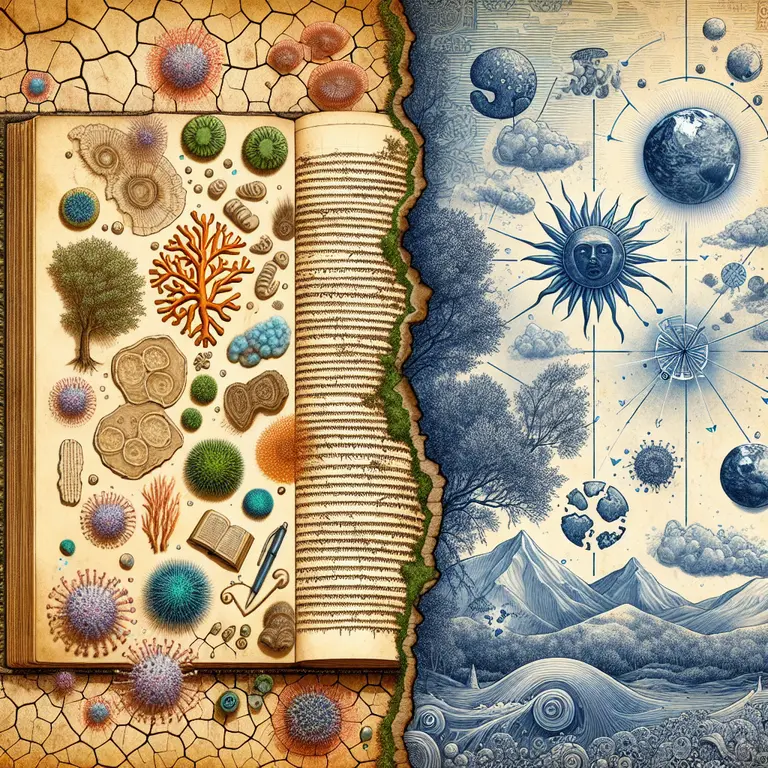
This emerging field, sometimes referred to as “biocodicology,” occupies a fascinating intersection of medieval studies, microbiology, and conservation science. Recent research has revealed that medieval manuscripts host complex microbiomes that tell stories as rich as the texts themselves. These biological signatures provide unprecedented insights into the past, revealing information about creation methods, usage patterns, storage conditions, and even the historical environments in which these treasured artifacts were used. As analytical techniques become more sophisticated, researchers continue to uncover new layers of information hidden within the microscopic communities that have inhabited these ancient pages for centuries.
Living Libraries: The Manuscript Microbiome
Each medieval manuscript contains a unique biological signature. DNA sequencing of microbes extracted from parchment pages has revealed communities of bacteria, fungi, and even insect fragments that vary according to the manuscript’s history, geography, and usage patterns.
Dr. Sarah Ahmed, a bioarchaeologist at the University of York, explains: “We’ve found that manuscripts stored in Mediterranean monasteries often contain distinct halophilic bacteria that differ from those in Northern European collections. These microorganisms act as biological geotags, revealing where a manuscript spent significant portions of its existence.”
Perhaps most surprising is that many of these microbes aren’t modern contaminants but original inhabitants dating back to the manuscript’s creation. The processing of animal skins into parchment, involving lime baths, stretching, and scraping, created unique ecological niches that selected for specific microbial communities.
The parchment-making process itself introduced particular microorganisms. Animal skins were soaked in lime solutions, dehaired, stretched on frames, and scraped with curved blades called lunellaria. Each step influenced the resulting microbial community. Highly alkaline lime treatments are selected for alkaliphilic bacteria that can withstand these harsh conditions. Regional differences in water sources, animal husbandry practices, and workshop environments further contributed to the formation of these distinctive microbiomes.
Research from the University of Copenhagen has identified specific bacterial signatures associated with different parchment-making traditions. Manuscripts produced in Benedictine scriptoria exhibit a higher prevalence of Actinobacteria, whereas those from Dominican workshops display a greater abundance of Proteobacteria. These differences reflect variations in raw materials, processing techniques, and workshop environments that persisted across centuries.
Anthropodermic Indicators
One particularly valuable discovery involves what researchers call “anthropodermic indicators”—microbes that are explicitly associated with human handling. By analyzing the concentration and distribution of human-associated Propionibacterium and Staphylococcus species, researchers can identify which pages of a manuscript were most frequently read.
“In devotional texts, we often find higher concentrations of human-associated bacteria on pages containing popular prayers or passages,” notes Dr. Timothy Stinson of North Carolina State University. “This gives us unprecedented insight into which texts medieval readers found most meaningful, creating a biological heat map of historical reading patterns.”
The implications extend beyond identifying popular passages. In communal manuscripts used by monastic communities, researchers can distinguish between books mainly used by individuals and those read collectively. Manuscripts with evenly distributed human-associated microbes typically served liturgical functions in group settings. At the same time, those with concentrated microbial “hot spots” likely belonged to individual scholars or were consulted for reference rather than continuous reading.
A 2019 study of the Bodleian Library’s MS. Bodley 264, a lavishly illustrated romance manuscript, revealed higher concentrations of skin-associated bacteria on pages featuring battle scenes and illustrations compared to text-only pages. This suggests medieval readers lingered over images, perhaps sharing these visual elements with others—a biological confirmation of art historical theories about manuscript usage.
Purple Patches: The Mystery of Parchment Foxing
For centuries, conservators have battled the purple-spotted discoloration known as “foxing” that appears on many medieval manuscripts. Traditional explanations attributed this to the corrosion of iron gall ink or environmental factors. However, metagenomic analysis has revealed that many of these purple spots are actually caused by specialized archaea that metabolize the collagen in parchment.
The most common culprit, a previously unidentified species tentatively named Halobacterium manuscriptum, appears to have evolved specifically to thrive in the high-salt, low-moisture environment of parchment pages. This discovery has led to new preservation approaches that target the biological rather than chemical aspects of manuscript degradation.
The relationship between these archaea and parchment is remarkably specialized. H. manuscriptum produces distinctive carotenoid pigments as protection against oxidative stress—pigments that create the characteristic purple discoloration. More intriguingly, the organism has adapted to metabolize specific peptide sequences in degraded collagen, suggesting a long evolutionary relationship with animal skin-based writing materials.
Some conservation scientists now theorize that specific parchment-making techniques inadvertently selected for these microbial communities. Alum treatments, commonly used to prepare parchment in traditional Southern European cultures, create environments particularly hospitable to halophilic archaea. This may explain why manuscripts from Italian and Spanish scriptoria show a higher incidence of purple foxing compared to their northern European counterparts.
Cross-Contamination and Historical Epidemiology
Perhaps the most unexpected application of manuscript microbiome research comes from the field of historical epidemiology. Medieval manuscripts sometimes preserve traces of pathogens that circulated during their creation and use.
In a groundbreaking study published in Microbiome, researchers identified DNA fragments of Yersinia pestis—the bacterium responsible for the Black Death—on the pages of a 14th-century French breviary. The manuscript had been used by Dominican friars who ministered to plague victims, inadvertently transferring bacterial material to the pages.
“These manuscripts functioned as passive samplers of their environment,” explains Dr. Gabriela Soto of the Max Planck Institute for the Science of Human History. “They’re like time capsules that preserved not just cultural knowledge but biological information about historical disease landscapes.”
This discovery has opened new avenues for understanding medieval disease ecology. A collaborative project between the Biblioteca Apostolica Vaticana and the Ancient Biomolecules Centre at Oxford University has begun systematically screening manuscripts from known plague periods for pathogen DNA. Their preliminary findings suggest that manuscripts may preserve evidence of multiple disease outbreaks, including smallpox, tuberculosis, and leprosy.
The microbial signatures also provide insight into medical practices. A 15th-century medical compendium from Montpellier contains traces of medicinal herbs and minerals consistent with treatments described in the text—evidence that the manuscript was used in an active medical practice rather than serving merely as a reference text.
Conservation Implications: Treating Living Artifacts
This biological understanding has revolutionized the conservation of manuscripts. Traditional approaches using fungicides and bactericides are being reconsidered, as some microbial communities may actually protect manuscripts from more destructive organisms through a process known as competitive exclusion.
Conservators now face philosophical questions about which biological communities should be preserved as part of a manuscript’s historical integrity. Is a 15th-century fungal community as worthy of preservation as the illuminations it lives alongside?
“We’re moving toward an ecological model of conservation,” says Elena Gonzalez, head conservator at the British Library’s manuscript division. “Rather than trying to eliminate all biological activity, we’re learning to manage manuscript ecosystems in ways that maintain equilibrium without accelerating degradation.”
This ecological approach has led to the development of innovative preservation strategies. Some institutions now monitor microbial communities in their collections, establishing baseline measurements of “healthy” manuscript microbiomes. When interventions become necessary, they target specific harmful organisms while preserving beneficial or neutral microbial communities. Environmental controls focus on maintaining conditions that favor stable microbial communities, rather than attempting to achieve sterile conditions.
The Vatican Library has pioneered a “probiotic” approach to manuscript conservation, deliberately introducing benign microorganisms that compete with damaging ones. Early results suggest this method may offer sustainable protection without the drawbacks of chemical treatments.
Future Directions: Parchment as Environmental Archive
As analytical techniques become more sensitive, researchers anticipate extracting even more environmental data from manuscript microbiomes. Pollen grains trapped in binding adhesives might reveal seasonal information about manuscript production. Trace DNA from insects could indicate historical pest pressures in different storage environments.
Some researchers have even proposed using the biological information in manuscripts to reconstruct historical climate data, as specific microbial communities respond predictably to temperature and humidity fluctuations.
An auspicious direction involves correlating manuscript microbiomes with historical climate records. A team at ETH Zurich has identified specific microbial markers in manuscript collections that correspond to known climate events, such as the Little Ice Age (c. 1300-1850). These biological indicators could help refine our understanding of historical climate patterns, particularly for regions lacking detailed written climate records.
These living libraries—texts within texts, written in the language of DNA—remind us that medieval manuscripts are not just cultural artifacts but complex biological systems that continue to evolve centuries after their creation. In their microscopic inhabitants, we find new ways to read between the lines of history, uncovering stories that have remained hidden for centuries until modern science developed the tools to detect them.